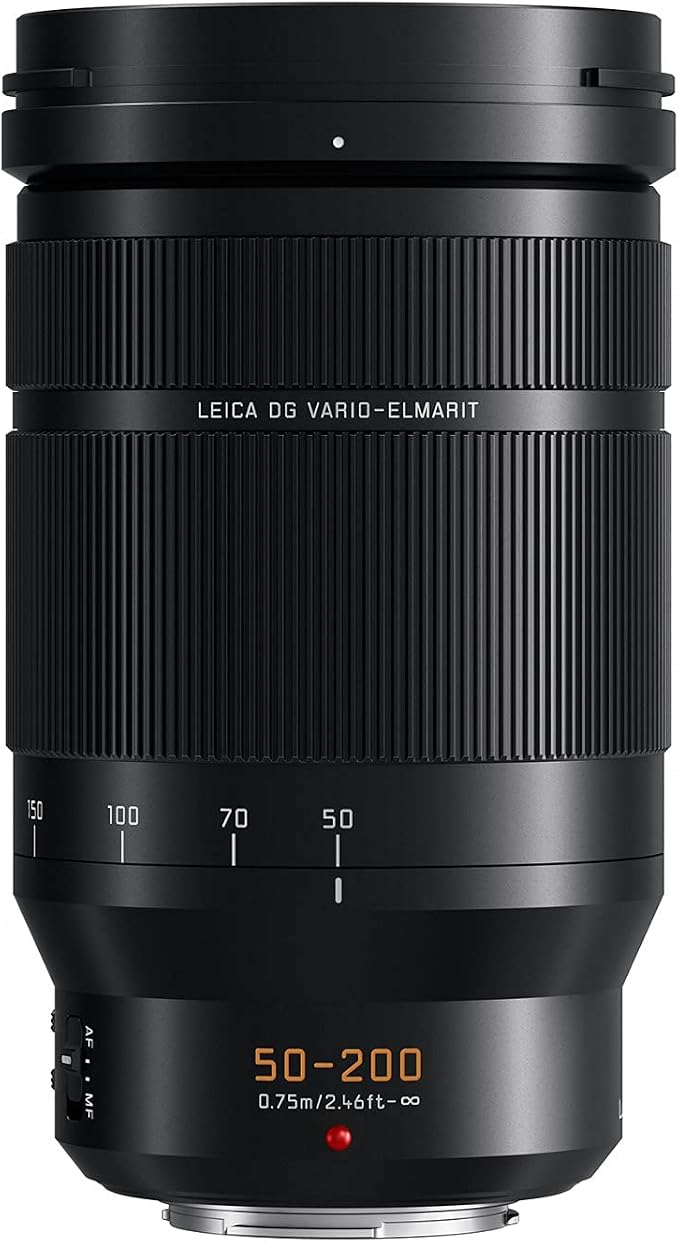
A flexible optic ideal for wildlife, outdoor, and nature photography, the Leica DG Vario-Elmarit 50-200mm f/2.8-4 ASPH. Lens from Panasonic is a 100-400mm equivalent zoom designed in collaboration with Leica for Micro Four Thirds cameras. The long reach is complemented by a bright f/2.8-4 maximum aperture range, which benefits working in low-light conditions and also affords control over depth of field for isolating subjects.
A flexible optic ideal for wildlife, outdoor, and nature photography, the Leica DG Vario-Elmarit 50-200mm f/2.8-4 ASPH. Lens from Panasonic is a 100-400mm equivalent zoom designed in collaboration with Leica for Micro Four Thirds cameras. The long reach is complemented by a bright f/2.8-4 maximum aperture range, which benefits working in low-light conditions and also affords control over depth of field for isolating subjects.
in 36 offers
last seen 2 Oct 2026
The lowest price we last saw for Panasonic Leica DG Vario-Elmarit 50-200mm f/2.8-4 ASPH Power O.I.S Lens was $1,402.15 at eBay.com.au, compared across 23 retailers (last seen 2 Oct 2026). Prices may have changed since.
The all-time low we recorded was $1,276.57 on 22 May 2024.
Prices last updated 2 Oct 2026.
Panasonic Leica DG Vario-Elmarit 50-200mm f/2.8-4 ASPH Power O.I.S Lens
A flexible optic ideal for wildlife, outdoor, and nature photography, the Leica DG Vario-Elmarit 50-200mm f/2.8-4 ASPH. Lens from Panasonic is a 100-400mm equivalent zoom designed in collaboration with Leica for Micro Four Thirds cameras. The long reach is complemented by a bright f/2.8-4 maximum aperture range, which benefits working in low-light conditions and also affords control over depth of field for isolating subjects.
A flexible optic ideal for wildlife, outdoor, and nature photography, the Leica DG Vario-Elmarit 50-200mm f/2.8-4 ASPH. Lens from Panasonic is a 100-400mm equivalent zoom designed in collaboration with Leica for Micro Four Thirds cameras. The long reach is complemented by a bright f/2.8-4 maximum aperture range, which benefits working in low-light conditions and also affords control over depth of field for isolating subjects.
Last updated at 02/10/2026 03:07:08
Panasonic LUMIX Professional 50-200mm Camera Lens, G Leica DG Vario-ELMARIT, F2.8-4.0 ASPH, Dual I.S. 2.0 with Power O.I.S, Mirrorless Micro Four
Free delivery
Affiliate Disclosure: We may receive a small commission for purchases made through this link at no extra cost to you. This helps support our site. Thank you!
Panasonic Leica Dg Vario-elmarit 50-200mm F2.8-4.0 Asph. Power O.i.s.
Delivery $52.04
Affiliate Disclosure: We may receive a small commission for purchases made through this link at no extra cost to you. This helps support our site. Thank you!
Used Panasonic Leica DG Elmarit 50-200mm f/2.8-4.0 ASPH - Excellent
Delivery $43.37
Panasonic Leica DG Vario-Elmarit 50-200mm f/2.8-4 ASPH. POWER O.I.S. L
Delivery $26.90
Panasonic 50-200mm f2.8-4 Leica DG Vario-Elmarit ASPH. Power O.I.S (H-ES50200)
Delivery $59
Panasonic Leica DG Vario-Elmarit 50-200mm f/2.8-4 ASPH. POWER O.I.S. Lens
Free delivery between 9–16 Oct
Panasonic Leica DG Vario-Elmarit 50-200mm f/2.8-4 ASPH. POWER O.I.S. Lens by Onestop Digital
Free delivery between 10–15 Oct
Panasonic Leica DG Elmarit 50-200mm f2.8-4 ASPH OIS Lens - Brand New
Free delivery between 8–14 Oct
Panasonic 50-200mm f/2.8-4 Lumix (Leica) DG Vario-Elmarit ASPH Power OIS Lens
Delivery $9.90
Panasonic Leica DG 50-200mm f2.8-4 Lens (H-ES50200GC)
Free delivery
originally posted on adorama.com
As the owner of an Olympus 7-14mm f/2.8 lens it was tough deciding whether or not I should add the Panasonic 8-18mm f/2.0-4.0 lens to my camera bag. In my opinion, the Olympus 7-14mm is to M43 cameras what the Nikon 14-24mm f/2.8 is to full frame cameras (set the bar for quality). The image quality I get from both those lenses is exceptional and they are a pleasure to use! I have no issues with the Olympus 7-14mm image or build quality, but I wanted an alternative for other reasons.I usually bring an ultra-wide angle zoom with me while traveling so weight and size are important. Sometimes carry on weight and size restrictions are so tight on small aircraft that they become critical factors. The Panasonic 8-18mm lens weights about 8 oz. less and is more compact ... MoreAs the owner of an Olympus 7-14mm f/2.8 lens it was tough deciding whether or not I should add the Panasonic 8-18mm f/2.0-4.0 lens to my camera bag. In my opinion, the Olympus 7-14mm is to M43 cameras what the Nikon 14-24mm f/2.8 is to full frame cameras (set the bar for quality). The image quality I get from both those lenses is exceptional and they are a pleasure to use! I have no issues with the Olympus 7-14mm image or build quality, but I wanted an alternative for other reasons.I usually bring an ultra-wide angle zoom with me while traveling so weight and size are important. Sometimes carry on weight and size restrictions are so tight on small aircraft that they become critical factors. The Panasonic 8-18mm lens weights about 8 oz. less and is more compact than the Olympus lens. It also accepts 67mm screw on filters, rather than requiring a more complex filter setup. There have been times when I didn't want to take the Olympus 7-14mm out because of high winds and blowing dust because it doesn't accept screw on filters. Being able to screw on a protection filter can be important.I shot the Panasonic 8-18mm side-by-side with my Olympus 7-14mm for comparison. Both lenses performed well, but I preferred the images from the Olympus lens in the range of 7-10mm. The Olympus images had marginally better resolution and I could pull more detail out of dark areas (may be contrast related). When I zoomed the lenses further out the images seemed comparable. I shot these images using 1/3 stop increments from f/2.8 through f/7.1. When my camera bag is weight constrained, I intend to use CP/ND filters, or I am seriously concerned about lens protection I will be using the Panasonic 8-18mm lens. Otherwise I will continue to use the Olympus 7-14mm.Yes the 1mm difference is focal length is noticeable, but it will not determine whether or not I carry one lens of the other. I like the fact that the Panasonic has a 36mm effective focal length on the long end. It allows me to cover a larger range of preferred focal lengths without switching back to a standard/travel zoom or prime lens (same effective focal length range as the Nikon 16-36mm I had). I prefer zoom lenses with a constant wide aperture setting across all focal lengths like the Olympus zoom, but I don't expect to be constrained by the Panasonic variable aperture limits. I shoot stills not video, so this is not really a factor.The build and image quality of Panasonic DG series lenses is consistently excellent, and the 8-18mm lens is no exception (I have 3 other Leica DG type lenses). If I could only choose one between the Olympus and Panasonic ultra-wide zoom lenses I would select the Panasonic because: it is lighter and more compact, it accepts screw on filters, the image and build quality are comparable to Olympus, and it costs a little less. I need more experience with the 8-18mm to know if it is going to become my new go-to lens for all M43 ultra-wide angle zoom applications.
originally posted on bhphotovideo.com
Beautifully made, beautifully executed. It produces excellent results. It's a shame to have a variable aperture, but I understand it as a reasonable compromise between size and quality. It is a really useful focal range.If this were full frame, the price and size would be at least two times what we see here.It's expensive but it's really worth it.
originally posted on bhphotovideo.com
I purchased this lens to supplement the 12-60mm lens I got as part of my Panasonic G9 kit. I really like the mid-range lens in the PL Elmarit trio, but quickly realized it didn’t have the reach I wanted. There are plenty of lens choices out there, and telephoto zooms are no exception. I chose this lens specifically because of its range and build quality. Make no mistake, this is very high-quality glass, and it has a price tag to match. The old adage “you get what you pay for” is true in spades here.The weight of the lens is immediately noticeable. It is twice as heavy as the other two in the trio. On my G9 it feels decently balanced and would probably feel even more so if I had the additional battery grip. I would have liked to see a tripod foot on the lens to ... MoreI purchased this lens to supplement the 12-60mm lens I got as part of my Panasonic G9 kit. I really like the mid-range lens in the PL Elmarit trio, but quickly realized it didn’t have the reach I wanted. There are plenty of lens choices out there, and telephoto zooms are no exception. I chose this lens specifically because of its range and build quality. Make no mistake, this is very high-quality glass, and it has a price tag to match. The old adage “you get what you pay for” is true in spades here.The weight of the lens is immediately noticeable. It is twice as heavy as the other two in the trio. On my G9 it feels decently balanced and would probably feel even more so if I had the additional battery grip. I would have liked to see a tripod foot on the lens to help support the weight; however, I trust the camera mount to properly support it.Another nice feature of the lens is its compatibility with Panasonic’s teleconverters. Strangely, this isn’t advertised anywhere. Even Panasonic’s own materials don’t provide this information. I’m not sure why, as the teleconverters in conjunction with this lens provide an extremely versatile kit. Put the 2x converter behind the lens and you’ve now got the equivalent focal range of the Panasonic-Leica 100-400mm, albeit at a cost of 2 stops of light – the maximum aperture range goes from f/2.8-4 to f/5.6-8. This is just a bit slower than the 100-400, which offers a maximum aperture range from f/4-6.3.As with the other two lenses in the trio, the maximum aperture of f/2.8 is only available at the smallest focal length. In the case of this lens, that means 50mm. As soon as you move that ring, the maximum aperture starts to close down. For example, it moves to f/2.9 at 53mm and f/3 at 56mm. If we go by the focal lengths marked on the lens, you’ll see that at 50mm it’s f/2.8, at 70mm it’s f/3.3, at 100mm it’s f/3.6, at 150mm it’s f/3.9 and at 200mm it’s f/4. It actually gets to f/4 at 179mm and that remains the maximum aperture from there.This lens defines the Micro Four Thirds system vision. If you compare it to a full frame lens like the Sony FE 100-400mm f/4.5-5.6 GM OSS, it is smaller, lighter and cheaper for the same equivalent focal length range. Yes, the Sony lens is a touch faster – f/4.5 vs f/5.6 equivalent. However, that Sony lens weighs over twice as much and costs about $1000 more.This isn’t a cheap lens by any stretch of the imagination. It is, however, an extremely good one.
| Maximum Aperture | f/2.8 to 4 |
| Minimum Aperture | f/22 |
| Lens Mount | Micro Four Thirds |
| Lens Format Coverage | Micro Four Thirds |
| Angle of View | 24° to 6.2° |

Panasonic LUMIX Professional 50-200mm Camera Lens, G Leica DG Vario-ELMARIT, F2.8-4.0 ASPH, Dual I.S. 2.0 with Power O.I.S, Mirrorless Micro Four
Free delivery
Affiliate Disclosure: We may receive a small commission for purchases made through this link at no extra cost to you. This helps support our site. Thank you!
Panasonic Leica Dg Vario-elmarit 50-200mm F2.8-4.0 Asph. Power O.i.s.
Delivery $52.04
Affiliate Disclosure: We may receive a small commission for purchases made through this link at no extra cost to you. This helps support our site. Thank you!
Used Panasonic Leica DG Elmarit 50-200mm f/2.8-4.0 ASPH - Excellent
Delivery $43.37
Panasonic Leica DG Vario-Elmarit 50-200mm f/2.8-4 ASPH. POWER O.I.S. L
Delivery $26.90
Panasonic 50-200mm f2.8-4 Leica DG Vario-Elmarit ASPH. Power O.I.S (H-ES50200)
Delivery $59
As the owner of an Olympus 7-14mm f/2.8 lens it was tough deciding whether or not I should add the Panasonic 8-18mm f/2.0-4.0 lens to my camera bag. In my opinion, the Olympus 7-14mm is to M43 cameras what the Nikon 14-24mm f/2.8 is to full frame cameras (set the bar for quality). The image quality I get from both those lenses is exceptional and they are a pleasure to use! I have no issues with the Olympus 7-14mm image or build quality, but I wanted an alternative for other reasons.I usually bring an ultra-wide angle zoom with me while traveling so weight and size are important. Sometimes carry on weight and size restrictions are so tight on small aircraft that they become critical factors. The Panasonic 8-18mm lens weights about 8 oz. less and is more compact ... MoreAs the owner of an Olympus 7-14mm f/2.8 lens it was tough deciding whether or not I should add the Panasonic 8-18mm f/2.0-4.0 lens to my camera bag. In my opinion, the Olympus 7-14mm is to M43 cameras what the Nikon 14-24mm f/2.8 is to full frame cameras (set the bar for quality). The image quality I get from both those lenses is exceptional and they are a pleasure to use! I have no issues with the Olympus 7-14mm image or build quality, but I wanted an alternative for other reasons.I usually bring an ultra-wide angle zoom with me while traveling so weight and size are important. Sometimes carry on weight and size restrictions are so tight on small aircraft that they become critical factors. The Panasonic 8-18mm lens weights about 8 oz. less and is more compact than the Olympus lens. It also accepts 67mm screw on filters, rather than requiring a more complex filter setup. There have been times when I didn't want to take the Olympus 7-14mm out because of high winds and blowing dust because it doesn't accept screw on filters. Being able to screw on a protection filter can be important.I shot the Panasonic 8-18mm side-by-side with my Olympus 7-14mm for comparison. Both lenses performed well, but I preferred the images from the Olympus lens in the range of 7-10mm. The Olympus images had marginally better resolution and I could pull more detail out of dark areas (may be contrast related). When I zoomed the lenses further out the images seemed comparable. I shot these images using 1/3 stop increments from f/2.8 through f/7.1. When my camera bag is weight constrained, I intend to use CP/ND filters, or I am seriously concerned about lens protection I will be using the Panasonic 8-18mm lens. Otherwise I will continue to use the Olympus 7-14mm.Yes the 1mm difference is focal length is noticeable, but it will not determine whether or not I carry one lens of the other. I like the fact that the Panasonic has a 36mm effective focal length on the long end. It allows me to cover a larger range of preferred focal lengths without switching back to a standard/travel zoom or prime lens (same effective focal length range as the Nikon 16-36mm I had). I prefer zoom lenses with a constant wide aperture setting across all focal lengths like the Olympus zoom, but I don't expect to be constrained by the Panasonic variable aperture limits. I shoot stills not video, so this is not really a factor.The build and image quality of Panasonic DG series lenses is consistently excellent, and the 8-18mm lens is no exception (I have 3 other Leica DG type lenses). If I could only choose one between the Olympus and Panasonic ultra-wide zoom lenses I would select the Panasonic because: it is lighter and more compact, it accepts screw on filters, the image and build quality are comparable to Olympus, and it costs a little less. I need more experience with the 8-18mm to know if it is going to become my new go-to lens for all M43 ultra-wide angle zoom applications.
Beautifully made, beautifully executed. It produces excellent results. It's a shame to have a variable aperture, but I understand it as a reasonable compromise between size and quality. It is a really useful focal range.If this were full frame, the price and size would be at least two times what we see here.It's expensive but it's really worth it.
I purchased this lens to supplement the 12-60mm lens I got as part of my Panasonic G9 kit. I really like the mid-range lens in the PL Elmarit trio, but quickly realized it didn’t have the reach I wanted. There are plenty of lens choices out there, and telephoto zooms are no exception. I chose this lens specifically because of its range and build quality. Make no mistake, this is very high-quality glass, and it has a price tag to match. The old adage “you get what you pay for” is true in spades here.The weight of the lens is immediately noticeable. It is twice as heavy as the other two in the trio. On my G9 it feels decently balanced and would probably feel even more so if I had the additional battery grip. I would have liked to see a tripod foot on the lens to ... MoreI purchased this lens to supplement the 12-60mm lens I got as part of my Panasonic G9 kit. I really like the mid-range lens in the PL Elmarit trio, but quickly realized it didn’t have the reach I wanted. There are plenty of lens choices out there, and telephoto zooms are no exception. I chose this lens specifically because of its range and build quality. Make no mistake, this is very high-quality glass, and it has a price tag to match. The old adage “you get what you pay for” is true in spades here.The weight of the lens is immediately noticeable. It is twice as heavy as the other two in the trio. On my G9 it feels decently balanced and would probably feel even more so if I had the additional battery grip. I would have liked to see a tripod foot on the lens to help support the weight; however, I trust the camera mount to properly support it.Another nice feature of the lens is its compatibility with Panasonic’s teleconverters. Strangely, this isn’t advertised anywhere. Even Panasonic’s own materials don’t provide this information. I’m not sure why, as the teleconverters in conjunction with this lens provide an extremely versatile kit. Put the 2x converter behind the lens and you’ve now got the equivalent focal range of the Panasonic-Leica 100-400mm, albeit at a cost of 2 stops of light – the maximum aperture range goes from f/2.8-4 to f/5.6-8. This is just a bit slower than the 100-400, which offers a maximum aperture range from f/4-6.3.As with the other two lenses in the trio, the maximum aperture of f/2.8 is only available at the smallest focal length. In the case of this lens, that means 50mm. As soon as you move that ring, the maximum aperture starts to close down. For example, it moves to f/2.9 at 53mm and f/3 at 56mm. If we go by the focal lengths marked on the lens, you’ll see that at 50mm it’s f/2.8, at 70mm it’s f/3.3, at 100mm it’s f/3.6, at 150mm it’s f/3.9 and at 200mm it’s f/4. It actually gets to f/4 at 179mm and that remains the maximum aperture from there.This lens defines the Micro Four Thirds system vision. If you compare it to a full frame lens like the Sony FE 100-400mm f/4.5-5.6 GM OSS, it is smaller, lighter and cheaper for the same equivalent focal length range. Yes, the Sony lens is a touch faster – f/4.5 vs f/5.6 equivalent. However, that Sony lens weighs over twice as much and costs about $1000 more.This isn’t a cheap lens by any stretch of the imagination. It is, however, an extremely good one.
I am coming from a DSLR background where any zoom is big and constant f/2.8 zooms are quite heavy. This is a relief.As I zoom in to longer focal length, my initial shots were blurry. I needed to get used to it and learn to keep the hands more steady, or use a support to lean on. Once I got it, the shots are very crisp and pleasing.Using it in daylight is no problem. When the light goes down, I can only use it at f/2.8 on the wide end.Get a faster prime of your most used focal length, or a flash, if you use it a lot in low light, zoomed in.
Prior to buying the 8-18, I'd just bought the Nocticron, which is an amazing lens allowing me to "see" stars & clusters on f1.2 - 1.3" exposures not visible with the naked eye with IS binoculars. That got me interested in night landscape photography, one of the main reasons I bought this lens. There are a few notable issues on the 8-18. #1 the front glass element retracts into the lens as you zoom inwards. The tube it rides in is then fully open to the atmosphere, which would allow dust/moisture to enter. I always buy a quality UV coated filter for my lens purchases, but this could be an issue without a filter. The B+W coated 67mm from B&H is ideal for this lens w/ no vignette. #2 unlike my Nocticron, the stars don't focus to a "point" (or round cluster of pixels) - ... MorePrior to buying the 8-18, I'd just bought the Nocticron, which is an amazing lens allowing me to "see" stars & clusters on f1.2 - 1.3" exposures not visible with the naked eye with IS binoculars. That got me interested in night landscape photography, one of the main reasons I bought this lens. There are a few notable issues on the 8-18. #1 the front glass element retracts into the lens as you zoom inwards. The tube it rides in is then fully open to the atmosphere, which would allow dust/moisture to enter. I always buy a quality UV coated filter for my lens purchases, but this could be an issue without a filter. The B+W coated 67mm from B&H is ideal for this lens w/ no vignette. #2 unlike my Nocticron, the stars don't focus to a "point" (or round cluster of pixels) - more like a C shaped point, suggestive of small amounts of astigmatism & distortion #3 it's only f2.8 right at 8.0mm -- as soon as you touch the zoom ring, it begins counting up 2.9, 3.0 -- up to 4.0 when you hit 18mm. I'd hoped this would be a good wide angle compliment to my pana 12-35 f2.8, but it's significantly slower by the time it hits 12mm than my constant aperture lens. So, beyond 12mm, I'd want to switch to my 12-35, reducing the usefulness of this to 8-11mm. Since it was best parked on 8.0 mm, I'm returning it and buying the Laowa 7.5mm f2.0 prime instead. The depth of field on these wide angle lenses is so great that manual focusing is easy, especially with the GH5 focus tools. If I later feel the need for a wide zoom, I'd likely sell my 12-35, and buy either the newly announced Pana 10mm-? constant aperture f 1.7 zoom OR get the sigma 18-35 + focal reducer / speed booster adapter. The Panasonic depth from defocus feature with their native lenses is great at longer focal lengths, but with a wide angle, the degradation of focus speed likely wouldn't be noticed.The major niche for this lens would be for real estate agents as the rectilinear design makes nice straight lines while photographing while inside a bathroom. That use also wouldn't likely see the astigmatism or distortion.
This lens is what I would expect from anything bearing the Leica name. It's fast, focusing is consistent, and it delivers sharp images.The feel is solid, with excellent haptics for the controls. It's not light, especially after a kit lens, but the weight is comfortable for anything but extended handheld use.Other reviews have commented that the color palette skews very slightly red: I cannot confirm that yet but first impressions are that is correct. This is easy to offset (or exaggerate, depending on your style) in-camera with color profiles.My one peeve is that the aperture narrows so quickly: by 20mm or so 4.0 is as wide as you can get. Bokeh from this lens is next to impossible. It's leaps and bounds above the kit lenses, though, and the OIS goes a long ... MoreThis lens is what I would expect from anything bearing the Leica name. It's fast, focusing is consistent, and it delivers sharp images.The feel is solid, with excellent haptics for the controls. It's not light, especially after a kit lens, but the weight is comfortable for anything but extended handheld use.Other reviews have commented that the color palette skews very slightly red: I cannot confirm that yet but first impressions are that is correct. This is easy to offset (or exaggerate, depending on your style) in-camera with color profiles.My one peeve is that the aperture narrows so quickly: by 20mm or so 4.0 is as wide as you can get. Bokeh from this lens is next to impossible. It's leaps and bounds above the kit lenses, though, and the OIS goes a long way toward offsetting the aperture shortcoming.I would recommend this for any MFT shooter.
This is an early impression, which may change with more use.This is an amazing lens. Build quality is impressive. Images are clear and sharp. Shooting slightly below max aperture produces some very, VERY good results.I agree with other reviewers that the aperture closes down very quickly as the focal length extends, but I won't call it a 12mm f/2.8 with a 14/60 f/4 attached. There's enough headroom here for f/3.5 to carry on almost to 25mm. But it's still a short run, and anyone using it should be ready for f/4 almost across the range.It is heavier, and bulkier, than other MFT lenses with portions of its range. The kit 14-42 is barely half its size and substantially lighter. But that extra heft brings so much that it's hard to say the mass makes enough ... MoreThis is an early impression, which may change with more use.This is an amazing lens. Build quality is impressive. Images are clear and sharp. Shooting slightly below max aperture produces some very, VERY good results.I agree with other reviewers that the aperture closes down very quickly as the focal length extends, but I won't call it a 12mm f/2.8 with a 14/60 f/4 attached. There's enough headroom here for f/3.5 to carry on almost to 25mm. But it's still a short run, and anyone using it should be ready for f/4 almost across the range.It is heavier, and bulkier, than other MFT lenses with portions of its range. The kit 14-42 is barely half its size and substantially lighter. But that extra heft brings so much that it's hard to say the mass makes enough difference.This is fast becoming my first-choice lens for most outdoor and portrait work.
I have found this lens to be OK for video with my prior main complaint being the very nonlinear focusing on the ring. The latest firmware update for the Panasonic BGH1 seems to have fixed this, as it can linearly focus now, no speed sensitivity associated with focus speed. I wish manufacturers would just look at legacy lenses, say the Zeiss lenses from 1920 on and even the Olympus lenses from 1980 onwards. The depth of field, focus, and even zoom could use a lot of human interface design from studying these old school lenses. I wish this had an aperture ring, but it generally is good for video, not suffering a lot from focus breathing or other issues. Depth of field is nice and controllable and not out of hand. The zoom is a little nonlinear with respect to ... MoreI have found this lens to be OK for video with my prior main complaint being the very nonlinear focusing on the ring. The latest firmware update for the Panasonic BGH1 seems to have fixed this, as it can linearly focus now, no speed sensitivity associated with focus speed. I wish manufacturers would just look at legacy lenses, say the Zeiss lenses from 1920 on and even the Olympus lenses from 1980 onwards. The depth of field, focus, and even zoom could use a lot of human interface design from studying these old school lenses. I wish this had an aperture ring, but it generally is good for video, not suffering a lot from focus breathing or other issues. Depth of field is nice and controllable and not out of hand. The zoom is a little nonlinear with respect to aperture, but it is what it is, an adaptable, high-quality lens and arguably very good lens for the money.
Love the range and the optical quality of it. It was a toss-up between this and the Olympus 40-150 f2.8.Olympus is a bit (only a bit) superior...but is heavier and bulkier, so this one won since I will use it so much more for its portability.I shoot mostly video, and manually focusing was a pain...until June 8 when Panasonic released firmware v1.1 for this on certain Panasonic bodies.Wow! Linear focusing is amazing and make this lens so incredibly useful. It takes me back to my ENG camera days when pulling focus was a joy.Love how Panasonic made a great lens even greater!
I look at this as a functional counterpart to the classic Canon 24-105, which as a documentary filmmaker offers substantial range and practicality for most shooting situations. I've been using this on my GH5 with excellent results, for both video and still photography. The fly-by-wire focus is a bit annoying for manual focusing when shooting video (I don't find it to be an issue at all for stills), but I use autofocus often enough to where I don't find it a huge detriment to my work. The lens is well built and feels solid in the hand and on camera, and I basically haven't taken it off my camera since I got it. For those who need the utmost sharpness when shooting at longer focal lengths, they should know that this lens does soften a bit when fully extended, so you ... MoreI look at this as a functional counterpart to the classic Canon 24-105, which as a documentary filmmaker offers substantial range and practicality for most shooting situations. I've been using this on my GH5 with excellent results, for both video and still photography. The fly-by-wire focus is a bit annoying for manual focusing when shooting video (I don't find it to be an issue at all for stills), but I use autofocus often enough to where I don't find it a huge detriment to my work. The lens is well built and feels solid in the hand and on camera, and I basically haven't taken it off my camera since I got it. For those who need the utmost sharpness when shooting at longer focal lengths, they should know that this lens does soften a bit when fully extended, so you should be mindful to shoot a bit more closed down if possible in those situations. It should also be noted that because the aperture almost instantly begins to close down if extending beyond 12mm, I generally consider this to be an f/4.0 glass. If you plan to shoot more regularly in lower light situations, the Panasonic 12-35 f/2.8 may be a better choice. Overall, I'm very happy with this lens, and use it frequently.
| Maximum Aperture | f/2.8 to 4 |
| Minimum Aperture | f/22 |
| Lens Mount | Micro Four Thirds |
| Lens Format Coverage | Micro Four Thirds |
| Angle of View | 24° to 6.2° |


