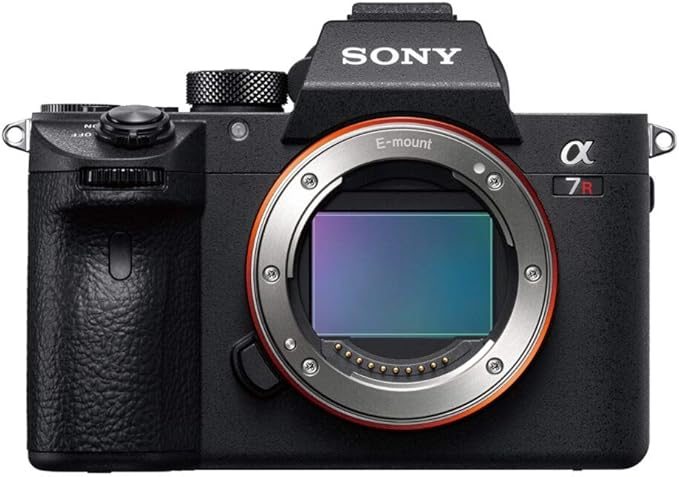
Sony A7R III Digital Camera Body
High-Performance Camera The Sony Alpha a7R III Mirrorless Digital Camera is an incredibly versatile, high-performance camera. It features a 42.2MP full-frame sensor, 10fps burst shooting, and a sophisticated AF system, making it an ideal choice for a range of photographers. Not only is it renowned for its resolution, but also for its multimedia versatility. The camera features improved dynamic range, incredible high ISO performance, and significantly improved real-world AF performance as well as enhanced 5-axis in-body image stabilisation over its predecessor. The A7R Mark III A offers incredibly well-rounded features, with great image quality, fast burst shooting speeds, dual SD memory card slots and high quality 4K video in a reasonably compact package. Besides, the seemingly limitless customization options allow the user to act quickly whether capturing fast action scenes or expansive landscapes. Sony A7R IIIA employs an improved rear LCD panel, up to 2.36 million dots compared to the 1.44 million dots in the original A7R III model. Also, the USB port has been updated to USB 3.2 to match Sony A7S III. The Sony A7R Mark III A is perfect for hybrid stills and video shooters, photographers looking for a versatile tool for a broad range of subjects in a compact camera body.
High-Performance Camera The Sony Alpha a7R III Mirrorless Digital Camera is an incredibly versatile, high-performance camera. It features a 42.2MP full-frame sensor, 10fps burst shooting, and a sophisticated AF system, making it an ideal choice for a range of photographers. Not only is it renowned for its resolution, but also for its multimedia versatility. The camera features improved dynamic range, incredible high ISO performance, and significantly improved real-world AF performance as well as enhanced 5-axis in-body image stabilisation over its predecessor. The A7R Mark III A offers incredibly well-rounded features, with great image quality, fast burst shooting speeds, dual SD memory card slots and high quality 4K video in a reasonably compact package. Besides, the seemingly limitless customization options allow the user to act quickly whether capturing fast action scenes or expansive landscapes. Sony A7R IIIA employs an improved rear LCD panel, up to 2.36 million dots compared to the 1.44 million dots in the original A7R III model. Also, the USB port has been updated to USB 3.2 to match Sony A7S III. The Sony A7R Mark III A is perfect for hybrid stills and video shooters, photographers looking for a versatile tool for a broad range of subjects in a compact camera body.
High-Performance Camera The Sony Alpha a7R III Mirrorless Digital Camera is an incredibly versatile, high-performance camera. It features a 42.2MP full-frame sensor, 10fps burst shooting, and a sophisticated AF system, making it an ideal choice for a range of photographers. Not only is it renowned for its resolution, but also for its multimedia versatility. The camera features improved dynamic range, incredible high ISO performance, and significantly improved real-world AF performance as well as enhanced 5-axis in-body image stabilisation over its predecessor. The A7R Mark III A offers incredibly well-rounded features, with great image quality, fast burst shooting speeds, dual SD memory card slots and high quality 4K video in a reasonably compact package. Besides, the seemingly limitless customization options allow the user to act quickly whether capturing fast action scenes or expansive landscapes. Sony A7R IIIA employs an improved rear LCD panel, up to 2.36 million dots compared to the 1.44 million dots in the original A7R III model. Also, the USB port has been updated to USB 3.2 to match Sony A7S III. The Sony A7R Mark III A is perfect for hybrid stills and video shooters, photographers looking for a versatile tool for a broad range of subjects in a compact camera body.
High-Performance Camera The Sony Alpha a7R III Mirrorless Digital Camera is an incredibly versatile, high-performance camera. It features a 42.2MP full-frame sensor, 10fps burst shooting, and a sophisticated AF system, making it an ideal choice for a range of photographers. Not only is it renowned for its resolution, but also for its multimedia versatility. The camera features improved dynamic range, incredible high ISO performance, and significantly improved real-world AF performance as well as enhanced 5-axis in-body image stabilisation over its predecessor. The A7R Mark III A offers incredibly well-rounded features, with great image quality, fast burst shooting speeds, dual SD memory card slots and high quality 4K video in a reasonably compact package. Besides, the seemingly limitless customization options allow the user to act quickly whether capturing fast action scenes or expansive landscapes. Sony A7R IIIA employs an improved rear LCD panel, up to 2.36 million dots compared to the 1.44 million dots in the original A7R III model. Also, the USB port has been updated to USB 3.2 to match Sony A7S III. The Sony A7R Mark III A is perfect for hybrid stills and video shooters, photographers looking for a versatile tool for a broad range of subjects in a compact camera body.
in 6 offers
The lowest price for Sony A7R III Digital Camera Body right now is $1,809.39 at eBay.com.au, compared across 2 retailers.
The all-time low was $1,340.33 on 3 Aug 2026 — today's price is 35% above the lowest ever. It has been notably cheaper before — worth setting a price alert.
Prices last updated 16 Oct 2026.
Last updated at 16/10/2026 22:26:35
[top Mint] Sony A7r Iii Ilce-7rm3a Mirrorless Camera Body (shutter
Free delivery
Affiliate Disclosure: We may receive a small commission for purchases made through this link at no extra cost to you. This helps support our site. Thank you!
Sony ILCE-7RM3A α7RIII Full Size Mirrorless SLR Camera Body No Lens Black
Delivery between 21–25 Oct $41
originally posted on bhphotovideo.com
This camera has it all - while not being the best at any one thing. It isn't the highest resolution (See Fuji medium frame 100Mpx for the same price), it isn't the fastest shutter (see just about any other modern non-Sony mirrorless), it isn't the best low light (see Sony's high sensitivity series), it doesn't have the fastest auto-tracking (see most Stacked cameras, such as Sony A9 or A1, Canon R3, Nikon Z9), it doesn't have the most loved user interface (some people prefer Nikon button layout or canon screen - I haven't played with their systems so I can't personally compare).Yet, I can't think of a feature I want that it's missing. Insanely high resolution (allows gorgeous crops), insanely vibrant dynamic range (lightroom recovers eye dropped results from the ... MoreThis camera has it all - while not being the best at any one thing. It isn't the highest resolution (See Fuji medium frame 100Mpx for the same price), it isn't the fastest shutter (see just about any other modern non-Sony mirrorless), it isn't the best low light (see Sony's high sensitivity series), it doesn't have the fastest auto-tracking (see most Stacked cameras, such as Sony A9 or A1, Canon R3, Nikon Z9), it doesn't have the most loved user interface (some people prefer Nikon button layout or canon screen - I haven't played with their systems so I can't personally compare).Yet, I can't think of a feature I want that it's missing. Insanely high resolution (allows gorgeous crops), insanely vibrant dynamic range (lightroom recovers eye dropped results from the shadows or highlights), it's lack of super-high ISO can be compensated by AI software (such as from topaz - I have ZERO complaints from my 4,000 iso images in mostly night-lit rooms).It feels perfect in my hand (though when sporting the Sony 70-200GMii for a 1.5 hour video shoot, my arms were pushing the limits of image-stabilization). The menus felt intuitive (to me - not having a pre-conceived preferred menu layout from other vendors). The C1, C2, etc custom buttons are nicely placed to help mental spatial memory. I do kind of wish it had a knob-button on the top-left, but LOVE that I have 4 tactile knobs on the right side so I never need to move my eye from the eye-piece.I haven't even kicked in the 9Mpix viewfinder - the resolution (reduced by default) is already just gorgeous. (in theory you have better battery life with the lower res/lower frame-rate).The auto-bracketing seems to work well (I use either photoshop or helios) for normal lenses ; For macro lenses I had to resort to a more manual setting. I have not yet tried pixel-shift; but as I understand it; you need a VERY stable shooting environment - and you'd have to use the Sony software (which I'm not overly excited about).The flash system seems to work decently (I'm still trying to get high-speed flash sync ; but this is probably user error; I haven't yet read the instructions). The combination of high-res, side-flash, mounted-macro-rail,cell-phone-trigger is producing gorgeous micro-photography for me.There has been a working exif-hack to get the .ARW files to work in lightroom. I successfully got one image to work in this fashion - but I think lightroom and capture-one now officially support AR7V anyway (so, glad I didn't waste too much time on it). Prior to this, I used a combination of the MASSIVE jpeg files or using the Sony-software to export-as-TIFF; both worked as one would expect (within their respective limits). My prior experience with the AR7iii in lightroom with ARW files suggests this should be equally amazing.The AI tracking is very good. My cats are both curious and yet unwilling to pose for more than 3 seconds; yet I already have a thousand shots (many of which are pretty good).. The (cat) subject is always selected, no matter what direction they face; and I can flip detection between person (e.g. my children) or animal and it always correctly boxes the subject-type. I haven't yet tried insects or birds. The eye focusing, in general, has trouble in darker lights (which is consistent with online reviews). But the hybrid manual focus (DMF) easily compensates for this.The battery life is ok - but by the end of a shooting session I'm down to 5%. Since I rarely use the back-screen (mostly using the eye piece), I might do well to disable it; so as to gain some extra time. Similarly, I played with, but don't use the touch-screen.. Using the thumb, wheel and zoom-in/zoom-out while looking through eye-piece is far more rewarding than pinch-zoom on the lower-contrast/lower-brightness backlit display.The external USB-C transfer speed is decent - not great.. I'm only getting 40MB/sec off a 300MB/s UHS-II v90 onboard card. If i simultaneously copy from both cards (over the USB) it divides the bandwidth between them. Still, I find that more convenient than pulling the SD cards and plugging in a portable SD-reader (100GB transfers fast enough for a bathroom break). I did decide to wait on purchasing compact-flash express Type-A cards.. VERY sad that Sony refuses to catch up with 3 year old cameras and offer Type-B. Twice the size, 3x the bandwidth and half the price as the Type-A. Still, I have yet to max out my SD card bandwidth - My son likes to hold the shutter button down, and we've yet to get a buffer-full notice. (we store RAW on SD1 and JPEG on SD2). In theory the highest resolution video might max out the SD card - so this is still to be seen (I've only used 4k 24fps video to date).I haven't tested the rolling shutter effect - but I expect it will be annoying with fast moving targets - as seen on youtube reviews.With inflation hitting, and even used equipment going up in price, this could be seen as a good long term investment. I would have loved to wait for a Sony A1 mark ii, (or really, any high res stacked sensor) but I bet it'll be twice this camera's price at launch. My only hope is that Sony is willing to update the AI models over time (as AI-weight-files are pure software; should have no limitations on the existing hardware of this device).
originally posted on bhphotovideo.com
I have also own an A7Riv, and have owned the A7Riii, a7iv, a7iii and also the a6500 + 3 Nex-7 bodies and an RX10iv. The a7Rv is superior to all these.The 61mp sensor suits my needs better than those of lesser resolution, allowing deeper cropping instead of toting burdensome super telephotos, and improves resolution when cropping macro images.Contrary to what had been conventional wisdom, the fine pixel pitch of the 61mp sensor does not interfere with low light, high ISO, astro landscapes. Noise is finer grain and easier to filter in post, with retention of greater detail. Thus my previous modus operandi of using a lower resolution a7iii or a7iv for night landscapes was not advantageous.The pivoting screen for tilted use in portrait orientation enables better ... MoreI have also own an A7Riv, and have owned the A7Riii, a7iv, a7iii and also the a6500 + 3 Nex-7 bodies and an RX10iv. The a7Rv is superior to all these.The 61mp sensor suits my needs better than those of lesser resolution, allowing deeper cropping instead of toting burdensome super telephotos, and improves resolution when cropping macro images.Contrary to what had been conventional wisdom, the fine pixel pitch of the 61mp sensor does not interfere with low light, high ISO, astro landscapes. Noise is finer grain and easier to filter in post, with retention of greater detail. Thus my previous modus operandi of using a lower resolution a7iii or a7iv for night landscapes was not advantageous.The pivoting screen for tilted use in portrait orientation enables better composition and easier use when on a low tripod or close to the ground.Ability to close the shutter with power-off protects the sensor from airborne dust when changing lenses outdoors. Sensor cleaning is needed less often, same as with the a7iv, which I enjoyed for this feature.While my a7Riv could only track humans in AF-C, now the the camera can also track furry animals, birds, insects. (I don't care about trains planes and cars so I inactivated these selections). I have this feature programmed to the red top button when in photo mode.Ability to program the right top wheel to ISO puts ISO where it belongs, and the wheel locks with a button, preventing accidental ISO shifts.The processor is much faster than that in the a7Riv. All operations occur faster. The camera is again ready to shoot sooner after buffering and writing to the card. Fewer shots are missed. The camera is more pleasant to operate.The new menu takes learning. I learned it on an a7iv. It's a beast with 900 nodes! But it is very capable. Now I can program a custom button to AF-C tracking. Thus I have two back buttons set for focus, one for single focus (usually center focus), and one for AF-C tracking.Those who shoot video will love the ability to program all the custom buttons separately for photo and for video, and flip between these with one lever under the mode dial.I do notice the 75 g increased weight. This is a small penalty.The higher resolution EVF is a further improvement on the excellent focus mag and peaking of all recent Sony cameras.Thus the a7Rv is more capable and nicer to operate than the already excellent a7Riv, but is just a little heavier out in the field.
originally posted on sony.co.uk
The A7R IV A was fundamentally incompatible with the FE 200-600 G lens. Producing soft, coarse grain images, that one could not crop. Even after major de-noising.The A7RV produces far sharper, cleaner images with the FE 200-600 G provided the lens has had the November 2022 Firmware update.The AI based AF system has improved tracking a moving subject eg Birds in flight, and the keeper rate is higher.The A7R V Focus Bracketing function is disappointing. The lack of being able to set a far focus point, is a major flaw when one has a subject that requires a focus stack to give an in focus subject, but still requires a de-focused background. For example in a macro scene where the background needs to be blurred. Sony need to improve this function, so one is not ... MoreThe A7R IV A was fundamentally incompatible with the FE 200-600 G lens. Producing soft, coarse grain images, that one could not crop. Even after major de-noising.The A7RV produces far sharper, cleaner images with the FE 200-600 G provided the lens has had the November 2022 Firmware update.The AI based AF system has improved tracking a moving subject eg Birds in flight, and the keeper rate is higher.The A7R V Focus Bracketing function is disappointing. The lack of being able to set a far focus point, is a major flaw when one has a subject that requires a focus stack to give an in focus subject, but still requires a de-focused background. For example in a macro scene where the background needs to be blurred. Sony need to improve this function, so one is not guessing how many images, at what spacing are needed to produce the correct stack of images for blending. I would suggest they look at the in camera Focus Bracketing offered by Fuji in most models and particularly that of the Phaseone XF, that demonstrates the standard to aspire to.Additionally it is a disappointment that the focus bracketing function does not work with Sony A mount lens with LA-EA5 converter. So no opportunity to use the classic Minolta 200 mm macro for focus bracketing with an A7R V.I would welcome Firmware updates that improved the Focus Bracketing function in these two areas. A Sony FE 200 mm GM Macro would also be welcome, as would a FE 100-400 GM II with an internal focus and a zoom, like the FE 200-600 G, making the 100-400 a far better wildlife lens.
| General | |
| Product Type | Digital camera - 4K - mirrorless system |
| Lens Included | Body only |
| Enclosure Colour | Black |
| Sensor Resolution | 42.4 Megapixel |
[top Mint] Sony A7r Iii Ilce-7rm3a Mirrorless Camera Body (shutter
Free delivery
Affiliate Disclosure: We may receive a small commission for purchases made through this link at no extra cost to you. This helps support our site. Thank you!
Sony ILCE-7RM3A α7RIII Full Size Mirrorless SLR Camera Body No Lens Black
Delivery between 21–25 Oct $41
This camera has it all - while not being the best at any one thing. It isn't the highest resolution (See Fuji medium frame 100Mpx for the same price), it isn't the fastest shutter (see just about any other modern non-Sony mirrorless), it isn't the best low light (see Sony's high sensitivity series), it doesn't have the fastest auto-tracking (see most Stacked cameras, such as Sony A9 or A1, Canon R3, Nikon Z9), it doesn't have the most loved user interface (some people prefer Nikon button layout or canon screen - I haven't played with their systems so I can't personally compare).Yet, I can't think of a feature I want that it's missing. Insanely high resolution (allows gorgeous crops), insanely vibrant dynamic range (lightroom recovers eye dropped results from the ... MoreThis camera has it all - while not being the best at any one thing. It isn't the highest resolution (See Fuji medium frame 100Mpx for the same price), it isn't the fastest shutter (see just about any other modern non-Sony mirrorless), it isn't the best low light (see Sony's high sensitivity series), it doesn't have the fastest auto-tracking (see most Stacked cameras, such as Sony A9 or A1, Canon R3, Nikon Z9), it doesn't have the most loved user interface (some people prefer Nikon button layout or canon screen - I haven't played with their systems so I can't personally compare).Yet, I can't think of a feature I want that it's missing. Insanely high resolution (allows gorgeous crops), insanely vibrant dynamic range (lightroom recovers eye dropped results from the shadows or highlights), it's lack of super-high ISO can be compensated by AI software (such as from topaz - I have ZERO complaints from my 4,000 iso images in mostly night-lit rooms).It feels perfect in my hand (though when sporting the Sony 70-200GMii for a 1.5 hour video shoot, my arms were pushing the limits of image-stabilization). The menus felt intuitive (to me - not having a pre-conceived preferred menu layout from other vendors). The C1, C2, etc custom buttons are nicely placed to help mental spatial memory. I do kind of wish it had a knob-button on the top-left, but LOVE that I have 4 tactile knobs on the right side so I never need to move my eye from the eye-piece.I haven't even kicked in the 9Mpix viewfinder - the resolution (reduced by default) is already just gorgeous. (in theory you have better battery life with the lower res/lower frame-rate).The auto-bracketing seems to work well (I use either photoshop or helios) for normal lenses ; For macro lenses I had to resort to a more manual setting. I have not yet tried pixel-shift; but as I understand it; you need a VERY stable shooting environment - and you'd have to use the Sony software (which I'm not overly excited about).The flash system seems to work decently (I'm still trying to get high-speed flash sync ; but this is probably user error; I haven't yet read the instructions). The combination of high-res, side-flash, mounted-macro-rail,cell-phone-trigger is producing gorgeous micro-photography for me.There has been a working exif-hack to get the .ARW files to work in lightroom. I successfully got one image to work in this fashion - but I think lightroom and capture-one now officially support AR7V anyway (so, glad I didn't waste too much time on it). Prior to this, I used a combination of the MASSIVE jpeg files or using the Sony-software to export-as-TIFF; both worked as one would expect (within their respective limits). My prior experience with the AR7iii in lightroom with ARW files suggests this should be equally amazing.The AI tracking is very good. My cats are both curious and yet unwilling to pose for more than 3 seconds; yet I already have a thousand shots (many of which are pretty good).. The (cat) subject is always selected, no matter what direction they face; and I can flip detection between person (e.g. my children) or animal and it always correctly boxes the subject-type. I haven't yet tried insects or birds. The eye focusing, in general, has trouble in darker lights (which is consistent with online reviews). But the hybrid manual focus (DMF) easily compensates for this.The battery life is ok - but by the end of a shooting session I'm down to 5%. Since I rarely use the back-screen (mostly using the eye piece), I might do well to disable it; so as to gain some extra time. Similarly, I played with, but don't use the touch-screen.. Using the thumb, wheel and zoom-in/zoom-out while looking through eye-piece is far more rewarding than pinch-zoom on the lower-contrast/lower-brightness backlit display.The external USB-C transfer speed is decent - not great.. I'm only getting 40MB/sec off a 300MB/s UHS-II v90 onboard card. If i simultaneously copy from both cards (over the USB) it divides the bandwidth between them. Still, I find that more convenient than pulling the SD cards and plugging in a portable SD-reader (100GB transfers fast enough for a bathroom break). I did decide to wait on purchasing compact-flash express Type-A cards.. VERY sad that Sony refuses to catch up with 3 year old cameras and offer Type-B. Twice the size, 3x the bandwidth and half the price as the Type-A. Still, I have yet to max out my SD card bandwidth - My son likes to hold the shutter button down, and we've yet to get a buffer-full notice. (we store RAW on SD1 and JPEG on SD2). In theory the highest resolution video might max out the SD card - so this is still to be seen (I've only used 4k 24fps video to date).I haven't tested the rolling shutter effect - but I expect it will be annoying with fast moving targets - as seen on youtube reviews.With inflation hitting, and even used equipment going up in price, this could be seen as a good long term investment. I would have loved to wait for a Sony A1 mark ii, (or really, any high res stacked sensor) but I bet it'll be twice this camera's price at launch. My only hope is that Sony is willing to update the AI models over time (as AI-weight-files are pure software; should have no limitations on the existing hardware of this device).
I have also own an A7Riv, and have owned the A7Riii, a7iv, a7iii and also the a6500 + 3 Nex-7 bodies and an RX10iv. The a7Rv is superior to all these.The 61mp sensor suits my needs better than those of lesser resolution, allowing deeper cropping instead of toting burdensome super telephotos, and improves resolution when cropping macro images.Contrary to what had been conventional wisdom, the fine pixel pitch of the 61mp sensor does not interfere with low light, high ISO, astro landscapes. Noise is finer grain and easier to filter in post, with retention of greater detail. Thus my previous modus operandi of using a lower resolution a7iii or a7iv for night landscapes was not advantageous.The pivoting screen for tilted use in portrait orientation enables better ... MoreI have also own an A7Riv, and have owned the A7Riii, a7iv, a7iii and also the a6500 + 3 Nex-7 bodies and an RX10iv. The a7Rv is superior to all these.The 61mp sensor suits my needs better than those of lesser resolution, allowing deeper cropping instead of toting burdensome super telephotos, and improves resolution when cropping macro images.Contrary to what had been conventional wisdom, the fine pixel pitch of the 61mp sensor does not interfere with low light, high ISO, astro landscapes. Noise is finer grain and easier to filter in post, with retention of greater detail. Thus my previous modus operandi of using a lower resolution a7iii or a7iv for night landscapes was not advantageous.The pivoting screen for tilted use in portrait orientation enables better composition and easier use when on a low tripod or close to the ground.Ability to close the shutter with power-off protects the sensor from airborne dust when changing lenses outdoors. Sensor cleaning is needed less often, same as with the a7iv, which I enjoyed for this feature.While my a7Riv could only track humans in AF-C, now the the camera can also track furry animals, birds, insects. (I don't care about trains planes and cars so I inactivated these selections). I have this feature programmed to the red top button when in photo mode.Ability to program the right top wheel to ISO puts ISO where it belongs, and the wheel locks with a button, preventing accidental ISO shifts.The processor is much faster than that in the a7Riv. All operations occur faster. The camera is again ready to shoot sooner after buffering and writing to the card. Fewer shots are missed. The camera is more pleasant to operate.The new menu takes learning. I learned it on an a7iv. It's a beast with 900 nodes! But it is very capable. Now I can program a custom button to AF-C tracking. Thus I have two back buttons set for focus, one for single focus (usually center focus), and one for AF-C tracking.Those who shoot video will love the ability to program all the custom buttons separately for photo and for video, and flip between these with one lever under the mode dial.I do notice the 75 g increased weight. This is a small penalty.The higher resolution EVF is a further improvement on the excellent focus mag and peaking of all recent Sony cameras.Thus the a7Rv is more capable and nicer to operate than the already excellent a7Riv, but is just a little heavier out in the field.
The A7R IV A was fundamentally incompatible with the FE 200-600 G lens. Producing soft, coarse grain images, that one could not crop. Even after major de-noising.The A7RV produces far sharper, cleaner images with the FE 200-600 G provided the lens has had the November 2022 Firmware update.The AI based AF system has improved tracking a moving subject eg Birds in flight, and the keeper rate is higher.The A7R V Focus Bracketing function is disappointing. The lack of being able to set a far focus point, is a major flaw when one has a subject that requires a focus stack to give an in focus subject, but still requires a de-focused background. For example in a macro scene where the background needs to be blurred. Sony need to improve this function, so one is not ... MoreThe A7R IV A was fundamentally incompatible with the FE 200-600 G lens. Producing soft, coarse grain images, that one could not crop. Even after major de-noising.The A7RV produces far sharper, cleaner images with the FE 200-600 G provided the lens has had the November 2022 Firmware update.The AI based AF system has improved tracking a moving subject eg Birds in flight, and the keeper rate is higher.The A7R V Focus Bracketing function is disappointing. The lack of being able to set a far focus point, is a major flaw when one has a subject that requires a focus stack to give an in focus subject, but still requires a de-focused background. For example in a macro scene where the background needs to be blurred. Sony need to improve this function, so one is not guessing how many images, at what spacing are needed to produce the correct stack of images for blending. I would suggest they look at the in camera Focus Bracketing offered by Fuji in most models and particularly that of the Phaseone XF, that demonstrates the standard to aspire to.Additionally it is a disappointment that the focus bracketing function does not work with Sony A mount lens with LA-EA5 converter. So no opportunity to use the classic Minolta 200 mm macro for focus bracketing with an A7R V.I would welcome Firmware updates that improved the Focus Bracketing function in these two areas. A Sony FE 200 mm GM Macro would also be welcome, as would a FE 100-400 GM II with an internal focus and a zoom, like the FE 200-600 G, making the 100-400 a far better wildlife lens.
I know this camera is catered to still photographers, but I recently got it to use for video podcasting and live streaming because of it's incredible resolution and simplified webcam setup. However, I was surprised by a few factors that I really hope Sony adjusts for in the future.1. The fact that a battery still has to be in the camera and be somewhat charged while using external power means that I'm still limited by battery power. I really wish you could bypass the battery altogether with external power so you could eliminate that worry for longer shoots, especially live ones.2. More on external power issues, if I want to use the camera as a high res 4k or 1080p webcam, I have to use the usb-c port on the camera, but that is also the only way to get external ... MoreI know this camera is catered to still photographers, but I recently got it to use for video podcasting and live streaming because of it's incredible resolution and simplified webcam setup. However, I was surprised by a few factors that I really hope Sony adjusts for in the future.1. The fact that a battery still has to be in the camera and be somewhat charged while using external power means that I'm still limited by battery power. I really wish you could bypass the battery altogether with external power so you could eliminate that worry for longer shoots, especially live ones.2. More on external power issues, if I want to use the camera as a high res 4k or 1080p webcam, I have to use the usb-c port on the camera, but that is also the only way to get external power... so then I'm limited to getting a 720p stream via the micro-usb port. I'm going to try a dummy battery with an AC power adapter next so I can get back to using the USB-C port for the live stream connection, but that requires purchasing extra accessories and I'm going to have to completely remove the battery cover on the bottom of the camera since the camera won't sit on my tripod plate correctly while that door is open. It looks like some models have a second, smaller door that can be opened for the dummy cord, but the a7Rv does not.3. The camera only records audio in 48kHz/16-bit. The standard audio format used in video is 48kHz/24-bit (or 441.kHz/16-bit if you're working primarily in music). I initially tried routing my external mics through the Sony via a mixpre6 and at best was getting a bad buzzing sound, and at worst a terrible buzz that drowned out everything else. So, I decided to record my audio separately and re-sync in post which is when I actually realized that the audio in the Sony is recorded in 48khz/16-bit and there's no way to change it (I scoured the handbook and even called Sony and got a rep to confirmed it can only be changed with 4-channels external accessories). Then when I tried to sync the good audio, I'm getting black frames in my footage and I can't help but wonder if it's due to the mis-matched audio settings. Going to look into transcoding my Sony footage first next time to see if that makes a difference, but right now I'm just really surprised that I'm even having to trouble shoot this. I don't understand why you can't adjust the bit depth of the audio, or at least why the setting doesn't match the industry standard of 48kHz/24 bit?Overall, the look this camera provides is incredible which is why I haven't given up yet, but these issues do limit how easy it is to use the camera...
Most people have covered the reasons why you want this camera: AF, resolution, image quality, etc. Here are five things I've discovered that reviews didn't really talk about.1. Sony cameras disengage the EVF sensor when the screen is not flat against the camera. This works great on tilting screens, which I always flip out a bit when I'm using the screen. However, on cameras with fully articulating screens (A7C & A7 IV), I usually have the screen flat against the camera even when I'm using it, meaning I keep triggering the EVF sensor, so I disabled the auto-switch and got used to mapping one custom button to the EVF/LCD switch. This A7R V has a tilting and articulating screen, and therefore, I find myself flipping it out a bit every time I use the screen, and now I ... MoreMost people have covered the reasons why you want this camera: AF, resolution, image quality, etc. Here are five things I've discovered that reviews didn't really talk about.1. Sony cameras disengage the EVF sensor when the screen is not flat against the camera. This works great on tilting screens, which I always flip out a bit when I'm using the screen. However, on cameras with fully articulating screens (A7C & A7 IV), I usually have the screen flat against the camera even when I'm using it, meaning I keep triggering the EVF sensor, so I disabled the auto-switch and got used to mapping one custom button to the EVF/LCD switch. This A7R V has a tilting and articulating screen, and therefore, I find myself flipping it out a bit every time I use the screen, and now I get to use more custom buttons!2. I am primarily a stills shooter, but I do take video. When I heard that the 4K60 had a 1.2x crop, I didn't realize that it meant that you can't shoot in Super 35 at all in 4K60, even if you have a crop lens. This is a bit infuriating, but a workaround is that you can use Clear Image Zoom to zoom into the picture to remove the vignette, or if you're outputting square/vertical video, the vignette is invisible, anyway. However, lens distortion for APS-C is not corrected in 4K60 (or 8K24 mode), so your APS-C lenses will look far more distorted than otherwise, with a fisheye type effect. Not a dealbreaker, and I plan on using the wild, uncorrected 4K60 casually for fun videos, but I wish a reviewer had pointed this out. Super 35 is great in 4K24/30, but if you want professional quality Super 35 in 4K60 from a full-frame camera, stick with the A7 IV.3. You don't have to shoot in 61 MP all the time. I really like the 26 MP option. Because these 26 MP images are downsampled from a 61 MP sensor, they're much more detailed and less noisy than a native 26 MP image like one from an EOS RP. Most images don't have 61 MP of detail, unless you're near base ISO in good lighting with fast shutter speeds, so why save 61 MP worth of data? Try out the intermediate file sizes, and the crop mode for stills is great, too, as it actually has more MP in crop mode than all Sony APS-C cameras at the moment. File sizes are very manageable.4. I loved the mode dial on the A7 IV. The A7R V has a similar mode dial with a subdial for movie/stills, but the main dial has a lock button. This little button has to be pressed every time while turning the mode dial. I wish this was a latching button like on the rightmost dial. I am starting to get used to it, but it slows me down. Did anyone really need that lock to be there? Could be a problem for people in cold weather.5. One of the things I always found annoying about touch operation on the Sony is that unlike on a Canon, there's no way to get to the Fn screen by tapping the screen, and you can't map the Fn menu to any custom button. Very annoying if you're shooting yourself on a tripod and need to change settings. However, there's this new thing called Main Menu on the A7R V which has all the major settings in an easily accessed grid (reminds me of Olympus SCP), and you can map Main Menu to a custom button. I put it on C2 and now I have a super useful button that I can click whether I'm in front of or behind the camera. I can even format memory cards from that button. I love it.Overall, great camera with some quirks, but the good far outweighs the bad. Hopefully, some of my deep dive has given you something to think about.
The 60 Megapixels offers photographers plenty of room in the editing process to crop into the best frame of every shot. Paired with the AI autofocus and dedicated subject/eye tracking processor, the speed and accuracy of the autofocus is top tier. Not many consumer level cameras even come close at the accuracy and speed, even in tough environments like forests or two stops below ideal exposure.The subject tracking has been extended to humans, animals, insects, birds, planes, and even trains.I use for weddings, the option to record at lossless L, M, snd S MP equivalent sizes is amazing. If you don’t need the full 60MP, no problem, save file size and memory by choosing the M format (roughly 26MP).Video is amazing too! It’s not a dedicated video line camera, but ... MoreThe 60 Megapixels offers photographers plenty of room in the editing process to crop into the best frame of every shot. Paired with the AI autofocus and dedicated subject/eye tracking processor, the speed and accuracy of the autofocus is top tier. Not many consumer level cameras even come close at the accuracy and speed, even in tough environments like forests or two stops below ideal exposure.The subject tracking has been extended to humans, animals, insects, birds, planes, and even trains.I use for weddings, the option to record at lossless L, M, snd S MP equivalent sizes is amazing. If you don’t need the full 60MP, no problem, save file size and memory by choosing the M format (roughly 26MP).Video is amazing too! It’s not a dedicated video line camera, but it holds its weight with 4:2:2 10-bit and 4k60 and 8K.Admittedly not ideal for low light overall, but it holds its dynamic range pretty close to its smaller MP counterparts like the A7iii, actually boasting a slight edge l across iso values, especially its second native iso of 320. Mind the increased noise in lower light situations, it’s still very useable up to 3000 with no problem in photo mode. Video is even a stronger contender with Slog3 with surprisingly useable noise levels almost reaching 10,000.As always use lights and wide apertures if available, but even without it is a strong contender.The low-light crop-in photos attached shows how the low-light, crop-in, and post-processing noise reduction all work together to make otherwise impossible situations possible without additional light.
We have been shooting for 30 years and have been in the Canon, Nikon and Sony ecosystems. The Sony A1 is the first camera I've used that I thought was fun to shoot and not just a tool. It is fantastic in low light, autofocus is quick accurate and sticky. The files are great, needing minimal processing in raw. Everything really came together in terms of photography in this camera. BUT, the A1 is billed as a hybrid camera and not just a stills camera. How Sony got a pass on the overheating issues in the A1 is amazing. On a recent trip to Rwanda, we got 7 and 9 minutes respectively at 8k/24. Then less than 20 minutes when switching directly to 4k. We ended up recording the last 30 minutes of our time with gorillas using iPhones. While the A1s don't always overheat that ... MoreWe have been shooting for 30 years and have been in the Canon, Nikon and Sony ecosystems. The Sony A1 is the first camera I've used that I thought was fun to shoot and not just a tool. It is fantastic in low light, autofocus is quick accurate and sticky. The files are great, needing minimal processing in raw. Everything really came together in terms of photography in this camera. BUT, the A1 is billed as a hybrid camera and not just a stills camera. How Sony got a pass on the overheating issues in the A1 is amazing. On a recent trip to Rwanda, we got 7 and 9 minutes respectively at 8k/24. Then less than 20 minutes when switching directly to 4k. We ended up recording the last 30 minutes of our time with gorillas using iPhones. While the A1s don't always overheat that quickly they do invariably overheat, making them unusable as an A cam or even a B cam on anything long form. We do have the temperature set to high and occasionally catch the odor of burning plastic about the time the high temperature warning goes off in the viewfinder. Slog is still Slog in video, but PP OFF is so strong and accurate we regularly shoot with that. The A1 is at least a full stop better than the R5 in low light and probably two stops better in DR. At double the price it should be better. The last negative: AF tracking in video is not very good with wildlife and any type of interference (like sagebrush in the foreground) and the camera AF just will not stay with a moving subject such as a grizzly bear. It's the best single camera on the market, but, at this price point should have been better.
From the perspective of an enthusiastic amateur photographer. This is the first ILC camera that I've owned myself. Any other shooting I've been doing over the years has been afforded to me by people or companies that let me borrow their gear from time to time.I got this with the Sony 50mm F1.8 with the slow auto-focus, and the Tamron 28mm-75mm F2.8. I've enjoyed both lenses for what they're good at.I've shot a lot of different scenarios, and have been really thrilled with the results. Shot a bunch of high school sports, a bunch of local church events, couple portraits, some group shots, sunsets on the lake, candids at some corporate events, and other numerous things that I can't specifically recall at the moment.The video it creates is beautiful, and captures ... MoreFrom the perspective of an enthusiastic amateur photographer. This is the first ILC camera that I've owned myself. Any other shooting I've been doing over the years has been afforded to me by people or companies that let me borrow their gear from time to time.I got this with the Sony 50mm F1.8 with the slow auto-focus, and the Tamron 28mm-75mm F2.8. I've enjoyed both lenses for what they're good at.I've shot a lot of different scenarios, and have been really thrilled with the results. Shot a bunch of high school sports, a bunch of local church events, couple portraits, some group shots, sunsets on the lake, candids at some corporate events, and other numerous things that I can't specifically recall at the moment.The video it creates is beautiful, and captures moments better than anything I've used previously.There were a few times where I wish I had a longer telephoto lens while shooting some sports, but otherwise I don't feel like the gear is ever holding me back. Any time I've missed a shot, it's either been a really challenging scenario that I think any existing auto-focus system would struggle with, or it's been me not using the camera effectively, or forgetting something in my technique. I've never really been in a situation where I felt like the camera failed me in terms of its performance.This camera isn't perfect. There's cameras that shoot faster, cameras that have more megapixels, cameras that are better at low light, cameras that do 4K60 without a crop, and cameras that have less rolling shutter. But this camera is really great at a lot of shooting situations while minimizing its weaknesses.I find myself really liking the layout of the camera. Having the Photo/Video/S&Q on its own dial is fantastic. I think Fuji is the only other one who's does that right now, and I think every other company should copy that feature, because it's a huge quality of life improvement if you need to switch quickly between photos, videos, and custom settings between the two.I know many say, and continue to say that Sony's handling and/or menus are bad in comparison to the Canons, Nikons, Fujis, and Panasonics of the world, and they might be right. But since I haven't used any one brand at great length, I honestly haven't found the menus of the Sony A7IV really difficult or troubling. There's a ton of settings there, and after having the camera for many months, I still feel like I'm merely scratching the surface of what can be done with the settings, but I don't really feel like I'm left overwhelmed by option paralysis or that the menus are too confusing or disorganized to find the thing I need to adjust. Some of the other brands may have better menus, but in my case, ignorance is bliss.I've enjoyed the amount of customization that can be done with the buttons and dials. Just about everything can be remapped to my liking, and there's so many different functions that can be mapped to those buttons and dials. I really feel like I can mould the camera around the way I want to use it.I bought a second battery for the camera as I figured I'd probably need it. However, I have yet to need to switch to the second battery any time I've gone out shooting with the camera. The battery life has been really solid for me. Still glad I have that second battery if I ever need to do a marathon shooting session.In all the shooting I've done with this camera, I've never really needed the speed of CF Express cards. I've only outrun the buffer like two or 3 times since purchasing the camera, and the recovery was fast enough that it wasn't a problem for me. I'm using dual 128GB ProGrade UHS-II/V90 SD cards shooting redundantly, and have been very happy with that setup.This is completely subjective, but I prefer the fully articulating screens like what is in the Sony A7IV. I like being able to hide/protect the LCD screen when I'm not using it, I like being able to put it off to the side facing forward if I'm trying to check something about a scene while in the scene, taking a self portrait or filming myself. It works for me.In conclusion, I like the camera, the battery life, the lens lineup and third party lens support, the quality of the images and video. I like the files I get straight out of the camera. It does everything that it does well enough to make me happy.I know I should have a list of cons, because no product is perfect, and that's the case with the A7IV too, but when it comes down to it, I'm having fun using the camera. There's nothing about this camera that leaves me saying, Man, I can't believe this camera doesn't do that. or I wish this camera would do this....It should be able to do this. I pull the camera out of the bag, I stick a lens on it, and I start taking photos. I'm having fun when I'm using the camera. I'm not finding myself frustrated with the camera after using it for several hours. It's doing for me what I hoped it would do. Now maybe I'd be just as happy with a Canon R6, or a Nikon Z6II, but I'm having too much fun with my Sony A7IV right now to worry about those what ifs. This is a really good camera. If you've got the budget for it, I think you'll be pleased with what you can accomplish with it.
Coming from a Sony A7iii (with grip), I had very high expectations when purchasing this camera. I will use this almost exclusively as a nature photography tool, and already I can appreciate the focus abilities, resolution, and ability to track many subjects - especially birds in flight. It seems as if there is almost endless ability to program the buttons and features, but the design of this camera is less refined than that of my A7iii. The biggest drawback is the placement of the movie button where C1 used to be (and visa versa). Luckily I was able to program the movie button to function the way I want so it is consistent with the function on my A7iii. However, if I change the C1 function to act as the movie button, the grip will now start movie recording when ... MoreComing from a Sony A7iii (with grip), I had very high expectations when purchasing this camera. I will use this almost exclusively as a nature photography tool, and already I can appreciate the focus abilities, resolution, and ability to track many subjects - especially birds in flight. It seems as if there is almost endless ability to program the buttons and features, but the design of this camera is less refined than that of my A7iii. The biggest drawback is the placement of the movie button where C1 used to be (and visa versa). Luckily I was able to program the movie button to function the way I want so it is consistent with the function on my A7iii. However, if I change the C1 function to act as the movie button, the grip will now start movie recording when pressing C1. Therefore I had to set the C1 function and Movie button as the same so the battery grip functions the way I want the C1 button to work. The battery grips for these cameras are not cheap, but I won't use these bodies without them. Herein also lies my gripe with Sony design. The grip on this A7RV is nowhere near as refined as the grip with the A7iii. The way the grip fits with the body on the A7RV is not well designed - almost as if it wasn't made for it. A real disappointment considering the cost and button placement. I know I'll come to love it eventually, but the design is a bit to be desired. This camera is an energy hog, so the grip is a necessity for me to have the power without changing batteries mid-shoot. You will have to check your post processing software to make sure it is compatible with the latest 'R' raw files. I had to update my software, but that is a minor gripe. The viewfinder is spectacular, and a real joy to use in the field!
Came to this from the A7R-IV, so I am going to speak strictly to the differences. To set the context here, and all shooters are different: I also shoot exclusively still images - no video, so look elsewhere for comments on video performance. Finally, as a rule I shoot raw and process in post. I have almost never relied on in-camera processing for noise, color, or sharpening in my jpeg output. Again, I shoot exclusively raw. Others, therefore, can speak more confidently about the camera's jpeg rendering.While the image sensor has not changed in this model, this camera is a huge improvement over its predecessor. This model has retained all of the strengths image-quality-wise, while making massive improvements in autofocus and image stabilization.I have worked ... MoreCame to this from the A7R-IV, so I am going to speak strictly to the differences. To set the context here, and all shooters are different: I also shoot exclusively still images - no video, so look elsewhere for comments on video performance. Finally, as a rule I shoot raw and process in post. I have almost never relied on in-camera processing for noise, color, or sharpening in my jpeg output. Again, I shoot exclusively raw. Others, therefore, can speak more confidently about the camera's jpeg rendering.While the image sensor has not changed in this model, this camera is a huge improvement over its predecessor. This model has retained all of the strengths image-quality-wise, while making massive improvements in autofocus and image stabilization.I have worked birds-in-flight, birds in captivity, cats, and human family members since taking delivery about 2 weeks ago and can say that the subject autofocus is snappy and accurate. The camera identifies the subject consistently and finds the head pretty much whenever it is visible, even when the subject is in odd positions. Eye autofocus is very reliable when the eye is in view. For BIF, the autofocus hit rate is very high.The other place where this camera sees a massive improvement is image stabilization. My experience with the prior model was that I had to "tripod up" pretty much all of the time. Because of pixel density, the "5.5 stops" of image stabilization was just sufficient to enable the reciprocal rule for shutter speed - or maybe just a hair better. This made handheld shooting impractical in many situations where it would otherwise have been preferred. This was a big issue when shooting indoors for family events and when traveling for tourism. (I make the distinction between traveling for photography and traveling for tourism. One is about getting photographs as the primary reason for taking the trip. The other is about having a travel experience and using the tool simply to capture that experience. I do both and can tell you that these are two VERY different types of shooting - and traveling.)This new model's image stabilization is vastly improved over the old model. I was able over the holidays to shoot handheld indoors with my 85mm lens at f/4-f/8 and get good images at 1/10 second, and even that limit was reached due more to subject motion than camera movement. Shots with my 20mm lens were, well, completely limited by subject motion. THIS is a camera that you can slap a "walk-around" lens on, hang it off you via a strap, and go walk around a city or countryside or museum or art gallery and you won't need to lug a tripod - and you will still be able to capture sharp images with massive amounts of detail. You can keep it on the side table next to you on Christmas morning and "grab and shoot" when opportunities arise, still be fully engaged in the festivities with your family instead of "checking out to be the photographer" and still get great images.The use of CF-A cards makes the camera more responsive, since it completes image-writing procedures nearly as fast as you take the images. I have yet to get the hated "you can't do that right now" (or something to that effect) when the camera is waiting to flush its buffer. Even shooting birds in flight, by the time I chimp the images the care writes are done. I can't wait to take this thing to our local airshow this spring, to try out the vehicle AF and not sit around waiting for the buffer to clear my bursts.Other upgrades that many people talk about that I found less significant:- The EVF was great on the last unit. Maybe my eyes are too old. But I did notice that when doing BIF shooting the motion remained smoother more consistently, even when using the physical shutter. That made tracking a little easier, although it is not a big enough improvement to justify a camera upgrade sans all the other improvements.- Same with the "flippy screen". You video folks can gush about that. I almost exclusively use the viewfinder for shooting. Only in specific circumstances to I switch to the rear screen for shooting. So the flippy screen thing is, well, and underwhelming thing for me. I am sure many of you will love it though. If you can't find a position that it supports, I would guess it is on you and not the hardware.Downsides to this camera are pretty much the same as the last model.- Large file sizes mean lots of storage- Cards that are fast enough to take advantage are expensive (and now more so).- Motion distortion can still be a problem since the sensor is not stacked. If this is important to you then the A1 or upcoming A9 upgrade are going to make you happier.Overall, this is an incredibly versatile camera. Few others come close.
| General | |
| Product Type | Digital camera - 4K - mirrorless system |
| Lens Included | Body only |
| Enclosure Colour | Black |
| Sensor Resolution | 42.4 Megapixel |

