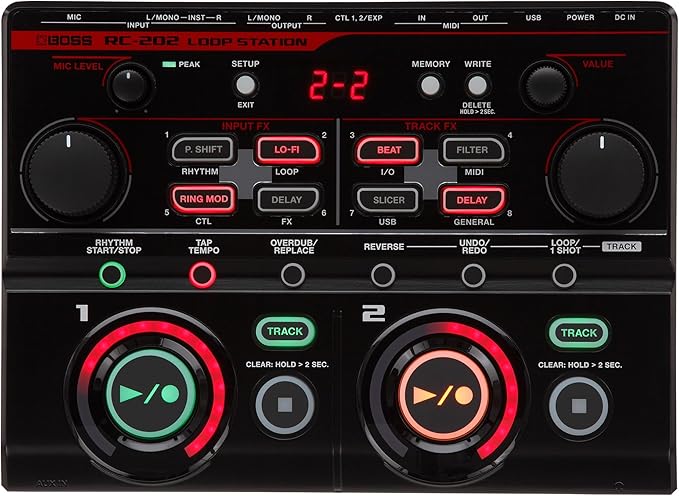
Boss RC-500 - Loop Station
Get yourself 13 hours of stereo recording time and a pristine sound with the BOSS RC-500 Loop Station, a looper pedal for electric guitarists and vocalists. Loop vocal parts and guitar parts for all your improvisations or songs. They'll be replayed in stellar sound quality, thanks to the 32-Bit AD/DA engine and 32-Bit onboard DSP. The pedal supplies 16 built-in rhythm its with 57 patterns, and 2 variations per pattern. This lets you use the pedal to create your own one-person band. You can apply effects to the loops for experimental, esoteric purposes, and you can add reverb to the rhythm parts. Store any pattern you like into a memory slot; you'll have 99 in total. The RC-500 has an XLR input for microphones. Use it to power condenser mics with phantom power if you so choose. You'll also find a stereo 1/4" path for instruments, as well as a control/expression jack and MIDI I/O over 3.5mm connections. Power the unit off alkaline batteries, or pick up a separately available AC adapter to run the RC-500 right off your pedalboard's power supply.
Get yourself 13 hours of stereo recording time and a pristine sound with the BOSS RC-500 Loop Station, a looper pedal for electric guitarists and vocalists. Loop vocal parts and guitar parts for all your improvisations or songs. They'll be replayed in stellar sound quality, thanks to the 32-Bit AD/DA engine and 32-Bit onboard DSP. The pedal supplies 16 built-in rhythm its with 57 patterns, and 2 variations per pattern. This lets you use the pedal to create your own one-person band. You can apply effects to the loops for experimental, esoteric purposes, and you can add reverb to the rhythm parts. Store any pattern you like into a memory slot; you'll have 99 in total. The RC-500 has an XLR input for microphones. Use it to power condenser mics with phantom power if you so choose. You'll also find a stereo 1/4" path for instruments, as well as a control/expression jack and MIDI I/O over 3.5mm connections. Power the unit off alkaline batteries, or pick up a separately available AC adapter to run the RC-500 right off your pedalboard's power supply.
Get yourself 13 hours of stereo recording time and a pristine sound with the BOSS RC-500 Loop Station, a looper pedal for electric guitarists and vocalists. Loop vocal parts and guitar parts for all your improvisations or songs. They'll be replayed in stellar sound quality, thanks to the 32-Bit AD/DA engine and 32-Bit onboard DSP. The pedal supplies 16 built-in rhythm its with 57 patterns, and 2 variations per pattern. This lets you use the pedal to create your own one-person band. You can apply effects to the loops for experimental, esoteric purposes, and you can add reverb to the rhythm parts. Store any pattern you like into a memory slot; you'll have 99 in total. The RC-500 has an XLR input for microphones. Use it to power condenser mics with phantom power if you so choose. You'll also find a stereo 1/4" path for instruments, as well as a control/expression jack and MIDI I/O over 3.5mm connections. Power the unit off alkaline batteries, or pick up a separately available AC adapter to run the RC-500 right off your pedalboard's power supply.
Get yourself 13 hours of stereo recording time and a pristine sound with the BOSS RC-500 Loop Station, a looper pedal for electric guitarists and vocalists. Loop vocal parts and guitar parts for all your improvisations or songs. They'll be replayed in stellar sound quality, thanks to the 32-Bit AD/DA engine and 32-Bit onboard DSP. The pedal supplies 16 built-in rhythm its with 57 patterns, and 2 variations per pattern. This lets you use the pedal to create your own one-person band. You can apply effects to the loops for experimental, esoteric purposes, and you can add reverb to the rhythm parts. Store any pattern you like into a memory slot; you'll have 99 in total. The RC-500 has an XLR input for microphones. Use it to power condenser mics with phantom power if you so choose. You'll also find a stereo 1/4" path for instruments, as well as a control/expression jack and MIDI I/O over 3.5mm connections. Power the unit off alkaline batteries, or pick up a separately available AC adapter to run the RC-500 right off your pedalboard's power supply.
in 34 offers
The lowest price for Boss RC-500 - Loop Station right now is $349.00 at Vivace Music, compared across 24 retailers.
The all-time low was $212.29 on 19 July 2025 — today's price is 64% above the lowest ever. It has been notably cheaper before — worth setting a price alert.
Prices last updated 17 Oct 2026.
Last updated at 17/10/2026 20:22:09
Boss RC-5 Loop Station Pedal (RC5)
Delivery between 23–29 Oct $23.43
Boss RC500 Loop Station Guitar Pedalboard
Delivery $98.51
Boss Rc-500 Loop Station Guitar Effect Pedals 2-track Looper Reverse
Free delivery
Affiliate Disclosure: We may receive a small commission for purchases made through this link at no extra cost to you. This helps support our site. Thank you!
Boss RC-500 Loop Station 32-Bit
Free delivery between 22–28 Oct
Boss RC-500 Loop Station Advanced 2-Track Looper Pedal
Free delivery
BOSS RC-500 Loop Station
Delivery between 22–27 Oct $60.93
Roland Boss Rc-500 Dual-Track Loop Station Pedal W/ On-Board Mixing Replacing Rc30
Delivery between 21–30 Oct $12.50
Boss RC-500 Loop Station | Volaris Brunswick
Delivery $12.50
BOSS RC-500 Loop Station | Sieffs Music Australia
Delivery $16
Boss RC-500 Loop Station
Delivery $10
originally posted on ebay.com
Not as good as ditto tc 4 for series looping (verse, chorus) Probably better for parallel loops. Problem is you need to make two switches to change loops(eg: verse to chorus) whereas the TC4 only requires one switch. However, the Boss does allow you a bit more choice of loop timing. Complex to use, manual isnt great but online videos help Hopefully more reliable than the ditto though (TC 4 often fails if knocked!) Good that you can use batteries which is good for quick set up in a pub. Loop playback volume isnt super easy to control in a live situation, can get too loud
originally posted on pmtonline.co.uk
Drum loop patterns a bit limited in variation. Loop wise if you're new to looping takes time to getting used to. Batteries drain super fast! Will probably have to use rechargeable batteries at the rate I'm going if outdoors. Decided to buy a mains adaptor for the pedal as can't afford to use too many batteries. Pickups? It's not a guitar. Quality is very good, a bit too pricey but they are selling the brand too aren't they.
originally posted on pmtonline.co.uk
Very easy to use for the basic functions I am still learning the advanced features. Easy to record and overdub it also has a built in drum function. The unit is very solidMost recording and overdubbing can be operated with your foot while still playingAlso has a microphone input with optional ghost power
| Product Type | Effects Pedal |
| Subtype | Looper, Looper pedal |
| Inputs | XLR mic input (with phantom power) |
| Outputs | Stereo outs, Mini stereo-style MIDI out, USB port |
| Connectivity Highlights | USB, MIDI |
Boss RC-5 Loop Station Pedal (RC5)
Delivery between 23–29 Oct $23.43
Boss RC500 Loop Station Guitar Pedalboard
Delivery $98.51
Boss Rc-500 Loop Station Guitar Effect Pedals 2-track Looper Reverse
Free delivery
Affiliate Disclosure: We may receive a small commission for purchases made through this link at no extra cost to you. This helps support our site. Thank you!
Boss RC-500 Loop Station 32-Bit
Free delivery between 22–28 Oct
Boss RC-500 Loop Station Advanced 2-Track Looper Pedal
Free delivery
Not as good as ditto tc 4 for series looping (verse, chorus) Probably better for parallel loops. Problem is you need to make two switches to change loops(eg: verse to chorus) whereas the TC4 only requires one switch. However, the Boss does allow you a bit more choice of loop timing. Complex to use, manual isnt great but online videos help Hopefully more reliable than the ditto though (TC 4 often fails if knocked!) Good that you can use batteries which is good for quick set up in a pub. Loop playback volume isnt super easy to control in a live situation, can get too loud
Drum loop patterns a bit limited in variation. Loop wise if you're new to looping takes time to getting used to. Batteries drain super fast! Will probably have to use rechargeable batteries at the rate I'm going if outdoors. Decided to buy a mains adaptor for the pedal as can't afford to use too many batteries. Pickups? It's not a guitar. Quality is very good, a bit too pricey but they are selling the brand too aren't they.
Very easy to use for the basic functions I am still learning the advanced features. Easy to record and overdub it also has a built in drum function. The unit is very solidMost recording and overdubbing can be operated with your foot while still playingAlso has a microphone input with optional ghost power
This is the first loop pedal I've used. It's probably a bit too advanced for me at present, but I wanted to buy a piece of kit that I would get into and not have to replace six months down the line because it couldn't do all I wanted it to.So far so good. It's well made and has a myriad of features. It's not too complicated to use. I managed to get some pretty decent sounding loops going within 15 minutes of getting it out the box.The instructions are very basic, but there are loads of excellent and comprehensive reviews and instructional videos on YouTube to cover all functionality of the pedal.All in all I'm very pleased. The possibilities for using this pedal are endless!
This is a great piece of kit…it’s my first looper. I bought it for sketching out song ideas and using it as a practice tool. I really noticed how it sharpens you up in a real short space of time.I found it a little tricky to use from the off as the instructions aren’t very good. I found more info on YouTube than anywhere else from demos and reviews.All in all its really good quality with excellent sound.I would highly recommend this for a first timer like me or an experienced looper.
Just bought the RC-500 after owning the RC-30 for about 7 years...My initial thoughts right out of the box, were that this thing has so much you can do with it. The drums are a huge upgrade from the RC-30. I'm still getting the hang of this thing, and so far I've been having fun with it. The 2 main cons I have found: The RC-500 has no physical volume control for the rhythm section. You have to press and hold down the button associated with starting and stopping the drums, then you get to the volume control. This is a huge bummer for me, especially coming from the RC-30, where the rhythm section has its' own volume knob. The RC-500 takes only 4 AA batteries, compared to the previous RC-30, that takes 6. The batteries only last about an hour and a half, while using ... MoreJust bought the RC-500 after owning the RC-30 for about 7 years...My initial thoughts right out of the box, were that this thing has so much you can do with it. The drums are a huge upgrade from the RC-30. I'm still getting the hang of this thing, and so far I've been having fun with it. The 2 main cons I have found: The RC-500 has no physical volume control for the rhythm section. You have to press and hold down the button associated with starting and stopping the drums, then you get to the volume control. This is a huge bummer for me, especially coming from the RC-30, where the rhythm section has its' own volume knob. The RC-500 takes only 4 AA batteries, compared to the previous RC-30, that takes 6. The batteries only last about an hour and a half, while using the pedal normally. I could take the RC-30 out with new batteries and it seemed to last for a couple days, seeing as you don't leave the cables plugged in. I have began watching many videos showing how you can utilize midi pedals and expression pedals to control some of the onboard functions, I'm hoping maybe I can control the drum volume with an added pedal maybe? However, upon finding out these couple downsides, I feel compelled to purchase the RC-300, which is more expensive, but seems to do everything I would need it to! Time shall tell
Great looper, not instantly user user friendly, more complicated than the single pedal, just takes time to learn how to use it,.. it has many functions it takes time too efficiently learn to use the pedal to its optimal,I had to return my 1st rc500 as the volume levels of the 2 tracks where significantly different volumes! The 2nd one instantly better the volume of the 2 tracks consistent, the sound quality is great and the 2 track function is great too, still learning it. Build is solid however as a gigging musician the dials on top could be better protected, as if they break or are damaged it would make the product useless.. so I built a protective box..
I got this quite recently and I'm having lots of fun with it... but I'm surprised by how weak the input gains are for mic and instrument level signals. I suppose they have given the instrument inputs plenty of head-room so that you can connect line level signals from keyboards or preamps but I don't understand why they have given the microphone input such feeble gain. If you connect a dynamic mic (e.g. an SM58) directly to the mic input and shout into it with the gain turned to max, you still cannot get it to peak and you immediately notice that the mic signal is very quiet compared with the internal drums. The instrument input is not much better... single coil passive pickups are very weak.... My active LR Baggs M80 and i-beam are a bit better but not great... You ... MoreI got this quite recently and I'm having lots of fun with it... but I'm surprised by how weak the input gains are for mic and instrument level signals. I suppose they have given the instrument inputs plenty of head-room so that you can connect line level signals from keyboards or preamps but I don't understand why they have given the microphone input such feeble gain. If you connect a dynamic mic (e.g. an SM58) directly to the mic input and shout into it with the gain turned to max, you still cannot get it to peak and you immediately notice that the mic signal is very quiet compared with the internal drums. The instrument input is not much better... single coil passive pickups are very weak.... My active LR Baggs M80 and i-beam are a bit better but not great... You can manage by fiddling about with the internal level controls, but it isn't very inspiring in terms of signal to noise... For my preference, I would only connect this unit after some pre-amp stages i.e. after a mic preamp and a guitar preamp (e.g. Fishman Platinum or an LR Baggs Venue DI) or in the effects loop of an amp or after mixer preamps using the aux or the effects loop or a main insert... All of these work fine... Just be aware that plugging a dynamic mic or pickup straight in to the unit as they show in the manual will be quite disappointing.... but when you get a good setup... Lots of fun!!!
I have used the Boss RC30 for three years. I create rhythm and instrument loops, store them in the memory and use them in live performance.The new RC500 is a significant improvement. Firstly the sound quality is so much better particularly when overdubbing as the clarity of each layer is maintained. Secondly the rhythm patterns are very usable and very flexible. I previously created drum patterns in Logic and imported them as wav files. I have just created presets for two new songs using the built in patterns and they are great. Thirdly the new menu system allows you to control each song individually. For example for most songs I keep the foot-switch configuration as start, stop and track change and use an additional switch for all start/stop. However, on two songs ... MoreI have used the Boss RC30 for three years. I create rhythm and instrument loops, store them in the memory and use them in live performance.The new RC500 is a significant improvement. Firstly the sound quality is so much better particularly when overdubbing as the clarity of each layer is maintained. Secondly the rhythm patterns are very usable and very flexible. I previously created drum patterns in Logic and imported them as wav files. I have just created presets for two new songs using the built in patterns and they are great. Thirdly the new menu system allows you to control each song individually. For example for most songs I keep the foot-switch configuration as start, stop and track change and use an additional switch for all start/stop. However, on two songs I use the additional foot- switch to turn the rhythm pattern on and off.Finally you can import your old RC30 presets but you do need to convert them to 32 bit floating point waves using a program such as Audacity or Sound Forge.
| Product Type | Effects Pedal |
| Subtype | Looper, Looper pedal |
| Inputs | XLR mic input (with phantom power) |
| Outputs | Stereo outs, Mini stereo-style MIDI out, USB port |
| Connectivity Highlights | USB, MIDI |