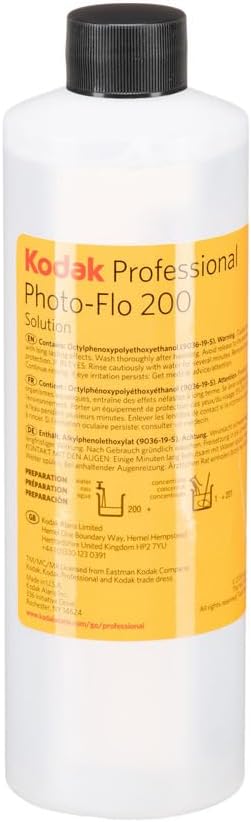
Update 2025: the product you receive is produced by the new U.S. manufacturer of Kodak photochemistry, Photo Systems. Kodak Photo-Flo 200 is a wetting agent used to minimize water marks or streaks during film development. It is used after the final wash when processing films to decrease the water-surface tension and promote faster, more uniform drying. This wetting agent is only usable with films not with traditional photographic papers!
Update 2025: the product you receive is produced by the new U.S. manufacturer of Kodak photochemistry, Photo Systems. Kodak Photo-Flo 200 is a wetting agent used to minimize water marks or streaks during film development. It is used after the final wash when processing films to decrease the water-surface tension and promote faster, more uniform drying. This wetting agent is only usable with films not with traditional photographic papers!
in 3 offers
The lowest price for Kodak Photo-Flo 200 Solution (16oz) right now is $57.70 at Amazon.com.au, compared across 3 retailers.
The all-time low was $13.32 on 2 June 2026 — today's price is 333% above the lowest ever. It has been notably cheaper before — worth setting a price alert.
Prices last updated 29 June 2026.
Kodak Photo-Flo 200 Solution (16oz)
Update 2025: the product you receive is produced by the new U.S. manufacturer of Kodak photochemistry, Photo Systems. Kodak Photo-Flo 200 is a wetting agent used to minimize water marks or streaks during film development. It is used after the final wash when processing films to decrease the water-surface tension and promote faster, more uniform drying. This wetting agent is only usable with films not with traditional photographic papers!
Update 2025: the product you receive is produced by the new U.S. manufacturer of Kodak photochemistry, Photo Systems. Kodak Photo-Flo 200 is a wetting agent used to minimize water marks or streaks during film development. It is used after the final wash when processing films to decrease the water-surface tension and promote faster, more uniform drying. This wetting agent is only usable with films not with traditional photographic papers!
Last updated at 29/06/2026 06:32:22
Kodak Photo-Flo 200 470ml
Affiliate Disclosure: We may receive a small commission for purchases made through this link at no extra cost to you. This helps support our site. Thank you!
Kodak Photo-Flo 200 solution - ProSciTech
Delivery $25
Photo-flo 200 Solution
Delivery between 3–7 July $15.52
originally posted on bhphotovideo.com
**I use Kodak Photo-Flo 200 as a surfactant to: (1) coat test tubes for ease in over-layering media (such as Percoll) of different densities in separating parasites from liver cells and other tissue cells; (2) remove the decomposed intestinal parasites of decomposed carnivorous mammals such as mink, fox and coyote. **Things that are great about it: Photo-Flo coated test tubes prevent bombing (i.e., mixing of the upper-layer lighter density medium with the surface of a lower-layer, slightly heavier density medium) thus making more efficient removal of parasites on the surface of the lower layer. Because of the inner coating of dried Photo-Flo the upper-layer overlays the lower-layer absolutely smoothly when allowed to run down the inner wall of the test tube. A ... More**I use Kodak Photo-Flo 200 as a surfactant to: (1) coat test tubes for ease in over-layering media (such as Percoll) of different densities in separating parasites from liver cells and other tissue cells; (2) remove the decomposed intestinal parasites of decomposed carnivorous mammals such as mink, fox and coyote. **Things that are great about it: Photo-Flo coated test tubes prevent bombing (i.e., mixing of the upper-layer lighter density medium with the surface of a lower-layer, slightly heavier density medium) thus making more efficient removal of parasites on the surface of the lower layer. Because of the inner coating of dried Photo-Flo the upper-layer overlays the lower-layer absolutely smoothly when allowed to run down the inner wall of the test tube. A Photo-Flo solution prevents decomposed parasites from clumping together when the host intestine and parasites have undergone some decomposition. This is particularly important because a clump of small parasites can consist of two or more species and forcefully separating them from a clump with utensils can result in the soft, fragile bodies of the decomposed parasites being torn apart thus making identification difficult. **Things that aren't so great about Photo-Flo: Photo-Flo on its own can not be kept for any length of time, even with refrigeration ( 4C), as it is a solution fertile for growth of fungi. Accordingly, to improve shelf life Photo-Flo solutions must be made up with a fungicide such as 0.02% sodium azide.
originally posted on bhphotovideo.com
This is the last step in my film development workflow before I hang my negs to dry and it is a crucial one. My negs always dry nice and evenly with no water spots. Never had an issue with this product. However the bottle is annoying to draw from with a syringe. Kodak should use a bottle with a top that allows you to draw with a syringe like children's Tylenol bottles have. Other than that, I have no complaints
originally posted on bhphotovideo.com
I purchase a Negative scanner and needed something help clean up thousands of Negative roll film so i can have a very clean film scan formy New digtal file.This Kodak solution works just fine, for clean film negatives
| Chemistry Type | Wetting Agent |
| Powder/Liquid | Liquid |
| Liquid Volume | 1 x 16.0 fl oz / 473.2 mL |
| Box Dimensions (LxWxH) | 7.9 x 2.45 x 2.35" |
Kodak Photo-Flo 200 470ml
Affiliate Disclosure: We may receive a small commission for purchases made through this link at no extra cost to you. This helps support our site. Thank you!
Kodak Photo-Flo 200 solution - ProSciTech
Delivery $25
Photo-flo 200 Solution
Delivery between 3–7 July $15.52
**I use Kodak Photo-Flo 200 as a surfactant to: (1) coat test tubes for ease in over-layering media (such as Percoll) of different densities in separating parasites from liver cells and other tissue cells; (2) remove the decomposed intestinal parasites of decomposed carnivorous mammals such as mink, fox and coyote. **Things that are great about it: Photo-Flo coated test tubes prevent bombing (i.e., mixing of the upper-layer lighter density medium with the surface of a lower-layer, slightly heavier density medium) thus making more efficient removal of parasites on the surface of the lower layer. Because of the inner coating of dried Photo-Flo the upper-layer overlays the lower-layer absolutely smoothly when allowed to run down the inner wall of the test tube. A ... More**I use Kodak Photo-Flo 200 as a surfactant to: (1) coat test tubes for ease in over-layering media (such as Percoll) of different densities in separating parasites from liver cells and other tissue cells; (2) remove the decomposed intestinal parasites of decomposed carnivorous mammals such as mink, fox and coyote. **Things that are great about it: Photo-Flo coated test tubes prevent bombing (i.e., mixing of the upper-layer lighter density medium with the surface of a lower-layer, slightly heavier density medium) thus making more efficient removal of parasites on the surface of the lower layer. Because of the inner coating of dried Photo-Flo the upper-layer overlays the lower-layer absolutely smoothly when allowed to run down the inner wall of the test tube. A Photo-Flo solution prevents decomposed parasites from clumping together when the host intestine and parasites have undergone some decomposition. This is particularly important because a clump of small parasites can consist of two or more species and forcefully separating them from a clump with utensils can result in the soft, fragile bodies of the decomposed parasites being torn apart thus making identification difficult. **Things that aren't so great about Photo-Flo: Photo-Flo on its own can not be kept for any length of time, even with refrigeration ( 4C), as it is a solution fertile for growth of fungi. Accordingly, to improve shelf life Photo-Flo solutions must be made up with a fungicide such as 0.02% sodium azide.
This is the last step in my film development workflow before I hang my negs to dry and it is a crucial one. My negs always dry nice and evenly with no water spots. Never had an issue with this product. However the bottle is annoying to draw from with a syringe. Kodak should use a bottle with a top that allows you to draw with a syringe like children's Tylenol bottles have. Other than that, I have no complaints
I purchase a Negative scanner and needed something help clean up thousands of Negative roll film so i can have a very clean film scan formy New digtal file.This Kodak solution works just fine, for clean film negatives
I've had issues with water spotting even with using distilled water. Now I've got none. Great product and a huge step forward for me when developing film.
I have used this stuff for years. To eliminate streaks or marks on B&W and color film:1.) Dilute it properly 5ml to 1 liter, if it is diluted incorrectly too weak or strong you will get watermarks. Use a clean medical syringe to accurately measure it. Using the bottle cap to eyeball dilution will not work!2.)Mix it with distilled water.3.)Once the film is emersed in it do not have any other liquid touch the film before drying or you will get watermarks or artifacts.4.)It is inexpensive so use it one-shot and throw away the working solution so any contaminants on the film, rinse water or processing equipment are not carried forward to its next use.Do the above and it is an outstanding product.I use it in place of the stabilizer that comes with C41 color ... MoreI have used this stuff for years. To eliminate streaks or marks on B&W and color film:1.) Dilute it properly 5ml to 1 liter, if it is diluted incorrectly too weak or strong you will get watermarks. Use a clean medical syringe to accurately measure it. Using the bottle cap to eyeball dilution will not work!2.)Mix it with distilled water.3.)Once the film is emersed in it do not have any other liquid touch the film before drying or you will get watermarks or artifacts.4.)It is inexpensive so use it one-shot and throw away the working solution so any contaminants on the film, rinse water or processing equipment are not carried forward to its next use.Do the above and it is an outstanding product.I use it in place of the stabilizer that comes with C41 color negative chemistry kits to minimize the occurrence of water spots.
I have zero water spots or drying issues with my negatives using this product, and this product is probably the most cost effective purchase you can make to improve the quality of your negatives. That being said, knowing a little about your water chemistry in your home will help you.The amount of photo-flo you will need to add depends on how hard the water you will use for the final wash and rinse of your negatives will be. Assuming you use distilled water to mix your chemistry, this means any tap water you will use to wash and rinse after fixing.If you have water spots on your glasses, stains on your bathroom fixtures, and or can taste mineral or metals in your water, you will likely need to use the strength of the suggested ratio for this product. If you have ... MoreI have zero water spots or drying issues with my negatives using this product, and this product is probably the most cost effective purchase you can make to improve the quality of your negatives. That being said, knowing a little about your water chemistry in your home will help you.The amount of photo-flo you will need to add depends on how hard the water you will use for the final wash and rinse of your negatives will be. Assuming you use distilled water to mix your chemistry, this means any tap water you will use to wash and rinse after fixing.If you have water spots on your glasses, stains on your bathroom fixtures, and or can taste mineral or metals in your water, you will likely need to use the strength of the suggested ratio for this product. If you have a water softener, salt based or otherwise, you will likely only need a few drops of this product per liter to get great results. The final solution should bubble only slightly when agitated and NOT foam like the head of a beer.
Please if you develop film at home do yourself a favor and buy this! You won't have to refill for about a year with how little you end up using. This is like the Rain-X equivalent for your negatives. Process and develop like normal, toss a little bit of this diluted solution on the negatives hang to dry and watch as the water slides off like nothing. I am STILL shocked at how well this works don't even need to squeegee the film ever again! Also no more waiting for hours and clogging up the bathroom shower with film negatives awaiting their dry potential
I've been using Kodak Photo-Flo for over 50 years. It's a wetting agent used in the very last rinse of negatives prior to drying. It keeps the water from beading up on the surface if the film. The problem with the water beads is that as they dry they may leave a residue on the surface of the negative. I have used Photo-Flo both with and without a squeegee. It works well both ways, but with a squeegee there is always a chance of scratching the negative.
Cuts drying time, helps with dust, and very cheap. I was having trouble with long drying times and water marks. I was using jugs of water for my final rinses and was looking for a way to lower cost/waste. After using the ilford method of washing with tap water, I do a final rinse with distilled water and the tiniest amount of Photoflo. The difference is staggering. No water marks, reduced dust, reduced curling, and drying times that allow me to get to scanning much quicker. I’d usually have to wait overnight for them to dry but the first time I used this, by the time I was done developing my second batch, the first was already dry. Maybe an hour of drying time. I waited another hour just to make sure but yup, they were dry. The cost per roll must be in the tenths of ... MoreCuts drying time, helps with dust, and very cheap. I was having trouble with long drying times and water marks. I was using jugs of water for my final rinses and was looking for a way to lower cost/waste. After using the ilford method of washing with tap water, I do a final rinse with distilled water and the tiniest amount of Photoflo. The difference is staggering. No water marks, reduced dust, reduced curling, and drying times that allow me to get to scanning much quicker. I’d usually have to wait overnight for them to dry but the first time I used this, by the time I was done developing my second batch, the first was already dry. Maybe an hour of drying time. I waited another hour just to make sure but yup, they were dry. The cost per roll must be in the tenths of a penny. No reason not to buy.
My bottle came in a rectangular box-shaped plastic bottle - not a major point of concern. When diluted and when using a inverting-film canister, it produces a lot of bubbles, that can make subsequent rinsing a bit problematic. It would not be a wetting solution if ti did not do that, though. This quantity is enough to last me for the rest of my life. I'm happy with this solution (pun not intended).
| Chemistry Type | Wetting Agent |
| Powder/Liquid | Liquid |
| Liquid Volume | 1 x 16.0 fl oz / 473.2 mL |
| Box Dimensions (LxWxH) | 7.9 x 2.45 x 2.35" |

