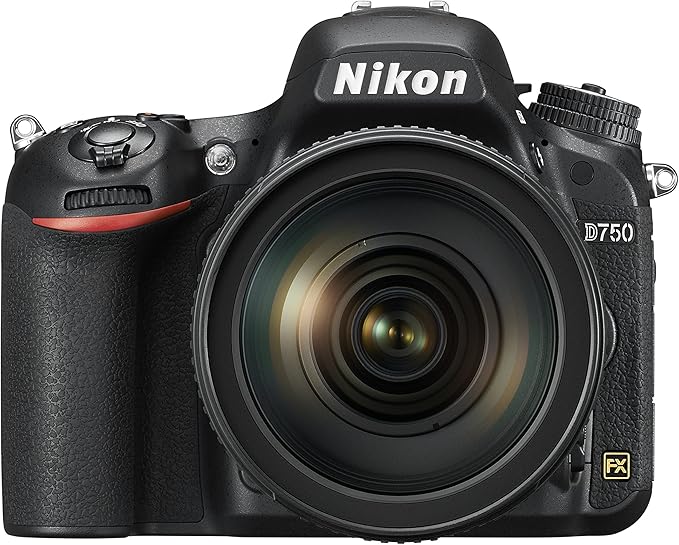
Nikon D750 with 24-120mm Lens Kit Digital SLR Camera
Championing a multimedia approach to photography, Nikon's D750 DSLR is an FX-format camera well-suited to both still imaging and video recording. Featuring a 24.3MP CMOS sensor, along with the EXPEED 4 image processor, this camera is capable of producing high-resolution imagery with smooth color gradations, low noise, and sensitivity to an expandable ISO 51200, at a continuous shooting rate of up to 6.5 fps. In regard to video recording, Full HD 1080p/60 is supported, along with the ability to record uncompressed video to an optional external recorder. Working from high and low angles is possible due to the tilting 3.2" 1,229k-dot LCD monitor or, for remote shooting, the D750 also features built-in Wi-Fi connectivity. Designed for the contemporary image-maker, this DSLR is poised to benefit still photographers and videographers alike with the versatility and performance to match any working situation.
Championing a multimedia approach to photography, Nikon's D750 DSLR is an FX-format camera well-suited to both still imaging and video recording. Featuring a 24.3MP CMOS sensor, along with the EXPEED 4 image processor, this camera is capable of producing high-resolution imagery with smooth color gradations, low noise, and sensitivity to an expandable ISO 51200, at a continuous shooting rate of up to 6.5 fps. In regard to video recording, Full HD 1080p/60 is supported, along with the ability to record uncompressed video to an optional external recorder. Working from high and low angles is possible due to the tilting 3.2" 1,229k-dot LCD monitor or, for remote shooting, the D750 also features built-in Wi-Fi connectivity. Designed for the contemporary image-maker, this DSLR is poised to benefit still photographers and videographers alike with the versatility and performance to match any working situation.
Championing a multimedia approach to photography, Nikon's D750 DSLR is an FX-format camera well-suited to both still imaging and video recording. Featuring a 24.3MP CMOS sensor, along with the EXPEED 4 image processor, this camera is capable of producing high-resolution imagery with smooth color gradations, low noise, and sensitivity to an expandable ISO 51200, at a continuous shooting rate of up to 6.5 fps. In regard to video recording, Full HD 1080p/60 is supported, along with the ability to record uncompressed video to an optional external recorder. Working from high and low angles is possible due to the tilting 3.2" 1,229k-dot LCD monitor or, for remote shooting, the D750 also features built-in Wi-Fi connectivity. Designed for the contemporary image-maker, this DSLR is poised to benefit still photographers and videographers alike with the versatility and performance to match any working situation.
Championing a multimedia approach to photography, Nikon's D750 DSLR is an FX-format camera well-suited to both still imaging and video recording. Featuring a 24.3MP CMOS sensor, along with the EXPEED 4 image processor, this camera is capable of producing high-resolution imagery with smooth color gradations, low noise, and sensitivity to an expandable ISO 51200, at a continuous shooting rate of up to 6.5 fps. In regard to video recording, Full HD 1080p/60 is supported, along with the ability to record uncompressed video to an optional external recorder. Working from high and low angles is possible due to the tilting 3.2" 1,229k-dot LCD monitor or, for remote shooting, the D750 also features built-in Wi-Fi connectivity. Designed for the contemporary image-maker, this DSLR is poised to benefit still photographers and videographers alike with the versatility and performance to match any working situation.
in 9 offers
The lowest price for Nikon D750 with 24-120mm Lens Kit Digital SLR Camera right now is $1,895.53 at eBay.com.au, compared across 9 retailers.
The all-time low was $409.69 on 12 Feb 2026 — today's price is 363% above the lowest ever. It has been notably cheaper before — worth setting a price alert.
Prices last updated 22 Sept 2026.
Last updated at 22/09/2026 02:51:50
Mint Only 320 Low Shutter Nikon D750 24-120 4g Vr Kit Digital Slr
Delivery $35
Affiliate Disclosure: We may receive a small commission for purchases made through this link at no extra cost to you. This helps support our site. Thank you!
Nikon D750 Digital SLR Camera Body & AF-S 24-120mm f/4 G VR ED Zoom-Nikkor Lens (Renewed)
Free delivery
Nikon D750 DSLR Camera with 24-120mm Lens
Delivery $35.16
Nikon D750 w/ AF-S 24-120mm f/4G ED VR Lens
Free delivery between 25 Sept – 2 Oct
Nikon D750 Kit (24-120mm) (With Wifi)
Delivery $192
Nikon D750 Digital SLR Camera with 24-120 lens
Free delivery
Nikon D750 Digital SLR Camera with 24-120 lens
Free delivery
Nikon D750 Digital SLR Camera with 24-120 lens
Free delivery
Nikon D750 Digital SLR Camera with 24-120 lens
Free delivery
originally posted on influenster.com
I used the D750 for years before upgrading to the D850, and I really loved it. In fact, I loved it enough to keep it as a second body for weddings. It was versatile, and there wasn't much I couldn't shoot with it. I loved the wifi function too, which made self-portraits a breeze. The focus tracking was lovely for moving subjects, like animals or children, or even a bride walking down the isle. Great camera for any price, but even better that it's quite the steal in terms of price these days. Definitely recommend this to anyone.
originally posted on influenster.com
The Nikon D750 is a superb full-frame DSLR camera that excels in various shooting conditions. Its 24.3MP sensor produces sharp and detailed images, and the tilting LCD screen adds versatility to composing shots. The robust build, combined with ergonomic design, ensures a comfortable grip. The D750's low-light performance is noteworthy, thanks to its wide ISO range. While it lacks 4K video, its 1080p video quality is excellent. Overall, the Nikon D750 is a reliable choice for enthusiasts and professionals alike
originally posted on adorama.com
Quick background - I have photographed professionally since 1995, started out with Minolta, then Canon and then Nikon. When digital hit the market I laughed and thought it would never overcome the quality of film and while some could argue there are nuances with film you can't get with digital none can argue that digital has surpassed film in so many areas. Denis Reggie convinced me to go digital back in 2004 and I've never looked back - who's laughing now.Is Full Frame worth it? - my first digital camera was the Canon 1D Mark II with a 1.3x crop factor, then I got a 30D with a 1.5x crop factor but something was missing from my photos that I remembered with film so when the 5D was released I jumped on the bandwagon and quickly saw what I was missing, literally, ... MoreQuick background - I have photographed professionally since 1995, started out with Minolta, then Canon and then Nikon. When digital hit the market I laughed and thought it would never overcome the quality of film and while some could argue there are nuances with film you can't get with digital none can argue that digital has surpassed film in so many areas. Denis Reggie convinced me to go digital back in 2004 and I've never looked back - who's laughing now.Is Full Frame worth it? - my first digital camera was the Canon 1D Mark II with a 1.3x crop factor, then I got a 30D with a 1.5x crop factor but something was missing from my photos that I remembered with film so when the 5D was released I jumped on the bandwagon and quickly saw what I was missing, literally, with a full frame sensor you do not lose focal length or bokeh for the majority of lenses designed for DSLR's. There is application for crop bodies especially for those who need to reach out really far, the crop factor definitely can help, but having spent time with multiple bodies from Canon and Nikon I can say there is something special about full frame sensors that the crop sensors, while getting better, cannot pull off.Nikon in a post D700 world - While the D700 was revolutionary, many photographers (myself included) hoped that Nikon would keep up the D700 series models to follow about a year behind their top DSLR release (D3, D4, D5, etc.) however, sadly Nikon has not done so. They introduced the D800 and it was a big disappointment for many photographers as most did not consider it the D700 replacement but more a high MP offering, great for photographers who needed uber megapixels, but a crux for the majority of photographers who don't and instead were hoping for better high ISO performance. Around 2012 I took a sabbatical from my professional wedding and portraiture business to spend more time with my family and decided to sell my Nikon gear and for a short while invested in micro four thirds for it's portability and while I was impressed by the system it seriously lacked in one area continuous focus and with four active kids this translated into shots missed, so when Nikon introduced the D7100 with the upgraded 51 point AF engine I decided to go back to DX cameras. While the D7100 was supposed to have a superior AF system to the D700 I found it wasn't quite up to what I'd hoped, but it was good enough for most of what I was doing at the time. Then Nikon announced the D750 and I hoped this would finally be the D700 replacement, but one spec kept me from going back to FX - Nikon decided to cripple the D750 with a max shutter of 1/4000 and based on that spec alone I decided to pass because I like to shoot with fast primes wide open in daylight at times.The D850 or D750 - A few months ago Nikon announced the D850 and to be honest I felt this would finally be the "true" D700 replacement as the body finally shares the same AF engine as the venerable D5 and includes an improved 45MP sensor with a 20MP DX mode. To me, this camera negates the need for any crop DSLR to date, including the D500 which I used for a bit this past summer with great results. However, as I am no longer shooting professionally on a consistent basis spending over $3k for a DSLR is not ideal, but the idea of going back to full frame got me to reconsider the D750 especially with the great deals around the holidays, and when I saw the fantastic deal Adorama was running on the D750 with 24-120 kit and the MB-D16 grip, I decided it was time try out this full frame offering.The Nikon D750 - Not to drag out this lengthy review any further, the D750 has exceeded my expectations. The sensor is simply phenomenal and reminds me of the quality of the D700 but with double the megapixels. The AF engine, while on paper seems to be shared with the D7100, seems better in all respects and while the 1/4000 shutter is a limitation, there are ways around this to get the shots I want. I am content to stick with the D750 until the D850 comes down in price in a couple years, knowing that I have a camera capable of taking amazing images. The quality seems far better than my D7100 and I'm happy to be back in the full frame world again.Conclusion - I would not hesitate to recommend the D750 to others, as mentioned throughout the review, there is something special about full frame sensors whether it be the difference in bokeh or the pixel pitch or what I do not know, but it is noticeable. That's not to say crop sensor DSLR's like the D7x00 series or the D500 can't take amazing images, they certainly do, but having gone back to full frame after almost 5 years has opened my eyes once again to why I've loved full frame DSLR's from the beginning and the D750 is certainly one very capable camera which might open your eyes to new photographic opportunities.
| Focal Length (mm) | 24-120 |
| Sensor size | Full frame (35.9 x 24 mm) |
| Storage | SD/SDHC/SDXC(dualslots) |
| Autofocus | Yes |
| Battery | EN-EL15 lithium-ion battery %26 charger |
Mint Only 320 Low Shutter Nikon D750 24-120 4g Vr Kit Digital Slr
Delivery $35
Affiliate Disclosure: We may receive a small commission for purchases made through this link at no extra cost to you. This helps support our site. Thank you!
Nikon D750 Digital SLR Camera Body & AF-S 24-120mm f/4 G VR ED Zoom-Nikkor Lens (Renewed)
Free delivery
Nikon D750 DSLR Camera with 24-120mm Lens
Delivery $35.16
Nikon D750 w/ AF-S 24-120mm f/4G ED VR Lens
Free delivery between 25 Sept – 2 Oct
Nikon D750 Kit (24-120mm) (With Wifi)
Delivery $192
I used the D750 for years before upgrading to the D850, and I really loved it. In fact, I loved it enough to keep it as a second body for weddings. It was versatile, and there wasn't much I couldn't shoot with it. I loved the wifi function too, which made self-portraits a breeze. The focus tracking was lovely for moving subjects, like animals or children, or even a bride walking down the isle. Great camera for any price, but even better that it's quite the steal in terms of price these days. Definitely recommend this to anyone.
The Nikon D750 is a superb full-frame DSLR camera that excels in various shooting conditions. Its 24.3MP sensor produces sharp and detailed images, and the tilting LCD screen adds versatility to composing shots. The robust build, combined with ergonomic design, ensures a comfortable grip. The D750's low-light performance is noteworthy, thanks to its wide ISO range. While it lacks 4K video, its 1080p video quality is excellent. Overall, the Nikon D750 is a reliable choice for enthusiasts and professionals alike
Quick background - I have photographed professionally since 1995, started out with Minolta, then Canon and then Nikon. When digital hit the market I laughed and thought it would never overcome the quality of film and while some could argue there are nuances with film you can't get with digital none can argue that digital has surpassed film in so many areas. Denis Reggie convinced me to go digital back in 2004 and I've never looked back - who's laughing now.Is Full Frame worth it? - my first digital camera was the Canon 1D Mark II with a 1.3x crop factor, then I got a 30D with a 1.5x crop factor but something was missing from my photos that I remembered with film so when the 5D was released I jumped on the bandwagon and quickly saw what I was missing, literally, ... MoreQuick background - I have photographed professionally since 1995, started out with Minolta, then Canon and then Nikon. When digital hit the market I laughed and thought it would never overcome the quality of film and while some could argue there are nuances with film you can't get with digital none can argue that digital has surpassed film in so many areas. Denis Reggie convinced me to go digital back in 2004 and I've never looked back - who's laughing now.Is Full Frame worth it? - my first digital camera was the Canon 1D Mark II with a 1.3x crop factor, then I got a 30D with a 1.5x crop factor but something was missing from my photos that I remembered with film so when the 5D was released I jumped on the bandwagon and quickly saw what I was missing, literally, with a full frame sensor you do not lose focal length or bokeh for the majority of lenses designed for DSLR's. There is application for crop bodies especially for those who need to reach out really far, the crop factor definitely can help, but having spent time with multiple bodies from Canon and Nikon I can say there is something special about full frame sensors that the crop sensors, while getting better, cannot pull off.Nikon in a post D700 world - While the D700 was revolutionary, many photographers (myself included) hoped that Nikon would keep up the D700 series models to follow about a year behind their top DSLR release (D3, D4, D5, etc.) however, sadly Nikon has not done so. They introduced the D800 and it was a big disappointment for many photographers as most did not consider it the D700 replacement but more a high MP offering, great for photographers who needed uber megapixels, but a crux for the majority of photographers who don't and instead were hoping for better high ISO performance. Around 2012 I took a sabbatical from my professional wedding and portraiture business to spend more time with my family and decided to sell my Nikon gear and for a short while invested in micro four thirds for it's portability and while I was impressed by the system it seriously lacked in one area continuous focus and with four active kids this translated into shots missed, so when Nikon introduced the D7100 with the upgraded 51 point AF engine I decided to go back to DX cameras. While the D7100 was supposed to have a superior AF system to the D700 I found it wasn't quite up to what I'd hoped, but it was good enough for most of what I was doing at the time. Then Nikon announced the D750 and I hoped this would finally be the D700 replacement, but one spec kept me from going back to FX - Nikon decided to cripple the D750 with a max shutter of 1/4000 and based on that spec alone I decided to pass because I like to shoot with fast primes wide open in daylight at times.The D850 or D750 - A few months ago Nikon announced the D850 and to be honest I felt this would finally be the "true" D700 replacement as the body finally shares the same AF engine as the venerable D5 and includes an improved 45MP sensor with a 20MP DX mode. To me, this camera negates the need for any crop DSLR to date, including the D500 which I used for a bit this past summer with great results. However, as I am no longer shooting professionally on a consistent basis spending over $3k for a DSLR is not ideal, but the idea of going back to full frame got me to reconsider the D750 especially with the great deals around the holidays, and when I saw the fantastic deal Adorama was running on the D750 with 24-120 kit and the MB-D16 grip, I decided it was time try out this full frame offering.The Nikon D750 - Not to drag out this lengthy review any further, the D750 has exceeded my expectations. The sensor is simply phenomenal and reminds me of the quality of the D700 but with double the megapixels. The AF engine, while on paper seems to be shared with the D7100, seems better in all respects and while the 1/4000 shutter is a limitation, there are ways around this to get the shots I want. I am content to stick with the D750 until the D850 comes down in price in a couple years, knowing that I have a camera capable of taking amazing images. The quality seems far better than my D7100 and I'm happy to be back in the full frame world again.Conclusion - I would not hesitate to recommend the D750 to others, as mentioned throughout the review, there is something special about full frame sensors whether it be the difference in bokeh or the pixel pitch or what I do not know, but it is noticeable. That's not to say crop sensor DSLR's like the D7x00 series or the D500 can't take amazing images, they certainly do, but having gone back to full frame after almost 5 years has opened my eyes once again to why I've loved full frame DSLR's from the beginning and the D750 is certainly one very capable camera which might open your eyes to new photographic opportunities.
One of the best modern full frame cameras you can buy. Lots of features to keep you happy, video, focusing, metering and a flip screen. But delivers incredible professional results from the superb full-frame sensor. Makes a great companion for vintage Nikon lenses or Canon lenses with an adapter.Rugged, reliable and a joy to use.
A very good bit of kit, not the latest tech by 2023 standards but still very capable. Great AF system linked to an excellent sensor with very good low light capability makes this a great body. Mine is on 280 thousand plus actuations and still work as it should. Shame Nikon crippled its burst mode but I suppose that would have hurt their pro camera sales. Still 6.5 frames a second is still not bad, if you want a very good sensibly priced FX body find yourself one of these. Also has dual SD slots and not XQD like the later bodies so you don't have to splash out on a new format of memory card as you can use any SD cards that you already have.
The D750 has proven to be useful for professional and artistic image taking. Does well in low light environments. It is arguable that this camera is a between camera-body, i.e., between a consumer and professional grade camera body design, which is commonly known as a prosumer model. I would note, however, before digital camera bodies we all used film camera bodies that had way less features than this digital D750 model, and we still were able to take beautiful images. So, is this camera prosumer or professional? By today's "common" speak, camera makers would say it is a prosumer model, but in reality, it a an FX camera, which means the FX lenses function nearly identical to film's 35 mm format, that is capable of doing professional work. It is rated at 150,000 ... MoreThe D750 has proven to be useful for professional and artistic image taking. Does well in low light environments. It is arguable that this camera is a between camera-body, i.e., between a consumer and professional grade camera body design, which is commonly known as a prosumer model. I would note, however, before digital camera bodies we all used film camera bodies that had way less features than this digital D750 model, and we still were able to take beautiful images. So, is this camera prosumer or professional? By today's "common" speak, camera makers would say it is a prosumer model, but in reality, it a an FX camera, which means the FX lenses function nearly identical to film's 35 mm format, that is capable of doing professional work. It is rated at 150,000 shutter clicks, and that is a lot of clicks. Unless, of course, you are a hard-core professional doing table top photography and/or fashion. But even so, 150,000 clicks is a tremendous amount of shutter clicks! Think of it this way, 411 clicks per day for 365 days (that's one year) would equal 150,015 clicks. That's 2,811 clicks per week. If you do more shutter clicks than that in one week, well, you must have more time on your hands than common sense allows. Or you are a hard-core professional photographer. God bless you.But most professionals, even wedding photographers, typically only average between 500-2,000 photos for a 6-8 hour event. I'm sure there are wedding photographers that may do more, but on average, for the average wedding, not super high end, 500-2,000 per week. So, this camera, is it worth the money? Yes, it takes great photos, has lots of bells and whistles, and can last for 150,000 clicks, which for the average person equates to several years of use!
I've had my D750 for about a month now. I've shot a wedding and some family pix. I've also shot over 1000 pix for myself and evaluated them considerably. Read other reviews for this camera and you'll see that mine falls right in line with most. The camera is almost perfect. It focuses practically in the dark...very quickly. The images that come out of the camera are nearly flawless no matter what quality you shoot them at...though I HIGHLY recommend 14 bit NEF RAW. When the RAW files are properly processed they are nothing short of spectacular as are the JPEGs The only complaint here is the buffer...it is a bit small and needs to be larger as the RAW files fill it very quickly...something I feel like Nikon with fix either with an update or with the next 750 (do you ... MoreI've had my D750 for about a month now. I've shot a wedding and some family pix. I've also shot over 1000 pix for myself and evaluated them considerably. Read other reviews for this camera and you'll see that mine falls right in line with most. The camera is almost perfect. It focuses practically in the dark...very quickly. The images that come out of the camera are nearly flawless no matter what quality you shoot them at...though I HIGHLY recommend 14 bit NEF RAW. When the RAW files are properly processed they are nothing short of spectacular as are the JPEGs The only complaint here is the buffer...it is a bit small and needs to be larger as the RAW files fill it very quickly...something I feel like Nikon with fix either with an update or with the next 750 (do you recall the D300/D300s?). The other complaints have nothing to do with the practical functioning of the camera. The ergonomics are OK,..some of the buttons on the back have more than one function and there is some two-handed juggling required. The menus are extensive, but a bit complicated. I wish they had made this camera more like the D800/810's or D300's...more professional in this regard. The form factor is small...if you have big hands it might be uncomfortable. The grip is deep, but a bit narrow. Itis EXTREMELY light...about like my D7000...noticeably lighter than my D300. The shutter is loud...I'm not sure what Nikon's excuse is for this...but is just is a loud shutter. Carrying it around all day is a breeze...even with a battery grip. Bottom line is that this camera is a great pro camera whether as a primary or a back up and it is a miraculous image capturing machine. It is also a fantastic value and perfectly placed between the entry level FX 600 series and the near pro dedicated 800 series...and is in many respects...better than both. Better imaging than the 600s...nearly equal to the 800s without some of there over the top huge file sizes. If you've been on the fence about the D750...buy it...you'll love it. Now Nikon...give us a D400 please. Well over 6 years now...I still love this camera. Some of the best images I've ever recorded/created I have done so with this camera. It is not the fastest...nor the lightest and it is extremely long in the tooth for a DSLR, but it is still a viable camera and I still in use. It has been wet, dirty, bumped and rattled and it is still purring right along. It even still looks pretty good. It produces phenomenal images that hold up very well even with todays cameras.
Great IQ good ISO performance low noise accurate auto focus. Body light weight compared to my D800 and has a nice flippy screen. Also files are easy to work with
Great Full Frame cam because of size. One for the smallest foot prints in FF (full frame) for better handling and deeper grip. Now at a great price as of Dec 2019. Not as taxing on lenses because of the 24mpg count vs the d810, d850. So if you own some mid to upper ranges lenses like say the 50mm 1.8 FX G or a 24mm 2.8 D or a 28-300 VR the sensor will be kinder to these types of lenses. The focus is fast and accurate and low light High ISO shots are actually better that the d810. The cam has an anti-alias filter which bucks the trend on Nikon cams that don't have them namely the d7200 d500 d800E, d810 and so on. For my needs I shoot a lot of old style architecture which some have horizontal lines and the filter helps keep them straight in this regard. if you are ... MoreGreat Full Frame cam because of size. One for the smallest foot prints in FF (full frame) for better handling and deeper grip. Now at a great price as of Dec 2019. Not as taxing on lenses because of the 24mpg count vs the d810, d850. So if you own some mid to upper ranges lenses like say the 50mm 1.8 FX G or a 24mm 2.8 D or a 28-300 VR the sensor will be kinder to these types of lenses. The focus is fast and accurate and low light High ISO shots are actually better that the d810. The cam has an anti-alias filter which bucks the trend on Nikon cams that don't have them namely the d7200 d500 d800E, d810 and so on. For my needs I shoot a lot of old style architecture which some have horizontal lines and the filter helps keep them straight in this regard. if you are coming to FF and from say at d71,7200 this cam will we seem at home to you as its button and dials are laid out the same. If you are contemplating FF this is the way to go if your into Nikon system and are looking to buy on the cheap. I call this a gap camera because it been around since introduced in 2014 and it will give you spectacular pics and I don't think its necessary to have to step up to the d810 or d850. Its prices used at this time around $800 while the d810 36 mpg is selling in excellent condition around $1200. when buying used pay attention to shutter count. Bottom line is larger format cams will in most cases produce cleaner, crisper, better detailed pic than APSc sensor cams. I my opinion better looking over all. Been around this hobby/pro business 60 years and worked in many formats. Hope this helps you out in deciding. Mean while keep snapping that shutter!
For a 7-year old camera body, it is amazing. Mine, I bought on eBay, had LESS than 2500 shutter releases. Images are sharp, controls easy to find and use. Even at 7 years old, it commands excellent money because everybody knows this camera is a dependable workhorse -a winner! Great technology which stood the test of time!!! Most technology is trash in three years, bot NOT this camera body. Most last to 200k shutter releases without any problems. I own two of these, and I love BOTH of them. The consistency is phenomenal. Both meter XCTLY the same. If I switch bodies, no differences in the images they generate!!! WOW!
| Focal Length (mm) | 24-120 |
| Sensor size | Full frame (35.9 x 24 mm) |
| Storage | SD/SDHC/SDXC(dualslots) |
| Autofocus | Yes |
| Battery | EN-EL15 lithium-ion battery %26 charger |

