Laowa 100mm f/2.8 2:1 Ultra Macro APO Lens (Sony E)
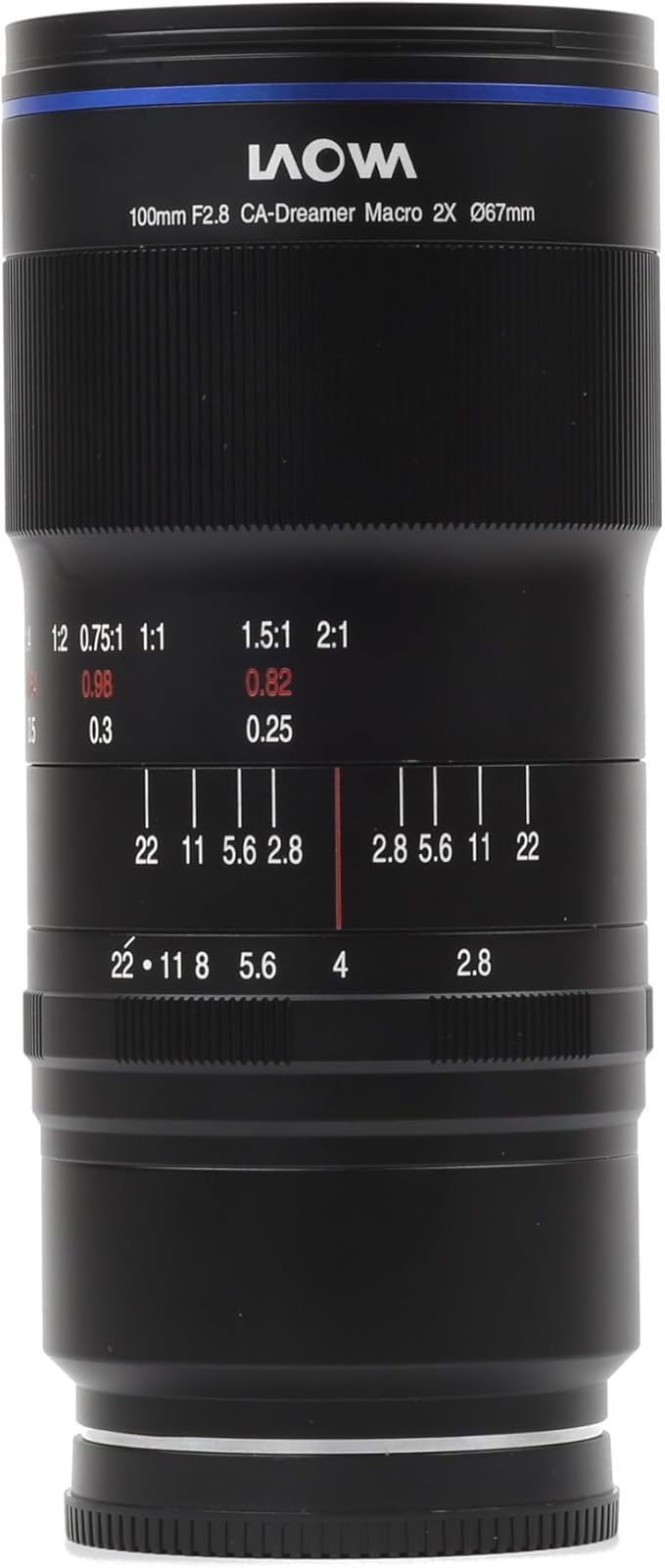
Characterized by its close-focusing capabilities and apochromatic design, the Sony E-mount Laowa 100mm f/2.8 2X Ultra Macro APO from Venus Optics is a unique and versatile short-telephoto prime. Featuring a pair of low dispersion elements, color fringing and chromatic aberrations have been virtually eliminated throughout the focusing range in order to achieve high clarity and color accuracy. The lens's manual focus design also suits its macro capabilities, which permit working with subjects as close as 2:1 with a minimum focusing distance of 9.7". Additionally, a 13-blade diaphragm contributes to a pleasing bokeh quality. Telephoto prime is designed for full-frame Sony E-mount mirrorless cameras and can also be used with APS-C models where it will provide a 150mm equivalent focal length. Featuring an apochromatic designation, this lens uses a pair of low dispersion elements to effectively eliminate chromatic aberrations and color fringing for greater clarity and accurate rendering. Greater-than-life-size 2:1 maximum magnification pairs with a 9.7" minimum focusing distance to suit working with close-up subjects. Manual focus design, along with focus distance and depth of field scales, aids in precise focusing control. A 13-blade diaphragm contributes to a pleasing bokeh quality.
Characterized by its close-focusing capabilities and apochromatic design, the Sony E-mount Laowa 100mm f/2.8 2X Ultra Macro APO from Venus Optics is a unique and versatile short-telephoto prime. Featuring a pair of low dispersion elements, color fringing and chromatic aberrations have been virtually eliminated throughout the focusing range in order to achieve high clarity and color accuracy. The lens's manual focus design also suits its macro capabilities, which permit working with subjects as close as 2:1 with a minimum focusing distance of 9.7". Additionally, a 13-blade diaphragm contributes to a pleasing bokeh quality. Telephoto prime is designed for full-frame Sony E-mount mirrorless cameras and can also be used with APS-C models where it will provide a 150mm equivalent focal length. Featuring an apochromatic designation, this lens uses a pair of low dispersion elements to effectively eliminate chromatic aberrations and color fringing for greater clarity and accurate rendering. Greater-than-life-size 2:1 maximum magnification pairs with a 9.7" minimum focusing distance to suit working with close-up subjects. Manual focus design, along with focus distance and depth of field scales, aids in precise focusing control. A 13-blade diaphragm contributes to a pleasing bokeh quality.
Characterized by its close-focusing capabilities and apochromatic design, the Sony E-mount Laowa 100mm f/2.8 2X Ultra Macro APO from Venus Optics is a unique and versatile short-telephoto prime. Featuring a pair of low dispersion elements, color fringing and chromatic aberrations have been virtually eliminated throughout the focusing range in order to achieve high clarity and color accuracy. The lens's manual focus design also suits its macro capabilities, which permit working with subjects as close as 2:1 with a minimum focusing distance of 9.7". Additionally, a 13-blade diaphragm contributes to a pleasing bokeh quality. Telephoto prime is designed for full-frame Sony E-mount mirrorless cameras and can also be used with APS-C models where it will provide a 150mm equivalent focal length. Featuring an apochromatic designation, this lens uses a pair of low dispersion elements to effectively eliminate chromatic aberrations and color fringing for greater clarity and accurate rendering. Greater-than-life-size 2:1 maximum magnification pairs with a 9.7" minimum focusing distance to suit working with close-up subjects. Manual focus design, along with focus distance and depth of field scales, aids in precise focusing control. A 13-blade diaphragm contributes to a pleasing bokeh quality.
Characterized by its close-focusing capabilities and apochromatic design, the Sony E-mount Laowa 100mm f/2.8 2X Ultra Macro APO from Venus Optics is a unique and versatile short-telephoto prime. Featuring a pair of low dispersion elements, color fringing and chromatic aberrations have been virtually eliminated throughout the focusing range in order to achieve high clarity and color accuracy. The lens's manual focus design also suits its macro capabilities, which permit working with subjects as close as 2:1 with a minimum focusing distance of 9.7". Additionally, a 13-blade diaphragm contributes to a pleasing bokeh quality. Telephoto prime is designed for full-frame Sony E-mount mirrorless cameras and can also be used with APS-C models where it will provide a 150mm equivalent focal length. Featuring an apochromatic designation, this lens uses a pair of low dispersion elements to effectively eliminate chromatic aberrations and color fringing for greater clarity and accurate rendering. Greater-than-life-size 2:1 maximum magnification pairs with a 9.7" minimum focusing distance to suit working with close-up subjects. Manual focus design, along with focus distance and depth of field scales, aids in precise focusing control. A 13-blade diaphragm contributes to a pleasing bokeh quality.
in 16 offers
The lowest price for Laowa 100mm f/2.8 2:1 Ultra Macro APO Lens (Sony E) right now is $633.66 at eBay.com.au, compared across 16 retailers.
The all-time low was $378.38 on 12 Mar 2026 — today's price is 67% above the lowest ever. It has been notably cheaper before — worth setting a price alert.
Prices last updated 2 Sept 2026.
Last updated at 02/09/2026 19:51:07
Laowa 100mm F2.8 Ultra Macro Lens For Sony Full Frame Camera (sony E
Free delivery
Affiliate Disclosure: We may receive a small commission for purchases made through this link at no extra cost to you. This helps support our site. Thank you!
Laowa 100mm f/2.8 2:1 Ultra Macro APO - Sony FE Lens
Free delivery
Laowa 100mm f/2.8 2X Ultra Macro APO Lens for Sony E
Delivery $9.90
Laowa 100mm F2.8 2x Ultra Macro APO Lens Sony FE Full Frame Telephoto Macro Lens
Delivery $9.95
Laowa FE 100mm F2.8 APO - Sony FE
Free delivery between Sat – Wed
Laowa FE 100mm F2.8 APO - Sony FE - Live Price Matching
Delivery $7.95
Laowa 100mm f/2.8 2:1 Ultra Macro APO - Sony FE
Delivery between 7–15 Sept $15
Laowa 100mm f/2.8 2X Ultra Macro APO Lens for Sony E (Black) by Onestop Digital
Free delivery between 8–14 Sept
Laowa 100mm f/2.8 2x Ultra Macro APO (Sony E Mount) at Etoren
Delivery $35
Laowa 100mm F2.8 2:1 Ultra Macro APO - Sony E Mount Laowa Camera Lens
Free delivery between Fri – Mon
originally posted on bhphotovideo.com
I was looking for a Z mount lens for my Z50 as my Tamron 90mm 1:1 was not a G2 model, and didn't work consistantly with the mirrorless body. After many reviews and analysis on the subjects I try to shoot with a macro lens, and my current skillset, I purchased one of these Venus Laowa 100mm 2:1.I mounted it via the Venus mount collar sold as an option. The collar works great if attached to the correct position on the lens. Althought some of the reviews on that device are negative, I found it as advisertised.The first day I had the lens I shot some test subjects and discovered quickly that a macro focus rail would be a HUGE help with this lens. I recommend ordering one with this lens should you purchase it.I ordered one, and put the whole system together ... MoreI was looking for a Z mount lens for my Z50 as my Tamron 90mm 1:1 was not a G2 model, and didn't work consistantly with the mirrorless body. After many reviews and analysis on the subjects I try to shoot with a macro lens, and my current skillset, I purchased one of these Venus Laowa 100mm 2:1.I mounted it via the Venus mount collar sold as an option. The collar works great if attached to the correct position on the lens. Althought some of the reviews on that device are negative, I found it as advisertised.The first day I had the lens I shot some test subjects and discovered quickly that a macro focus rail would be a HUGE help with this lens. I recommend ordering one with this lens should you purchase it.I ordered one, and put the whole system together today.Attached is a 2:1 shot of George Washington's eye on a $1 bill. I didnt focus stack this image - obviously - but I think the quick work demostrates what this lens can do.As stated some macro experience will make this lens more enjoyable, but it seems to be a nice lens to add to the bag especially given the price.
originally posted on adorama.com
I've ended up owning both the automatic aperture and manual aperture versions of this lens. Both are optically excellent and I'm enjoying the 2:1 capability in a versatile lens that is easy to use. I've been using this lens primarily for plant photographs, ranging from pictures of a whole shrub to handheld focus stacking for very small flowers & other plant parts.Contrary to my expectation, though, I find myself preferring the manual aperture lens. This is primarily because the automatic aperture is not particularly accurate, yielding slightly different exposures in a focus stack. I can work around this, but it's annoying. The manual aperture, on the other hand, turns out to be easier to use than I expected. Figuring out where the focus plane is when the lens is ... MoreI've ended up owning both the automatic aperture and manual aperture versions of this lens. Both are optically excellent and I'm enjoying the 2:1 capability in a versatile lens that is easy to use. I've been using this lens primarily for plant photographs, ranging from pictures of a whole shrub to handheld focus stacking for very small flowers & other plant parts.Contrary to my expectation, though, I find myself preferring the manual aperture lens. This is primarily because the automatic aperture is not particularly accurate, yielding slightly different exposures in a focus stack. I can work around this, but it's annoying. The manual aperture, on the other hand, turns out to be easier to use than I expected. Figuring out where the focus plane is when the lens is stopped down takes a bit more care and practice if (like me) you're only used to focusing with lenses wide open. I've screwed up a couple of pictures that way, but after a few days with the lens I think I've gotten over the learning curve. I do wish there was a tactile indication of where you are in the f-stop range, though.
originally posted on adorama.com
I've ended up owning both the automatic aperture and manual aperture versions of this lens. Both are optically excellent and I'm enjoying the 2:1 capability in a versatile lens that is easy to use. I've been using this lens primarily for plant photographs, ranging from pictures of a whole shrub to handheld focus stacking for very small flowers & other plant parts.Contrary to my expectation, though, I find myself preferring the manual aperture lens. This is primarily because the automatic aperture is not particularly accurate. For single exposures, I don't get exactly the aperture I intended, but I also don't care whether a picture ends up being f9.2 or f10, or whatever the discrepancy ends up being. For me, this is not quite ideal in principle but irrelevant in ... MoreI've ended up owning both the automatic aperture and manual aperture versions of this lens. Both are optically excellent and I'm enjoying the 2:1 capability in a versatile lens that is easy to use. I've been using this lens primarily for plant photographs, ranging from pictures of a whole shrub to handheld focus stacking for very small flowers & other plant parts.Contrary to my expectation, though, I find myself preferring the manual aperture lens. This is primarily because the automatic aperture is not particularly accurate. For single exposures, I don't get exactly the aperture I intended, but I also don't care whether a picture ends up being f9.2 or f10, or whatever the discrepancy ends up being. For me, this is not quite ideal in principle but irrelevant in practice. For focus stacking, though, it means that the pictures in the stack are all slightly differently exposed. I've been manually adjusting the exposures to match before running the stack through Zerene Stacker. This seems to work well enough, but it's an extra tedious step for a kind of photography that is already on the tedious end of the spectrum.
| Focal Length | 100mm |
| Maximum Aperture | f/2.8 |
| Minimum Aperture | f/22 |
| Lens Mount | Sony E |
| Lens Format Coverage | Full-Frame |
Laowa 100mm F2.8 Ultra Macro Lens For Sony Full Frame Camera (sony E
Free delivery
Affiliate Disclosure: We may receive a small commission for purchases made through this link at no extra cost to you. This helps support our site. Thank you!
Laowa 100mm f/2.8 2:1 Ultra Macro APO - Sony FE Lens
Free delivery
Laowa 100mm f/2.8 2X Ultra Macro APO Lens for Sony E
Delivery $9.90
Laowa 100mm F2.8 2x Ultra Macro APO Lens Sony FE Full Frame Telephoto Macro Lens
Delivery $9.95
Laowa FE 100mm F2.8 APO - Sony FE
Free delivery between Sat – Wed
I was looking for a Z mount lens for my Z50 as my Tamron 90mm 1:1 was not a G2 model, and didn't work consistantly with the mirrorless body. After many reviews and analysis on the subjects I try to shoot with a macro lens, and my current skillset, I purchased one of these Venus Laowa 100mm 2:1.I mounted it via the Venus mount collar sold as an option. The collar works great if attached to the correct position on the lens. Althought some of the reviews on that device are negative, I found it as advisertised.The first day I had the lens I shot some test subjects and discovered quickly that a macro focus rail would be a HUGE help with this lens. I recommend ordering one with this lens should you purchase it.I ordered one, and put the whole system together ... MoreI was looking for a Z mount lens for my Z50 as my Tamron 90mm 1:1 was not a G2 model, and didn't work consistantly with the mirrorless body. After many reviews and analysis on the subjects I try to shoot with a macro lens, and my current skillset, I purchased one of these Venus Laowa 100mm 2:1.I mounted it via the Venus mount collar sold as an option. The collar works great if attached to the correct position on the lens. Althought some of the reviews on that device are negative, I found it as advisertised.The first day I had the lens I shot some test subjects and discovered quickly that a macro focus rail would be a HUGE help with this lens. I recommend ordering one with this lens should you purchase it.I ordered one, and put the whole system together today.Attached is a 2:1 shot of George Washington's eye on a $1 bill. I didnt focus stack this image - obviously - but I think the quick work demostrates what this lens can do.As stated some macro experience will make this lens more enjoyable, but it seems to be a nice lens to add to the bag especially given the price.
I've ended up owning both the automatic aperture and manual aperture versions of this lens. Both are optically excellent and I'm enjoying the 2:1 capability in a versatile lens that is easy to use. I've been using this lens primarily for plant photographs, ranging from pictures of a whole shrub to handheld focus stacking for very small flowers & other plant parts.Contrary to my expectation, though, I find myself preferring the manual aperture lens. This is primarily because the automatic aperture is not particularly accurate, yielding slightly different exposures in a focus stack. I can work around this, but it's annoying. The manual aperture, on the other hand, turns out to be easier to use than I expected. Figuring out where the focus plane is when the lens is ... MoreI've ended up owning both the automatic aperture and manual aperture versions of this lens. Both are optically excellent and I'm enjoying the 2:1 capability in a versatile lens that is easy to use. I've been using this lens primarily for plant photographs, ranging from pictures of a whole shrub to handheld focus stacking for very small flowers & other plant parts.Contrary to my expectation, though, I find myself preferring the manual aperture lens. This is primarily because the automatic aperture is not particularly accurate, yielding slightly different exposures in a focus stack. I can work around this, but it's annoying. The manual aperture, on the other hand, turns out to be easier to use than I expected. Figuring out where the focus plane is when the lens is stopped down takes a bit more care and practice if (like me) you're only used to focusing with lenses wide open. I've screwed up a couple of pictures that way, but after a few days with the lens I think I've gotten over the learning curve. I do wish there was a tactile indication of where you are in the f-stop range, though.
I've ended up owning both the automatic aperture and manual aperture versions of this lens. Both are optically excellent and I'm enjoying the 2:1 capability in a versatile lens that is easy to use. I've been using this lens primarily for plant photographs, ranging from pictures of a whole shrub to handheld focus stacking for very small flowers & other plant parts.Contrary to my expectation, though, I find myself preferring the manual aperture lens. This is primarily because the automatic aperture is not particularly accurate. For single exposures, I don't get exactly the aperture I intended, but I also don't care whether a picture ends up being f9.2 or f10, or whatever the discrepancy ends up being. For me, this is not quite ideal in principle but irrelevant in ... MoreI've ended up owning both the automatic aperture and manual aperture versions of this lens. Both are optically excellent and I'm enjoying the 2:1 capability in a versatile lens that is easy to use. I've been using this lens primarily for plant photographs, ranging from pictures of a whole shrub to handheld focus stacking for very small flowers & other plant parts.Contrary to my expectation, though, I find myself preferring the manual aperture lens. This is primarily because the automatic aperture is not particularly accurate. For single exposures, I don't get exactly the aperture I intended, but I also don't care whether a picture ends up being f9.2 or f10, or whatever the discrepancy ends up being. For me, this is not quite ideal in principle but irrelevant in practice. For focus stacking, though, it means that the pictures in the stack are all slightly differently exposed. I've been manually adjusting the exposures to match before running the stack through Zerene Stacker. This seems to work well enough, but it's an extra tedious step for a kind of photography that is already on the tedious end of the spectrum.
I sold my Sony 90mm macro G lens in order to get Laowa macro lenses including the 100mm 2X Ultra Macro, the main reason being the 2:1 magnification ratio. This is certainly a great advantage. The optical quality is great in the macro range and is in the same class as the Sony one it has replaced. I haven't used it outside the macro range to testify on that (I was using the Sony outside the macro range and it was still an amazing lens regarding IQ). Manual focus isn't an issue in the macro range. I was using the Sony one in manual mode anyway as AF is pretty much unusable for macro photography. The built quality is great, all metal construction and solid. Unfortunately, the lens is very long, being designed for DSLR's and being adapted to mirrorless by adding a ... MoreI sold my Sony 90mm macro G lens in order to get Laowa macro lenses including the 100mm 2X Ultra Macro, the main reason being the 2:1 magnification ratio. This is certainly a great advantage. The optical quality is great in the macro range and is in the same class as the Sony one it has replaced. I haven't used it outside the macro range to testify on that (I was using the Sony outside the macro range and it was still an amazing lens regarding IQ). Manual focus isn't an issue in the macro range. I was using the Sony one in manual mode anyway as AF is pretty much unusable for macro photography. The built quality is great, all metal construction and solid. Unfortunately, the lens is very long, being designed for DSLR's and being adapted to mirrorless by adding a built-in lens mount adapter. However, my main gripe is the loss in working distance compared to the Sony one. The Sony lens is has about 130mm working distance at 1:1. The Laowa only has 93mm working distance at 1:1 (and 70mm at 2:1). This makes it harder to photography insects by intimidating them. I wished the lens had been designed from the ground up for the mirrorless systems with short flange distance and possibly with bigger working distance. This is still possible without even changing the optical design of the lens because the lens optical assembly extends as it focuses on closer objects. However, the Laowa engineers decided to insert the whole optical assembly inside a long metal tube so probably to avoid to be forced to implement weather sealing means to avoid dust/water, etc. entering the lens construction. Then they have included a free UV filter to be permanently attached to the lens to better protect it from environmental impacts. It is because of this long tube encircling the lens that the working distance has been compromised. Without it, the lens would have had much better working distance at 1:1 magnification.This is a great lens which is less than half the price of the Sony lens though I am planing to try some long focal length macro lenses (in the 180-200mm range) using adapters on my Sony system for their great advantage of much longer working distance. At the end, I can then decide which one is a more practical tool.In the second picture, the three Laowa lenses I own are seen beside each other. The middle one being the Laowa 25mm 2.5-5x ultra macro lens is much smaller in comparison to the Laowa 100mm lens.
While I completely understand the section of the market this lens falls in, I must saw I am impressed for the price which is why it gets 4 instead of 3 stars.I bought this lens for Macro work because Nikon did not have a solid Macro lens, even with the FTZ. Sharpness, hands down this lens out performs the old F Mount version. Where this lends fails is in stacked focal lengths. In Macro it is neigh impossible to get sharp images front to back because of shallow depth of field, you must used stacked images to obtain this. The Laowa 105 has massive focus breathing issues which pretty much makes stacking focus nearly impossible.Other than that the lens works really well. It's not going to breath the new Nikon in any category, the color rendering, smooth and precise ... MoreWhile I completely understand the section of the market this lens falls in, I must saw I am impressed for the price which is why it gets 4 instead of 3 stars.I bought this lens for Macro work because Nikon did not have a solid Macro lens, even with the FTZ. Sharpness, hands down this lens out performs the old F Mount version. Where this lends fails is in stacked focal lengths. In Macro it is neigh impossible to get sharp images front to back because of shallow depth of field, you must used stacked images to obtain this. The Laowa 105 has massive focus breathing issues which pretty much makes stacking focus nearly impossible.Other than that the lens works really well. It's not going to breath the new Nikon in any category, the color rendering, smooth and precise auto focus, absence of focus breathing is simply flawless on the new Z Mount 105. However, this lens is half the price of that masterpiece and gives you 2x Macros. It still has a place in the market and will perform well for what it is... A budget 100 Macro.
Excellent clarity through the entire range. One reviewer complained that the barrel is exposed while operating the zoom. However, the lens I received came with a Laowa MC UV filter attached which I have found functions well to keep dust and jumpy subjects out of the lens without reducing image quality.The length of the lens makes subject illumination a little tricky, especially if you are using extension tubes. I am using a Meike MK-MT24 flash set attached to FotoPro DMM-903s arms. That set up allows me to easily illuminate subjects regardless of how close they are to the end of the lens. See attached images for the setup and some example photographs taken with that setup on a Nikon Z6 ii.All the images are straight out the camera with no focus stacking or other ... MoreExcellent clarity through the entire range. One reviewer complained that the barrel is exposed while operating the zoom. However, the lens I received came with a Laowa MC UV filter attached which I have found functions well to keep dust and jumpy subjects out of the lens without reducing image quality.The length of the lens makes subject illumination a little tricky, especially if you are using extension tubes. I am using a Meike MK-MT24 flash set attached to FotoPro DMM-903s arms. That set up allows me to easily illuminate subjects regardless of how close they are to the end of the lens. See attached images for the setup and some example photographs taken with that setup on a Nikon Z6 ii.All the images are straight out the camera with no focus stacking or other processing. The salt shaker is at 2:1, the springtail on a fungus is at 2:1 with Meike MK-Z-AF1 11mm and 18mm Extension Tubes, and the dried rose is at about 0.75:1
I recently received the Venus Optics Laowa 65mm f/2.8 2X Ultra Macro APO lens for the Fujifilm X mount just in time for a trip. After using it extensively for over a month, I recommend it without hesitation as an absolute bargain purchase for Fujifilm shooters with a simply phenomenal performance to price ratio. Far from being a macro-specific tool, this lens is well-designed as an extremely flexible general purpose walkabout lens that can outclass lenses several times its price with its optical performance.Recently I have been enjoying using manual focus lenses on my Fujifilm X-T4, which offer a different and more tactile shooting experience compared to the autofocus Fujinon lenses. Manual lenses have smoother focus rings compared to focus-by-wire electronic ... MoreI recently received the Venus Optics Laowa 65mm f/2.8 2X Ultra Macro APO lens for the Fujifilm X mount just in time for a trip. After using it extensively for over a month, I recommend it without hesitation as an absolute bargain purchase for Fujifilm shooters with a simply phenomenal performance to price ratio. Far from being a macro-specific tool, this lens is well-designed as an extremely flexible general purpose walkabout lens that can outclass lenses several times its price with its optical performance.Recently I have been enjoying using manual focus lenses on my Fujifilm X-T4, which offer a different and more tactile shooting experience compared to the autofocus Fujinon lenses. Manual lenses have smoother focus rings compared to focus-by-wire electronic designs, and often have helpful hyperfocal distance markings to enable zone focusing. The mirrorless design of the Fujifilm system enables easy manual focusing, with tools like zoomed in views and focus peaking (highlighting in-focus regions in a chosen color), so manual focusing can often rival autofocus in both speed and accuracy with a bit of practice. The X-T4 also has in-body image stabilization (IBIS) that can be configured manually by setting the focal length of the lens and a detailed name that will be recorded in the image EXIF data as the lens name for easy sorting later. A fully manual lens like this one that has no electronic contacts only has two significant drawbacks compared to electronically-enabled lenses: 1) The IBIS can only use 3-axis stabilization, rather than its full 5-axis ability, since the camera does not have information about the focus distance; and, 2) The recorded EXIF data will be missing the used aperture settings so you will have to remember or take notes manually if that information is important to you.This Laowa lens came highly recommended to me due to its remarkable optical performance, including best-in-class levels of sharpness across the frame and a near lack of chromatic aberration (purple and green fringing at high-contrast edges) due to the apochromatic design (focusing 3 colors of the visible spectrum to the same focal plane rather than the usual 2). After using the lens in a variety of challenging scenarios, I can verify that its optical performance is simply spectacular.Since I also dabble in macro photography, I was also attracted to the exceptional close focus abilities of the Laowa lens, which can reach up to a remarkable 2x image magnification on the camera sensor while still being able to focus to infinity as a general purpose lens. The main competing Fujifilm macro lens is the 80mm f/2.8 macro, which does have in-lens optical image stabilization (OIS), but which is also much larger and heavier and can only achieve 1x magnification on the sensor. After using both in similar shooting scenarios, I can confirm that the Laowa lens is easily as sharp as the Fujinon 80mm and has a similar working distance from the front of the lens for shared magnification ratios, but the Laowa has slightly less chromatic aberration and smoother out-of-focus regions while being much more compact and thus easier to wield in the field. Using the camera IBIS with the Laowa is not quite as good as using the in-lens stabilization of the Fujinon, especially at closer focus, but it is good enough to get sharp shots handheld even at 2x magnification with good technique (or fast flash). Given the advantages in price, weight, size, and out-of-focus smoothness (bokeh), I would choose the Laowa over the Fujinon 80mm if I had to pick one.The 65mm focal length of the Laowa has the same field of view as a 99mm lens on a full-frame sensor, so is a natural focal length for both portrait work and macro work. It is slightly less long than the Fujinon 80mm macro, so is also a bit more useful for indoor portrait settings that have less room to back up. Note that 65mm is a flexible focal length for nature and detail-oriented landscape shots as well.In fact, given the corner-to-corner brilliant sharpness of the Laowa lens, I have found it to perform exceptionally well for just about any photographic scenario I throw at it. I imagine that for many shooters it could easily serve as a single-lens solution that remains permanently glued onto the camera. The f/2.8 aperture is even bright enough for many lower-light shooting scenarios, though not as bright as the f/2 "Fujicron" primes or the various f/1.4 or f/1.2 Fujinon or manual prime options if performance in extremely dim light is needed. In my opinion, the only lenses in the Fujifilm lineup that rival the Laowa 65mm f/2.8 in sharpness and microcontrast are the Fujinon 80mm f/2.8 macro, 90mm f/2, 50mm f/2, or 18mm f/1.4 primes, but none of those have an apochromatic design and all are more expensive. (Note, I have not used the latest 33mm f/1.4 or 23mm f/1.4 releases, but they may also compete.)Overall, I think it the Laowa 65mm f/2.8 lens is a hidden gem and a bargain.
For 2 years now I have worked on improving my equipment and techniques for high magnification macro photos of insects in the field, practising handheld focus bracketing. The goal is to use focus stacking for the final image (Helicon Focus). I have used several macro lenses (Canon 60 mm, Canon MP-E 65 mm, Tamron 90mm, ..). Somehow I was kind of hitting a wall in the sharpness of the end result. For the last 2 weeks I have switched to the Laowa 100 mm APO: a world of difference. The correction of chromatic aberration is the final key to obtain an optimal resolving power, especially when taking photos on a light table for a "Meet your neighbours" style. The same is true in landscape photography with naked branches against a white sky, because with backlighting the ... MoreFor 2 years now I have worked on improving my equipment and techniques for high magnification macro photos of insects in the field, practising handheld focus bracketing. The goal is to use focus stacking for the final image (Helicon Focus). I have used several macro lenses (Canon 60 mm, Canon MP-E 65 mm, Tamron 90mm, ..). Somehow I was kind of hitting a wall in the sharpness of the end result. For the last 2 weeks I have switched to the Laowa 100 mm APO: a world of difference. The correction of chromatic aberration is the final key to obtain an optimal resolving power, especially when taking photos on a light table for a "Meet your neighbours" style. The same is true in landscape photography with naked branches against a white sky, because with backlighting the fringe effect is maximal. I process my C-RAW photos with Dxo Photolab 4, but in my preset I don't even use purple fringe control anymore. I feel that I now get the full potential of the Canon 90D sensor, which has a very small pixel pitch.This is a manual lens, but I find that the choices made by Laowa are very wise. I am fortunate to have the only model of this lens with a chip (diaphragm control, and EXIF data). The course of the focus barrel is exceptionally short and rather stiff, and it is a big bonus for handheld focus bracketing: it allows me to slowly turn the barrel and remain centered on the subject while launching a burst of high-speed shots (the Kuangren Twin head flash at 1/128 or 1/64 of the power can keep the pace). The fact that the lens provides twice the 1:1 ratio is the final bonus.I recently joined INaturalist, so if you wish you can check the result of the switch from the Tamron 90 mm to the Laowa 100 mm APO on June 16, 2021. I now can consistently see the ommatidia in the compound eyes of subjects. Link: https://www.inaturalist.org/observations?place_id=any&subview=table&user_id=cback&verifiable=anyIf you click on a photo, the "I" icon will display all the EXIF info of the picture. These are low-res photos but I think that any one would easily see the difference. In any case, I join a photo of higher resolution as an example.In conclusion, there are many excellent macro lenses, but the Laowa 100 mm APO is exceptional.
I would like to first say that I had a pretty awful first and last experience with Adorama. I received a lens that was open box and didn't even have the lens cover on. The lens also made a rattling noise inside when I rotated it however this appears to be normal on the F mount version, I'm assuming due to the aperture coupling which works great btw. I promptly returned the lens to Adorama since it was clearly an open box product and I was also concerned at the time that it was defective due to the noise. They received the return on 2/23, however I did not receive my refund until 3/6 or 11 days, and nobody at customer service could tell me why because they're a call center in India. I ordered directly from the manufacturer for a replacement and had it within 48 hours ... MoreI would like to first say that I had a pretty awful first and last experience with Adorama. I received a lens that was open box and didn't even have the lens cover on. The lens also made a rattling noise inside when I rotated it however this appears to be normal on the F mount version, I'm assuming due to the aperture coupling which works great btw. I promptly returned the lens to Adorama since it was clearly an open box product and I was also concerned at the time that it was defective due to the noise. They received the return on 2/23, however I did not receive my refund until 3/6 or 11 days, and nobody at customer service could tell me why because they're a call center in India. I ordered directly from the manufacturer for a replacement and had it within 48 hours with proper, original packaging and even saved nearly $90 between tax and a 10% discount I found on YT. I highly recommend this lens, I just cannot recommend you buy it from Adorama after my experience.Now that I've described my very poor experience with Adorama I'll move on to the lens review. I have the Nikon F mount version and the aperture coupling is great, it keeps your aperture open while focusing and also lets your camera meter for proper exposure once set up in the menu assuming your camera is compatible. It's extremely sharp for everything I've tried it on and I haven't found much about it that I don't like. I do wish that the indexing mark to line the lens up to mount on the camera was on the side of the lens rather than the face of the mount but that's just working at finding something to complain about. I wouldn't think twice about recommending this lens to anyone with an interest in macro photography and I think it's amazing, especially considering the cost.
The Laowa 100mm, combined with the Sony A7IV, represents a great macro solution. This lens is built like a tank. The ability to zoom in at 2:1 offers an advantage over most other macro lens offerings. I found the Laowa to be incredibly sharp from f/2.8 - f/11. Even at f/16, diffraction barely impacts photo quality.The Focus Peaking and Zoom features on the Sony A7IV work well with the Laowa to ensure your subject is in focus.Macro photography with a manual-focus lens such as the Laowa does require some patience and practice, however, so expect to spend some time refining your technique.The only improvements I would suggest would be: 1. A slightly firmer clicking mechanism for the aperture ring and, 2. Changing the gear ratio of the manual focus ring to provide ... MoreThe Laowa 100mm, combined with the Sony A7IV, represents a great macro solution. This lens is built like a tank. The ability to zoom in at 2:1 offers an advantage over most other macro lens offerings. I found the Laowa to be incredibly sharp from f/2.8 - f/11. Even at f/16, diffraction barely impacts photo quality.The Focus Peaking and Zoom features on the Sony A7IV work well with the Laowa to ensure your subject is in focus.Macro photography with a manual-focus lens such as the Laowa does require some patience and practice, however, so expect to spend some time refining your technique.The only improvements I would suggest would be: 1. A slightly firmer clicking mechanism for the aperture ring and, 2. Changing the gear ratio of the manual focus ring to provide more incremental adjustments.
| Focal Length | 100mm |
| Maximum Aperture | f/2.8 |
| Minimum Aperture | f/22 |
| Lens Mount | Sony E |
| Lens Format Coverage | Full-Frame |