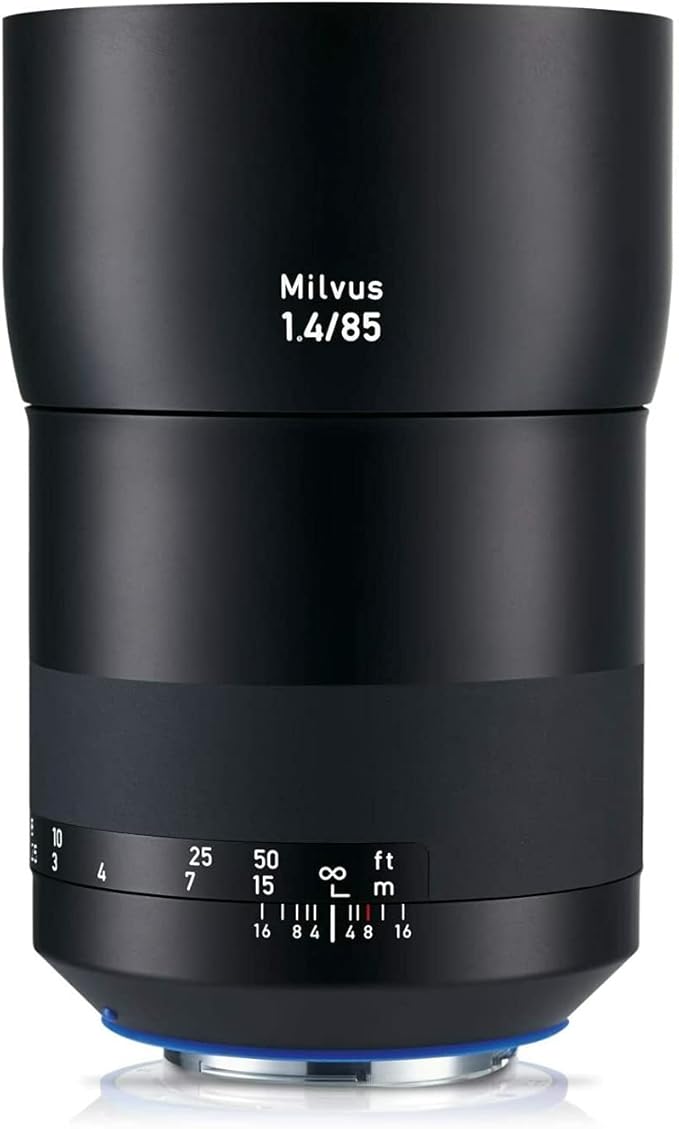
Zeiss Milvus 100mm f/2.0 Macro ZE Lens for Canon
Bridging the gap The ZEISS Milvus 2/100M of the type ZEISS Makro-Planar is currently the fastest 100 mm macro lens on the market and closes the gap between long range and breathtaking close-up shots. This lens bridges distances and allows unique image compositions. It is ideal when you need some distance between your camera and your subject, for example, during a portrait shoot. Its precise mechanical components with a large focus throw permit precise control, which is particularly important for macro photography in the close-up range.
Bridging the gap The ZEISS Milvus 2/100M of the type ZEISS Makro-Planar is currently the fastest 100 mm macro lens on the market and closes the gap between long range and breathtaking close-up shots. This lens bridges distances and allows unique image compositions. It is ideal when you need some distance between your camera and your subject, for example, during a portrait shoot. Its precise mechanical components with a large focus throw permit precise control, which is particularly important for macro photography in the close-up range.
Bridging the gap The ZEISS Milvus 2/100M of the type ZEISS Makro-Planar is currently the fastest 100 mm macro lens on the market and closes the gap between long range and breathtaking close-up shots. This lens bridges distances and allows unique image compositions. It is ideal when you need some distance between your camera and your subject, for example, during a portrait shoot. Its precise mechanical components with a large focus throw permit precise control, which is particularly important for macro photography in the close-up range.
Bridging the gap The ZEISS Milvus 2/100M of the type ZEISS Makro-Planar is currently the fastest 100 mm macro lens on the market and closes the gap between long range and breathtaking close-up shots. This lens bridges distances and allows unique image compositions. It is ideal when you need some distance between your camera and your subject, for example, during a portrait shoot. Its precise mechanical components with a large focus throw permit precise control, which is particularly important for macro photography in the close-up range.
in 4 offers
The lowest price for Zeiss Milvus 100mm f/2.0 Macro ZE Lens for Canon right now is $2,781.22 at Georges Cameras, compared across 4 retailers.
The all-time low was $625.52 on 30 May 2026 — today's price is 345% above the lowest ever. It has been notably cheaper before — worth setting a price alert.
Prices last updated 7 July 2026.
Last updated at 07/07/2026 03:58:02
ZEISS Milvus 100mm f/2 Full Frame Camera Lens for Canon EF-Mount ZE, Black
Affiliate Disclosure: We may receive a small commission for purchases made through this link at no extra cost to you. This helps support our site. Thank you!
Zeiss 100mm f/2 Milvus - Canon EF Mount
Delivery $9.90
ZEISS MILVUS 100mm f/2M ZE Macro Lens for Canon EF
Delivery $15
Zeiss Milvus 100mm f/2.0 Macro ZE Lens for Canon
Free delivery
originally posted on adorama.com
This is an excellent lens for portraiture. My clients and I have been very impressed with the results. It is obviously not for photographers requiring autofocus. It is surprisingly small and lightweight for a 100mm lens. It is extremely well-built with smooth, precise focusing. Color and contrast are excellent and it produces very sharp images. This has become my go-to lens for headshots and portraits. I pair it with a Nikon 60mm Micro when autofocus is needed. I can't say enough positive things about the Milvus 100mm Makro (Carl Zeiss made in Japan). If price and manual focus is not a deal-breaker, give it a try. You'll wonder why you waiting so long to get it.
originally posted on bhphotovideo.com
Zeiss Milvus 100mm Makro & Nikon D810 I began taking pictures in 1978 with a friend's camera. One of the things that I discovered early on was that his Contax RTS camera with Zeiss lenses looked as good or better than any 35mm camera system available at that time. It wasn't until I stepped up to the medium format Hasselblad with Zeiss lenses that I saw a big increase in output quality. By 2005 it became apparent that the film industry was being replaced by digital sensors and that Hasselblad did not have a reasonable digital back to replace film or to keep up with the advantages of digital 35mm cameras. I sold nearly 45K of Hasselblad and Sinar equipment in 2008 and went fully digital. I bought into the Canon system which over time included the 4Mp, (2) 8Mp, 16Mp, ... MoreZeiss Milvus 100mm Makro & Nikon D810 I began taking pictures in 1978 with a friend's camera. One of the things that I discovered early on was that his Contax RTS camera with Zeiss lenses looked as good or better than any 35mm camera system available at that time. It wasn't until I stepped up to the medium format Hasselblad with Zeiss lenses that I saw a big increase in output quality. By 2005 it became apparent that the film industry was being replaced by digital sensors and that Hasselblad did not have a reasonable digital back to replace film or to keep up with the advantages of digital 35mm cameras. I sold nearly 45K of Hasselblad and Sinar equipment in 2008 and went fully digital. I bought into the Canon system which over time included the 4Mp, (2) 8Mp, 16Mp, and finally the 21Mp camera bodies. The most discouraging discovery that became obvious when I purchased the 1DS Mark II was the fact that Canon's wide angle lenses could not produce a photo with sharp corners. My complaints to Chuck Westfall fell on deaf ears as his response, which was the second slap in the face, simply stated that the lenses were performing within spec. As of the fall of 2015, I sold all of my Canon equipment and have only missed the 1DS Mark III and 24mm TSE II lens which is an excellent lens. (Wake up Nikon ! you need to upgrade your PC lenses and add a super wide to your collection. At the very least offer a choice to buy the PC lenses already rotated in either direction without having to return a lens to the service department.) 2016 has become the year of the system rebuild. I am still spending many hours reading reviews and viewing samples, but my choice for a camera body was the Nikon D810. I was temped to stay with Canon when they brought out the 5DSR last year, but many respected equipment reviewers were discussing issues that I didn't want to deal with. These issues include, the more narrow dynamic range, the diffraction limited apertures, the lower acceptable ISO ranges, the need for a very obsessive compulsive shooting technique, and the postproduction requirements of the very large files. If I were going to deal with very large files, then I would rather use a medium format system. Using the Nikon was a strange experience at first. Lens attachment and removal felt bizarre. Button placement and menus have taken some time to get used to also. The warnings about needing a very good shot technique when doing technical work like architecture, macro and even landscapes should be heeded. I did find, however, that excellent results were generated when shooting two weddings with the D810. The lenses used were the Nikon 50mm f/1.4 G and 28mm f/2.8 AIS. They were hand-held at shutter speeds of 100 or higher. The large files allowed more than enough room for cropping to 8x10 at 300 dpi. I have not seen any moir with the D810 which was a concern mentioned in many of the reviews for the high mega pixel dslr cameras. The combination of the 36Mp sensor with the Zeiss 100mm Makro is the first camera and lens combination that feels like the Hasselblad-V experience. This, both in terms of the output quality of the image and the feel of the lens when focusing. My personal opinion, not necessarily a scientific one, is that the 36Mp size is the sweet spot for technical dslr work and the 21Mp range (like the Canon 1DS Mark III, 1DX Mark II, Leica SL, and the Nikon D5 full frame cameras) is the sweet spot for events, concerts, plays, operas, sports, weddings and even real estate. The speed of those cameras when shooting people-centric work outweighs the need for high mega pixel counts. Great expressions with less detail will out sell mediocre feelings with extreme detail any day of the week. More on the Zeiss 100mm Makro: The lens does display certain chromatic aberrations in certain specific situations, but then so do most lenses. No lens is perfect and even the Zeiss Otus receives a few complaints once in a while. I suspect that the higher the mega pixel count per square millimeter, the higher the probability of seeing more defects in a lens' performance. Conversely, when you get past the learning curve, the results from a very high quality lens like the 100mm Milvus really bring out the D810's full potential. One of the complaints levied against the 50mm and 100mm Makro lenses (both the Classic and Milvus versions) is that they are not true macro lenses. The reason for this false assertion is that these lenses only yield a 1:2 magnification ratio. A new urban legend has cropped up which states that only a lens that goes to 1:1 magnification is a true macro lens. Actually, while most macro lenses allow for close focusing, it is the design of the lens that defines the term macro. Macro lenses are flat field lenses and will reproduce flat objects totally sharp all the way out into the corners of the image. Hence they are great for copying old photos and artwork. As a matter of fact, I have already digitized some medium and large format negatives with the Zeiss Classic and Milvus makro lenses and the results were excellent. So excellent, that I sold the Nikon LS-8000-ED scanner. (On this topic: Remember too that the greater the magnification, the less depth of field you will have regardless of which lens you use. Put a 25mm wide angle lens on a 25mm extension tube and you will have 1:1 magnification, but you will not have a macro lens.) Another interesting complaint that I have read while searching these customer reviews and is one that I initially had too, was that the hard stop at infinity is slightly beyond infinity. I discovered this while shooting photos of the moon. The moon was sharp (and I got the camera's confirmation light on) when the focus was moved slightly back from the hard stop. When I took the time to go back and read the owners manual that came with the lens, Zeiss had already mentioned this. (Daah!) In conclusion, I am totally satisfied with the D810 and the Milvus 100mm lens. The shooting experience and the photographic results are the closest to my Hasselblad experience that I have come to since switching to all digital cameras. In fact, I must say that the detail rendered by this combination supersedes most of the Hasselblad's output, especially when I was shooting film at ASA's above 100. So there you have it: An obsessive compulsive type A personality who has lost a lot of money changing equipment is finally happy again!
originally posted on bhphotovideo.com
This is Milvus lens is used on a Nikon D850. After having used this lens for a month now I feel compelled to write this review. This is not so much about the technical aspect of this lens as anyone considering this lens most likely has studied the specifications. The manual focusing of this lens should not be a deterrent as the long focus throw is simply as precise as it gets. I use this lens on a tripod for slow and deliberate photography. It is very satisfying to slow down and compose and have control of the situation. The color rendering is stunning. I cannot say enough superlatives about the Milvus 100m F/2. Without hesitance I say this lens is special in a way that's hard to describe. Please see my samples below. Thank you.
| Focal length | 100 mm |
| Aperture range | f/2.0 – f/22 |
| Camera Mount | Canon EF-Mount* (ZE) | Nikon F-Mount* (ZF.2) |
| Format compatibility | Full Frame |
| Focusing range | 0,44 m (17.32") - ∞ |
ZEISS Milvus 100mm f/2 Full Frame Camera Lens for Canon EF-Mount ZE, Black
Affiliate Disclosure: We may receive a small commission for purchases made through this link at no extra cost to you. This helps support our site. Thank you!
Zeiss 100mm f/2 Milvus - Canon EF Mount
Delivery $9.90
ZEISS MILVUS 100mm f/2M ZE Macro Lens for Canon EF
Delivery $15
Zeiss Milvus 100mm f/2.0 Macro ZE Lens for Canon
Free delivery
This is an excellent lens for portraiture. My clients and I have been very impressed with the results. It is obviously not for photographers requiring autofocus. It is surprisingly small and lightweight for a 100mm lens. It is extremely well-built with smooth, precise focusing. Color and contrast are excellent and it produces very sharp images. This has become my go-to lens for headshots and portraits. I pair it with a Nikon 60mm Micro when autofocus is needed. I can't say enough positive things about the Milvus 100mm Makro (Carl Zeiss made in Japan). If price and manual focus is not a deal-breaker, give it a try. You'll wonder why you waiting so long to get it.
Zeiss Milvus 100mm Makro & Nikon D810 I began taking pictures in 1978 with a friend's camera. One of the things that I discovered early on was that his Contax RTS camera with Zeiss lenses looked as good or better than any 35mm camera system available at that time. It wasn't until I stepped up to the medium format Hasselblad with Zeiss lenses that I saw a big increase in output quality. By 2005 it became apparent that the film industry was being replaced by digital sensors and that Hasselblad did not have a reasonable digital back to replace film or to keep up with the advantages of digital 35mm cameras. I sold nearly 45K of Hasselblad and Sinar equipment in 2008 and went fully digital. I bought into the Canon system which over time included the 4Mp, (2) 8Mp, 16Mp, ... MoreZeiss Milvus 100mm Makro & Nikon D810 I began taking pictures in 1978 with a friend's camera. One of the things that I discovered early on was that his Contax RTS camera with Zeiss lenses looked as good or better than any 35mm camera system available at that time. It wasn't until I stepped up to the medium format Hasselblad with Zeiss lenses that I saw a big increase in output quality. By 2005 it became apparent that the film industry was being replaced by digital sensors and that Hasselblad did not have a reasonable digital back to replace film or to keep up with the advantages of digital 35mm cameras. I sold nearly 45K of Hasselblad and Sinar equipment in 2008 and went fully digital. I bought into the Canon system which over time included the 4Mp, (2) 8Mp, 16Mp, and finally the 21Mp camera bodies. The most discouraging discovery that became obvious when I purchased the 1DS Mark II was the fact that Canon's wide angle lenses could not produce a photo with sharp corners. My complaints to Chuck Westfall fell on deaf ears as his response, which was the second slap in the face, simply stated that the lenses were performing within spec. As of the fall of 2015, I sold all of my Canon equipment and have only missed the 1DS Mark III and 24mm TSE II lens which is an excellent lens. (Wake up Nikon ! you need to upgrade your PC lenses and add a super wide to your collection. At the very least offer a choice to buy the PC lenses already rotated in either direction without having to return a lens to the service department.) 2016 has become the year of the system rebuild. I am still spending many hours reading reviews and viewing samples, but my choice for a camera body was the Nikon D810. I was temped to stay with Canon when they brought out the 5DSR last year, but many respected equipment reviewers were discussing issues that I didn't want to deal with. These issues include, the more narrow dynamic range, the diffraction limited apertures, the lower acceptable ISO ranges, the need for a very obsessive compulsive shooting technique, and the postproduction requirements of the very large files. If I were going to deal with very large files, then I would rather use a medium format system. Using the Nikon was a strange experience at first. Lens attachment and removal felt bizarre. Button placement and menus have taken some time to get used to also. The warnings about needing a very good shot technique when doing technical work like architecture, macro and even landscapes should be heeded. I did find, however, that excellent results were generated when shooting two weddings with the D810. The lenses used were the Nikon 50mm f/1.4 G and 28mm f/2.8 AIS. They were hand-held at shutter speeds of 100 or higher. The large files allowed more than enough room for cropping to 8x10 at 300 dpi. I have not seen any moir with the D810 which was a concern mentioned in many of the reviews for the high mega pixel dslr cameras. The combination of the 36Mp sensor with the Zeiss 100mm Makro is the first camera and lens combination that feels like the Hasselblad-V experience. This, both in terms of the output quality of the image and the feel of the lens when focusing. My personal opinion, not necessarily a scientific one, is that the 36Mp size is the sweet spot for technical dslr work and the 21Mp range (like the Canon 1DS Mark III, 1DX Mark II, Leica SL, and the Nikon D5 full frame cameras) is the sweet spot for events, concerts, plays, operas, sports, weddings and even real estate. The speed of those cameras when shooting people-centric work outweighs the need for high mega pixel counts. Great expressions with less detail will out sell mediocre feelings with extreme detail any day of the week. More on the Zeiss 100mm Makro: The lens does display certain chromatic aberrations in certain specific situations, but then so do most lenses. No lens is perfect and even the Zeiss Otus receives a few complaints once in a while. I suspect that the higher the mega pixel count per square millimeter, the higher the probability of seeing more defects in a lens' performance. Conversely, when you get past the learning curve, the results from a very high quality lens like the 100mm Milvus really bring out the D810's full potential. One of the complaints levied against the 50mm and 100mm Makro lenses (both the Classic and Milvus versions) is that they are not true macro lenses. The reason for this false assertion is that these lenses only yield a 1:2 magnification ratio. A new urban legend has cropped up which states that only a lens that goes to 1:1 magnification is a true macro lens. Actually, while most macro lenses allow for close focusing, it is the design of the lens that defines the term macro. Macro lenses are flat field lenses and will reproduce flat objects totally sharp all the way out into the corners of the image. Hence they are great for copying old photos and artwork. As a matter of fact, I have already digitized some medium and large format negatives with the Zeiss Classic and Milvus makro lenses and the results were excellent. So excellent, that I sold the Nikon LS-8000-ED scanner. (On this topic: Remember too that the greater the magnification, the less depth of field you will have regardless of which lens you use. Put a 25mm wide angle lens on a 25mm extension tube and you will have 1:1 magnification, but you will not have a macro lens.) Another interesting complaint that I have read while searching these customer reviews and is one that I initially had too, was that the hard stop at infinity is slightly beyond infinity. I discovered this while shooting photos of the moon. The moon was sharp (and I got the camera's confirmation light on) when the focus was moved slightly back from the hard stop. When I took the time to go back and read the owners manual that came with the lens, Zeiss had already mentioned this. (Daah!) In conclusion, I am totally satisfied with the D810 and the Milvus 100mm lens. The shooting experience and the photographic results are the closest to my Hasselblad experience that I have come to since switching to all digital cameras. In fact, I must say that the detail rendered by this combination supersedes most of the Hasselblad's output, especially when I was shooting film at ASA's above 100. So there you have it: An obsessive compulsive type A personality who has lost a lot of money changing equipment is finally happy again!
This is Milvus lens is used on a Nikon D850. After having used this lens for a month now I feel compelled to write this review. This is not so much about the technical aspect of this lens as anyone considering this lens most likely has studied the specifications. The manual focusing of this lens should not be a deterrent as the long focus throw is simply as precise as it gets. I use this lens on a tripod for slow and deliberate photography. It is very satisfying to slow down and compose and have control of the situation. The color rendering is stunning. I cannot say enough superlatives about the Milvus 100m F/2. Without hesitance I say this lens is special in a way that's hard to describe. Please see my samples below. Thank you.
I choose 5 stars since there are not 6 on the scale. Yes, I would buy this again, even if it were more expensive. However, this review factors out the $$$ element since that is a matter of individual price-point tolerance and to me, while I can’t afford luxuries, the look is worth the $$$ and I can’t put any price on one-time right-light imagery. I’m using mine adapted on a Sony a7R3. Out of the box I install a Zeiss UV0 filter where it stays permanently.First off the negatives. If you haven’t already done so, stop reading this babble and go spend time with others’ experiences online. Ididn’t do that and found out after the fact that others said some of what I noticed firstly. To appreciate this lens perhaps you might rent one for a while to understand its true ... MoreI choose 5 stars since there are not 6 on the scale. Yes, I would buy this again, even if it were more expensive. However, this review factors out the $$$ element since that is a matter of individual price-point tolerance and to me, while I can’t afford luxuries, the look is worth the $$$ and I can’t put any price on one-time right-light imagery. I’m using mine adapted on a Sony a7R3. Out of the box I install a Zeiss UV0 filter where it stays permanently.First off the negatives. If you haven’t already done so, stop reading this babble and go spend time with others’ experiences online. Ididn’t do that and found out after the fact that others said some of what I noticed firstly. To appreciate this lens perhaps you might rent one for a while to understand its true place for you. I bought it because I already had the 2/50mm M Milvus and already loved that figuring this would be the same but with greater mag. I looked at Zeiss spec. charts but those don’t talk about real world fit. In many ways it is the same. But not…To repeat what has been largely said, this is indeed a limited application “niche” lens. You will fall in love with it and want to dump all others and sleep with it. You will also hate it to the point of destruction by explosion and cuss words. Get ready to face that IT will own YOU. First days experiences were not good by not understanding the true nature of the lens and its design. Insanepaper-thin DoF/focus zone at close distances ~2-4 feet @f2 - f4. That is typical macro experience anyway but here it is even thinner because the lens sharpness shows you just what focus is and isn’t when you get it off the camera. Forget life without a heavy tripod. Handheld at shutter speeds 1/250 on a 43MP camera simply wastes time and electrons. Even with IBIS enabled the resolutionof this lens is so fine that what you are used to handheld won’t typically work unless you want motion blur or like amping up your ISO. Not bad for me as I’m usually at ISO50-100 on a tripod or in bright sun for casual handhelds. This is not an APO lens so CA is high under expected circumstances. Typical purple and green fringed edges (fame center and fame boundaries are the same) under shotcircumstances where v-dark meets highlights. It minimizes fairly well starting at ~f3.5. This can be fixed in post-processing if needed. This lens is not suited for spontaneous or action work. The near 360 rotation focus throw between min. and infinity is perfect for stationary subjects. Not so for much else. You’ll miss action events since it takes so much time to move great distances for fast focus. Unless you are large distances away to minimize focus efforts for moving subjects, forget about races, kid play, pets, sports, dragonflys, meteorites, etc. Motionless show cars, tabletops, flower buds, portraits, landscape, etc = good choices.Neutral comments. Well-knowns that matter not to me but youmight care. It delivers 1:2 not 1:1 macro. I prefer the 1:2 visual limit. Ihaven’t tried extension tubes to go closer (and don’t want to since 1:2 is good for my needs). Manual-focus and aperture (Nikon mount version). Yes, that is exactly the features I want. I’m old-timer not an AF nut. I want control not speed. The aperture control locks at f22 when in default click stop mode. That is done for some cinema use. Annoying to have to button unlock it if going that far but I don’t care since I’m a still shooter and never stop down to f22. The aperturering could be a little wider for easier reach around from behind control. Note that the Milvus 50M does that too. It is not a partly internal focusing design like the Milvus 50M is so it nearly doubles in length at full extension to closest focus. Heavy. Ok with me. I use a tripod anyway and want that stability weight at the lens. It’s better if you are using it adapted to use a mount with a tripod foot. That shifts a lot of the strain weight away from the camera socketsimilar to using giant zoom and to give better balance.Some positives. Image quality: 5+. It’s beautiful. The classic “Zeiss look”. Sharpness: 5. It can be so sharp at times that you’ll want todial down contrast, or structure, or saturation in post processing. “Bokeh”: 5+. Beyond beautiful. At wide apertures the, painterly, impressionistic, smooth melded background look their designs are famous for come naturally. Build quality (form, fit, finish, and materials): 5. This is a finely crafted precision machine. Focusshift: 5. There is none! I tested it extensively by pixel peeping RAWs at each full f/stop and only see DoF growth not a shifted primary focus point at different apertures. Focus throw: 5. Very very very very long, precision, well-damped and smooth – great for stationary subjects. Handling: 4. It improves after adding a Zeiss lens gear for better focus grip handling.In my opinion everything in photography is a compromise. The images from Zeiss (this and other models) are stunning. I suspect that is largely because the flaws and limitations in a design are at least partly responsible for furthering its excellence and uniqueness. In other words; look closely at results. See how Zeiss seems to “leave it alone” to capture the quality in the look it is famous for. I guess that instead of throwing so much modernized correction and materials at theirs like everyone else does, their classic designs avoid the lifeless, sterile, flat, more just whatevers a lot of other lenses look like today. If you let the lens own you (as it will – just learn to happily get along with it) then you will be rewarded :) If you ask me, that makes the price irrelevant. You can’t buy this look otherwise.My comments here are of course subjective. I’m just sharing what I think, not arguing what you think.
No need to write a long technical review for this lens as their are many that are easy to find. Everyone touts the macro and even portrait capabilities of this lens but I did not find much out there about the use of the lens as a short telephoto for Landscape photography. I use this lens with my Nikon D850 and it is the first lens that I have purchased that keeps up with the Cameras high resolution digital performance. It’s sad that other lens makers aren’t keeping up here. This is a truly amazing Sharp, high resolution lens, Excellent in all respects. Thank you Zeiss!
I am impressed with the professional service that Lens Rentals provides. I had no dificulty navigating through the process to order and throughout the entire experience communications guided me and reminded me to assure the process was easy. The product arrived on time and very well packaged and included the material needed to complete the rental and return the product. I was able to accomplish evaluating the lens against other of the same lens I owned to guide my decision regarding added this lens to my collection. I decided not to add it, not due to the quality of the lens but because the lens I have (Milvus 855mm, Milvus 135mm) were very close to this one and I decided to pass on this one. I look forward to my next Lensrentals experience.
I thank all those good reviews in helping me to make the dive in buying this Zeiss 100mm 7 months.Don't spend your money on it if you are pressing for time or you need a lens to take fast action shots because until you master the manual focusing skills on using manual lenses, regardless which brand, you need that fast focusing ability of modern lenses to capture your action shots!Buy it only if you can afford the time to focus it right by using the focusing aid on you live view or screen. Focus confirmation on the camera helps a lot but it is not very accurate in all cases.The contrast and colors this lens and a few other of the Zeiss lenses that I have also used produced can bring out ordinary scenes amazing results that my other L lenses can't. You can ... MoreI thank all those good reviews in helping me to make the dive in buying this Zeiss 100mm 7 months.Don't spend your money on it if you are pressing for time or you need a lens to take fast action shots because until you master the manual focusing skills on using manual lenses, regardless which brand, you need that fast focusing ability of modern lenses to capture your action shots!Buy it only if you can afford the time to focus it right by using the focusing aid on you live view or screen. Focus confirmation on the camera helps a lot but it is not very accurate in all cases.The contrast and colors this lens and a few other of the Zeiss lenses that I have also used produced can bring out ordinary scenes amazing results that my other L lenses can't. You can easily search online videos and images on the quality of the Zeiss lenses.Buy it only you have already have other normal and decent quality auto focus lenses because only then you will realize what you have missed.There is no bad things about this lenses other than it is it is not light. I use it with a tripod about 85% of the time. I don't remember how heavy was the then new Leitz 90mm tele Elmarit I used in the 60's but I think this 100mm is heavier and bulkier than the 90mm.The end result of any thing you take with this lens as compare to your normally use auto focus modern lenses, it out shines them all easily. I like the natural colors, brilliant contrast and fine details this 100mm recorded on my shots.I like to give a thought to those who like to take close up pictures of insects and anything that is small and moving, in the Canon line, the Canon 180mm L is a must have lens, as least it is to me for years! The 180mm is one of the sharpest lenses money can buy in that focal range.Enjoy your shopping!
I was in the market for a new portrait lens with macro capability and was considering the Nikon 105mm f/2.8 after reading all of the glowing reviews for that lens but I was also seeing rave reviews for the Zeiss 100mm ZF.2 lens as well so I decided to rent the Zeiss and give a try. To make a long story short, I was blown away by the IQ, color and bokeh. It seems all of the rave reviews were spot on and I turned right around and purchased the Zeiss lens. Prior to using the Zeiss I had yet to find a lens that could match the resolving power of my D800's FX sensor. My Nikon 24-70mm f/2.8 and 16-35mm f/4 zooms are great lenses that produce good sharpness, color, contrast and bokeh but the Zeiss 100mm f/2 is simply in a league of its own. If you own a D800, D3x or D600 ... MoreI was in the market for a new portrait lens with macro capability and was considering the Nikon 105mm f/2.8 after reading all of the glowing reviews for that lens but I was also seeing rave reviews for the Zeiss 100mm ZF.2 lens as well so I decided to rent the Zeiss and give a try. To make a long story short, I was blown away by the IQ, color and bokeh. It seems all of the rave reviews were spot on and I turned right around and purchased the Zeiss lens. Prior to using the Zeiss I had yet to find a lens that could match the resolving power of my D800's FX sensor. My Nikon 24-70mm f/2.8 and 16-35mm f/4 zooms are great lenses that produce good sharpness, color, contrast and bokeh but the Zeiss 100mm f/2 is simply in a league of its own. If you own a D800, D3x or D600 you owe it to yourself to try this lens or any of the other Zeiss ZF.2 lenses. The proof for me was zooming in 100% on a properly focused .nef file. I've never seen this level of detail and sharpness even with my good Nikon glass. There is so much detail that it has a 3D look to it. In addition, I don't think you can get bad bokeh with this lens and if you shoot in the Adobe RBG color space like I do then you can expect some really nice color and contrast. The combination of outstanding bokeh and color will, in many cases, render a just OK image into a special image with a special character. Some folks may be put off by the manual focus requirement but that is not an issue for me when doing close-up or macro work. I have to work a little harder with this lens but it has provided me with images that I simply could not get with my best Nikon glass. There may be some fixed focal length Nikon/Canon lenses out there that are as good but I suspect there are not many that would surpass this lens. The build quality is outstanding and the focus ring is precise in a way my Nikons are not. Of course results may vary. I captured most of my samples on a tripod with the mirror locked up which is necessary for best results as most D800 users know. I also captured a series of hand-held portrait and landscape images and was very pleased with the results although this lens will not replace my good Nikon glass with AF and VR for obvious reasons. I will however being trying out the Zeiss 25mm f/2 to see how that works for critical landscapes and suspect that lens may outperform my Nikon glass as well at that focal length. The D800 sensor requires that the photographer use proper technique and is not suitable for all shooting situations. It has also been said many times that in order to realize the potential resolution from 24MP and 36MP FX sensors you need to put good glass in front of them and IMHO the Zeiss ZF.2 series lenses are that glass.
I have to admit that I am a big fan of Zeiss glass since the days back to Hasselblad V or Contax lenses. This Milvus lens replaced its ZF Classic predecessor in my arsenal and topped it optically and regarding weather resistance. The mechanics is awesome, nice touch and very smooth operation. Besides using it in Nikon bodies I am using it on an ALPA 12 FPS camera with a Hasselblad digital back attached. Its image circle is big enough to illuminate even the small medium format sensor (44mm x 33mm). Be it macro application, portraits or landscape captures, this lens lens delivers!
Using this extremely sharp lens exclusively for macro, focus stacking and water drop photography. 100% satisfaction. Worth the high price tag? ABSOLUTELY!!!!!
| Focal length | 100 mm |
| Aperture range | f/2.0 – f/22 |
| Camera Mount | Canon EF-Mount* (ZE) | Nikon F-Mount* (ZF.2) |
| Format compatibility | Full Frame |
| Focusing range | 0,44 m (17.32") - ∞ |