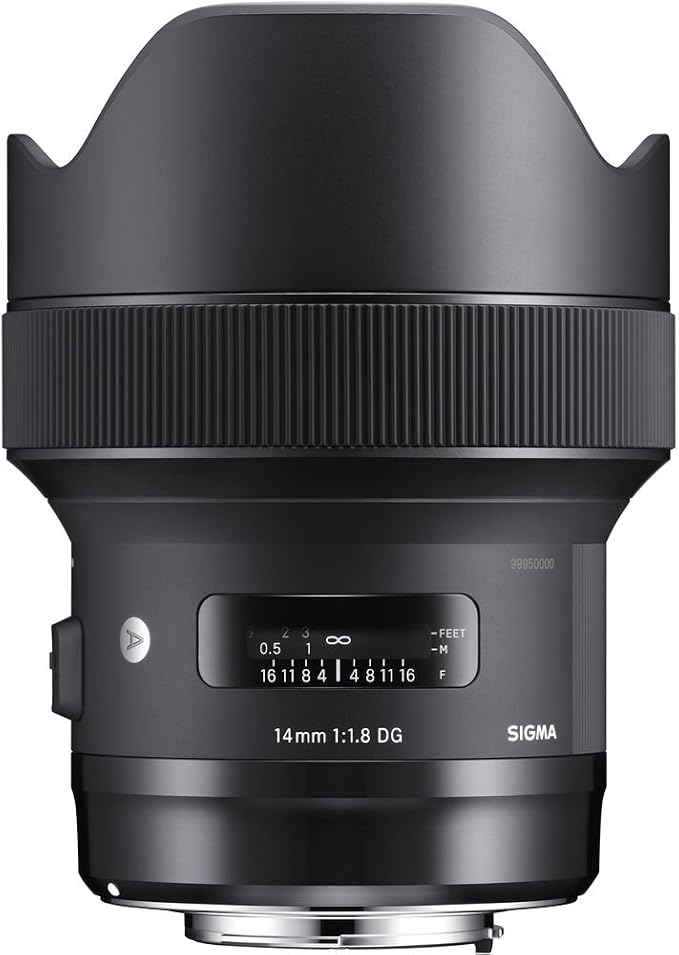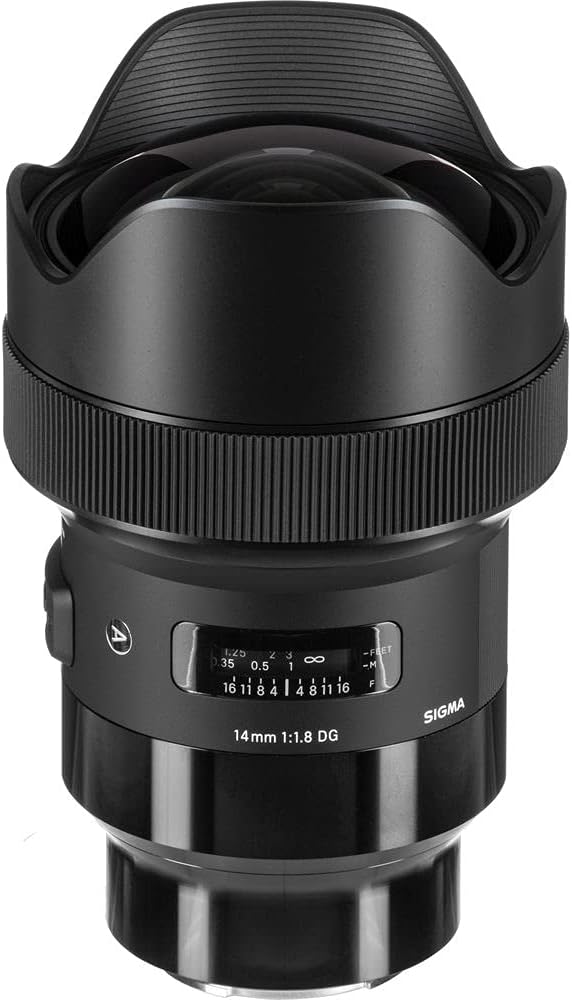
Sigma 14mm f/1.8 DG HSM Art Lens - Sony E-Mount
When taking photographing starry skies or other night-time celestial scenes, or the seashore with a wide perspective, a large-diameter lens is a strong ally. It allows the capture of a moving subject by adjusting shutter speed without relying on ISO sensitivity. With full-frame 35mm coverage, 14mm ultra-wide angle focal length, f/2 barrier-breaking f/1.8 aperture, the Sigma 14mm f/1.8 DG HSM Art is the high-speed, ultra-wide-angle lens photographers have been waiting for. Although some zoom lenses are available that can cover 14mm, the large diameter delivering f/1.8 brightness is a singular advantage. Going beyond fast shutter speed, this lens can capture a swarm of fireflies with crystal clarity, a beautiful bokeh effect, and outstanding control of light streaking. Art Lens Engineered for those who see photography as a critical expression of self, Sigma's Art line offers sophisticated optical performance and abundant expressive power to deliver faithfully on your artistic vision. DG for Digital Designed to deliver the ultimate in performance on full-frame digital SLRs, Sigma DG lenses also bring out the best in 35mm SLR film cameras and APS-C size DLSRs. Aspherical Lens Elements (ASP) The aspherical lens complex allows freedom of design, improved performance, a reduced number of component lenses and a compact size. Hyper Sonic Motor Focusing (HSM) HSM lenses employ a motor powered by ultrasonic waves that produce a quiet, yet high-speed AutoFocus. You can enjoy high performance with low noise in a variety of shooting situations. Inner Focus (IF) To ensure stability in focusing, this lens moves the inner lens group(s) without changing the lens' physical length. 14mm Ultra-Wide-Angle and f/1.8 Brightness By leveraging its extreme angle of view and the dramatic perspective this creates, an ultra-wide-angle lens can get up close and personal with a subject while at the same time taking in a vast background-an example of photography going beyond normal human vision.
When taking photographing starry skies or other night-time celestial scenes, or the seashore with a wide perspective, a large-diameter lens is a strong ally. It allows the capture of a moving subject by adjusting shutter speed without relying on ISO sensitivity. With full-frame 35mm coverage, 14mm ultra-wide angle focal length, f/2 barrier-breaking f/1.8 aperture, the Sigma 14mm f/1.8 DG HSM Art is the high-speed, ultra-wide-angle lens photographers have been waiting for. Although some zoom lenses are available that can cover 14mm, the large diameter delivering f/1.8 brightness is a singular advantage. Going beyond fast shutter speed, this lens can capture a swarm of fireflies with crystal clarity, a beautiful bokeh effect, and outstanding control of light streaking. Art Lens Engineered for those who see photography as a critical expression of self, Sigma's Art line offers sophisticated optical performance and abundant expressive power to deliver faithfully on your artistic vision. DG for Digital Designed to deliver the ultimate in performance on full-frame digital SLRs, Sigma DG lenses also bring out the best in 35mm SLR film cameras and APS-C size DLSRs. Aspherical Lens Elements (ASP) The aspherical lens complex allows freedom of design, improved performance, a reduced number of component lenses and a compact size. Hyper Sonic Motor Focusing (HSM) HSM lenses employ a motor powered by ultrasonic waves that produce a quiet, yet high-speed AutoFocus. You can enjoy high performance with low noise in a variety of shooting situations. Inner Focus (IF) To ensure stability in focusing, this lens moves the inner lens group(s) without changing the lens' physical length. 14mm Ultra-Wide-Angle and f/1.8 Brightness By leveraging its extreme angle of view and the dramatic perspective this creates, an ultra-wide-angle lens can get up close and personal with a subject while at the same time taking in a vast background-an example of photography going beyond normal human vision.
When taking photographing starry skies or other night-time celestial scenes, or the seashore with a wide perspective, a large-diameter lens is a strong ally. It allows the capture of a moving subject by adjusting shutter speed without relying on ISO sensitivity. With full-frame 35mm coverage, 14mm ultra-wide angle focal length, f/2 barrier-breaking f/1.8 aperture, the Sigma 14mm f/1.8 DG HSM Art is the high-speed, ultra-wide-angle lens photographers have been waiting for. Although some zoom lenses are available that can cover 14mm, the large diameter delivering f/1.8 brightness is a singular advantage. Going beyond fast shutter speed, this lens can capture a swarm of fireflies with crystal clarity, a beautiful bokeh effect, and outstanding control of light streaking. Art Lens Engineered for those who see photography as a critical expression of self, Sigma's Art line offers sophisticated optical performance and abundant expressive power to deliver faithfully on your artistic vision. DG for Digital Designed to deliver the ultimate in performance on full-frame digital SLRs, Sigma DG lenses also bring out the best in 35mm SLR film cameras and APS-C size DLSRs. Aspherical Lens Elements (ASP) The aspherical lens complex allows freedom of design, improved performance, a reduced number of component lenses and a compact size. Hyper Sonic Motor Focusing (HSM) HSM lenses employ a motor powered by ultrasonic waves that produce a quiet, yet high-speed AutoFocus. You can enjoy high performance with low noise in a variety of shooting situations. Inner Focus (IF) To ensure stability in focusing, this lens moves the inner lens group(s) without changing the lens' physical length. 14mm Ultra-Wide-Angle and f/1.8 Brightness By leveraging its extreme angle of view and the dramatic perspective this creates, an ultra-wide-angle lens can get up close and personal with a subject while at the same time taking in a vast background-an example of photography going beyond normal human vision.
When taking photographing starry skies or other night-time celestial scenes, or the seashore with a wide perspective, a large-diameter lens is a strong ally. It allows the capture of a moving subject by adjusting shutter speed without relying on ISO sensitivity. With full-frame 35mm coverage, 14mm ultra-wide angle focal length, f/2 barrier-breaking f/1.8 aperture, the Sigma 14mm f/1.8 DG HSM Art is the high-speed, ultra-wide-angle lens photographers have been waiting for. Although some zoom lenses are available that can cover 14mm, the large diameter delivering f/1.8 brightness is a singular advantage. Going beyond fast shutter speed, this lens can capture a swarm of fireflies with crystal clarity, a beautiful bokeh effect, and outstanding control of light streaking. Art Lens Engineered for those who see photography as a critical expression of self, Sigma's Art line offers sophisticated optical performance and abundant expressive power to deliver faithfully on your artistic vision. DG for Digital Designed to deliver the ultimate in performance on full-frame digital SLRs, Sigma DG lenses also bring out the best in 35mm SLR film cameras and APS-C size DLSRs. Aspherical Lens Elements (ASP) The aspherical lens complex allows freedom of design, improved performance, a reduced number of component lenses and a compact size. Hyper Sonic Motor Focusing (HSM) HSM lenses employ a motor powered by ultrasonic waves that produce a quiet, yet high-speed AutoFocus. You can enjoy high performance with low noise in a variety of shooting situations. Inner Focus (IF) To ensure stability in focusing, this lens moves the inner lens group(s) without changing the lens' physical length. 14mm Ultra-Wide-Angle and f/1.8 Brightness By leveraging its extreme angle of view and the dramatic perspective this creates, an ultra-wide-angle lens can get up close and personal with a subject while at the same time taking in a vast background-an example of photography going beyond normal human vision.
in 50 offers
The lowest price for Sigma 14mm f/1.8 DG HSM Art Lens - Sony E-Mount right now is $1,000.00 at eBay.com.au, compared across 37 retailers.
The all-time low was $755.56 on 7 May 2026 — today's price is 32% above the lowest ever. It has been notably cheaper before — worth setting a price alert.
Prices last updated 30 Sept 2026.
Last updated at 30/09/2026 05:34:06
Sigma 4450965 14mm f/1.8 DG HSM Art for Sony (E-Mount), Black
Affiliate Disclosure: We may receive a small commission for purchases made through this link at no extra cost to you. This helps support our site. Thank you!
Sigma 4450954 14mm f/1.8 DG HSM Art for Canon, Black
Affiliate Disclosure: We may receive a small commission for purchases made through this link at no extra cost to you. This helps support our site. Thank you!
Sigma 14mm F1.8 Dg Hsm Art Lens - Sony Fe
Free delivery
Affiliate Disclosure: We may receive a small commission for purchases made through this link at no extra cost to you. This helps support our site. Thank you!
Sigma 14mm F/1.8 Dg Hsm Art Lens For Sony E-mount (4450965)
Delivery $5
Affiliate Disclosure: We may receive a small commission for purchases made through this link at no extra cost to you. This helps support our site. Thank you!
Sigma 14mm F/1.8 Dg Hsm Art Lens For Sony E
Free delivery
Affiliate Disclosure: We may receive a small commission for purchases made through this link at no extra cost to you. This helps support our site. Thank you!
Sigma 14mm F1.8 Dg Hsm Art Lens - Sony Fe
Free delivery
Affiliate Disclosure: We may receive a small commission for purchases made through this link at no extra cost to you. This helps support our site. Thank you!
Sigma 14mm F1.8 Dg Hsm Art Lens - Sony Fe
Free delivery
Affiliate Disclosure: We may receive a small commission for purchases made through this link at no extra cost to you. This helps support our site. Thank you!
Sigma 14mm f/1.8 DG HSM Art Lens for Sony E
Affiliate Disclosure: We may receive a small commission for purchases made through this link at no extra cost to you. This helps support our site. Thank you!
Sigma 14mm f/1.8 DG HSM Art for Sony E-Mount **
Free delivery between 6–12 Oct
Sigma 14mm f/1.8 DG HSM Art for Sony E-Mount **
Free delivery between 1–14 Oct
originally posted on bhphotovideo.com
Test Images:Two pane image is comparison of corners at 200% zoom for Samyang 14mm SP F2.4 on left vs. Sigma Art 14mm F1.8 on right, both at ISO 3200 and 15 seconds. Note how sharp the Samyang is and perfect its stars are. The sigma produces much less noise in the same exposure time, or can shoot for a bit less than half the time for equivalent results. Denoise applied to each image, basic exposure matching in post.Both 3 pane images have Samyang 14mm SP F2.4 on left, Sigma in the center, and Tamron 15-30mm F2.8 right. All exposures were 15 seconds taken as wide open as each lens will get, at ISO 3200. Exposures matched in post, with denoise applied. Note the Sigma 14mm F1.8 pulls much more light and detail in the same exposure time and has much better noise. The ... MoreTest Images:Two pane image is comparison of corners at 200% zoom for Samyang 14mm SP F2.4 on left vs. Sigma Art 14mm F1.8 on right, both at ISO 3200 and 15 seconds. Note how sharp the Samyang is and perfect its stars are. The sigma produces much less noise in the same exposure time, or can shoot for a bit less than half the time for equivalent results. Denoise applied to each image, basic exposure matching in post.Both 3 pane images have Samyang 14mm SP F2.4 on left, Sigma in the center, and Tamron 15-30mm F2.8 right. All exposures were 15 seconds taken as wide open as each lens will get, at ISO 3200. Exposures matched in post, with denoise applied. Note the Sigma 14mm F1.8 pulls much more light and detail in the same exposure time and has much better noise. The main flaw is the coma in the corners. At 4K, especially if cropped 16:9, this will be not much of an issue. On a large monitor (65) I can notice the stars seems slightly fatter, but the zooms here are all at 200%. For timelapse, this coma will not be that noticeable, but the noise will. See the full frame image for a non zoomed look at the stars.This lens is heavy, and expensive. Obviously you need a good reason to choose it over similar 14mm options, or slightly less wide options of which there are many. For most of us the need for this lens is about being ultra wide and very fast at F1.8, and also sharp wide open. For my particular use I apply this lens for astrophotography and low light time lapse and video. For cases where F2.8 is good enough, I would suggest alternatives.To be quite clear, the coma of this Sigma Art lens is not greatly controlled from mid to extreme corners, so if perfect stars are an issue for you or you do big crops in on corners, there are better choices that save weight and money. The Samyang 14mm SP F2.4 (the latest version with low distortion) for example is about a stop slower, has worse vignette, but is sharper corner to corner than this Sigma wide open (if you get a good copy). The Samyang at about half the price and weight has almost perfect coma control to the far corners and very similar distortion performance. So, if you can stack exposures to deal with noise, better star results will come from that lens than this Sigma.However, if you need an ultrawide lens for single exposures or video that gathers as much light as possible, or you need to cut exposure times, or lower noise, etc. than you cannot beat the speed of this Sigma 14mm F1.8. The reduction in noise by this lens on star fields and other shadow areas is dramatic, as the nearest peer lenses are all 1.5-2.5 stops darker in the corners, and 1-1.5 stops worse in the center. Even on new sensors, if you are already at 3200 or 6400, being able to drop down 1-2 stops cleans up a lot of detail for timelapse.The build quality is good, and the lens copy was reliable on the first try, so I imagine this lens will not give me trouble beyond the cost and weight.For my use, this will be a valuable addition to the tool box and perhaps the best available on Canon. Sadly, Canon are not playing nice with the RF mount, as I suspect an RF version of this would be able to improve coma or speed or both slightly. For wide low light, this lens paired with the Samyang 24mm 1.4 is about the best combo possible as of 9/22 for Canon. Since the coma performance sis poor, I will hang onto my Samyang 14mm SP F2.4 for a while and use it on my second camera or for stills I can stack when needed, or when weight is an issue.For those who can deal with an FOV of 20mm, the lighter and newer Art lens is said to have great coma performance and might be a better purchase for Sony E and Nikon mounts (not available for other mounts yet).
originally posted on bhphotovideo.com
The Sigma 14mm f1.8 Art is an outstanding lens, sharp and well built. I also own the 20mm f1.4 and 24mm f1.4 Art lenses. From my experience you absolutely must have the Sigma USB Dock. None of these 3 lenses focused properly out of the box with the 20mm being the worst of the three. And you really do need a focusing target like LensAlign or something similar. From my experience, Sigma Art lenses really aren’t calibrated to any standard so it’s important to use Sigma’s optimization software and calibrate your new lens at each of the distances shown in the software. Making adjustments at infinity is the hardest part. I found a distant object outside that had enough detail, so I could check the sharpness. But without a focus scale I found manually adjusting the focus ... MoreThe Sigma 14mm f1.8 Art is an outstanding lens, sharp and well built. I also own the 20mm f1.4 and 24mm f1.4 Art lenses. From my experience you absolutely must have the Sigma USB Dock. None of these 3 lenses focused properly out of the box with the 20mm being the worst of the three. And you really do need a focusing target like LensAlign or something similar. From my experience, Sigma Art lenses really aren’t calibrated to any standard so it’s important to use Sigma’s optimization software and calibrate your new lens at each of the distances shown in the software. Making adjustments at infinity is the hardest part. I found a distant object outside that had enough detail, so I could check the sharpness. But without a focus scale I found manually adjusting the focus as I looked through the viewfinder helped me determine if the lens was front or back focusing. This may seem like a lot of work, but I’ve found that once calibrated, those settings transfer to other Nikon bodies. Once adjusted on one camera body using the USB dock, I can use the lens on other Nikon bodies. However, with each new body it’s still important to use AF fine-tune to tweak the focus for that body. AF fine-Tune may be more important with these lenses due to their shallower depth of field.My main reason for purchasing these fast prims is for star shots, the advantage being the 2 or almost 2 extra stops of light. I can shoot at much lower ISO resulting in much less noise, no more star stacking to reduce noise. Previously, I’ve been using Nikon’s 14-24mm f2.8 and while it’s surprisingly sharp even compared to the sigma primes, f2.8 is too slow for astrophotography.So, what’s not to like? First you must calibrate the lens yourself. From all the testing I did, I also found the Sigma lenses don’t focus as consistently as the Nikon’s do. I could see this visually in the series of tests shots I took, and it was even more obvious when I used FocusTune software in conjunction with the LensAlign target. When FocusTune analyzes a series of shots, it produces a plot of the variation within the test group. In many of the Sigma test there was an inexplicable outlier or wild way out of focus shot. Even at their best the Sigma lenses had larger groups than the Nikon lenses. Where focus is critical, I often double check using manual focus, an extra step I don’t do with Nikon lenses.Weather sealing isn’t great either. Of the three lenses I own, only the 14mm f1.8 has a gasket on the flange and all were purchased since July 2017. I also discovered during a trip to the southwest, that a small grain of sand found its way into the focusing ring of the 20mm f1.4. I could feel the roughness when I turned the focus ring. Fortunately, I could see the tiny piece of grit and I was able to remove it with a brush and compressed air. In terms of astrophotography, I can’t say the 14 and 20 have reduced coma relative to other lenses like the Nikon 14-24mm. Stars in the corners develop some interesting shapes particularly in the 20mm, but I kind of like them since there shape reminds me of alien space craft. FX Corners on both the 14mm & 20mm when shot wide open are decidedly soft and don’t really become sharp until f8 or even f11 at the expense of reduced center sharpness. Also, at those f-stops you begin to encounter diffraction limitations.These are great lenses but if you don’t need a fast prime or you’re on a budget, the Nikon 14-24mm is still a very good lens. Sigma has also announced a new 14-24mm f2.8 Art lens that looks very promising.
originally posted on lensrentals.com
This lens is way bigger than I imagined, but it was well worth the rental. I used it for shooting architecture, but I'm pretty sure I'll rent it in the future for some astro photography. Images are sharp, color is pretty clean and neutral, I didn't shoot it wide open at 1.8. I was a little worried about the depth of field being too shallow, but at 5.6, everything is in focus. It worked really well for my purpose. I used it on a Leica CL, which needed a firmware update before the lens could be recognized. I think the battery drained faster, but I have no idea why that would be the case, so that might be my imagination, or due to the new firmware. I would recommend this lens easily to anyone considering it. And as always, Lensrentals customer service was outstanding.
| Focal Length | 14mm |
| Maximum Aperture | f/1.8 |
| Minimum Aperture | f/16 |
| Lens Mount | Sony E |
| Lens Format Coverage | Full-Frame |

Sigma 4450965 14mm f/1.8 DG HSM Art for Sony (E-Mount), Black
Affiliate Disclosure: We may receive a small commission for purchases made through this link at no extra cost to you. This helps support our site. Thank you!
Sigma 4450954 14mm f/1.8 DG HSM Art for Canon, Black
Affiliate Disclosure: We may receive a small commission for purchases made through this link at no extra cost to you. This helps support our site. Thank you!
Sigma 14mm F1.8 Dg Hsm Art Lens - Sony Fe
Free delivery
Affiliate Disclosure: We may receive a small commission for purchases made through this link at no extra cost to you. This helps support our site. Thank you!
Sigma 14mm F/1.8 Dg Hsm Art Lens For Sony E-mount (4450965)
Delivery $5
Affiliate Disclosure: We may receive a small commission for purchases made through this link at no extra cost to you. This helps support our site. Thank you!
Sigma 14mm F/1.8 Dg Hsm Art Lens For Sony E
Free delivery
Affiliate Disclosure: We may receive a small commission for purchases made through this link at no extra cost to you. This helps support our site. Thank you!
Test Images:Two pane image is comparison of corners at 200% zoom for Samyang 14mm SP F2.4 on left vs. Sigma Art 14mm F1.8 on right, both at ISO 3200 and 15 seconds. Note how sharp the Samyang is and perfect its stars are. The sigma produces much less noise in the same exposure time, or can shoot for a bit less than half the time for equivalent results. Denoise applied to each image, basic exposure matching in post.Both 3 pane images have Samyang 14mm SP F2.4 on left, Sigma in the center, and Tamron 15-30mm F2.8 right. All exposures were 15 seconds taken as wide open as each lens will get, at ISO 3200. Exposures matched in post, with denoise applied. Note the Sigma 14mm F1.8 pulls much more light and detail in the same exposure time and has much better noise. The ... MoreTest Images:Two pane image is comparison of corners at 200% zoom for Samyang 14mm SP F2.4 on left vs. Sigma Art 14mm F1.8 on right, both at ISO 3200 and 15 seconds. Note how sharp the Samyang is and perfect its stars are. The sigma produces much less noise in the same exposure time, or can shoot for a bit less than half the time for equivalent results. Denoise applied to each image, basic exposure matching in post.Both 3 pane images have Samyang 14mm SP F2.4 on left, Sigma in the center, and Tamron 15-30mm F2.8 right. All exposures were 15 seconds taken as wide open as each lens will get, at ISO 3200. Exposures matched in post, with denoise applied. Note the Sigma 14mm F1.8 pulls much more light and detail in the same exposure time and has much better noise. The main flaw is the coma in the corners. At 4K, especially if cropped 16:9, this will be not much of an issue. On a large monitor (65) I can notice the stars seems slightly fatter, but the zooms here are all at 200%. For timelapse, this coma will not be that noticeable, but the noise will. See the full frame image for a non zoomed look at the stars.This lens is heavy, and expensive. Obviously you need a good reason to choose it over similar 14mm options, or slightly less wide options of which there are many. For most of us the need for this lens is about being ultra wide and very fast at F1.8, and also sharp wide open. For my particular use I apply this lens for astrophotography and low light time lapse and video. For cases where F2.8 is good enough, I would suggest alternatives.To be quite clear, the coma of this Sigma Art lens is not greatly controlled from mid to extreme corners, so if perfect stars are an issue for you or you do big crops in on corners, there are better choices that save weight and money. The Samyang 14mm SP F2.4 (the latest version with low distortion) for example is about a stop slower, has worse vignette, but is sharper corner to corner than this Sigma wide open (if you get a good copy). The Samyang at about half the price and weight has almost perfect coma control to the far corners and very similar distortion performance. So, if you can stack exposures to deal with noise, better star results will come from that lens than this Sigma.However, if you need an ultrawide lens for single exposures or video that gathers as much light as possible, or you need to cut exposure times, or lower noise, etc. than you cannot beat the speed of this Sigma 14mm F1.8. The reduction in noise by this lens on star fields and other shadow areas is dramatic, as the nearest peer lenses are all 1.5-2.5 stops darker in the corners, and 1-1.5 stops worse in the center. Even on new sensors, if you are already at 3200 or 6400, being able to drop down 1-2 stops cleans up a lot of detail for timelapse.The build quality is good, and the lens copy was reliable on the first try, so I imagine this lens will not give me trouble beyond the cost and weight.For my use, this will be a valuable addition to the tool box and perhaps the best available on Canon. Sadly, Canon are not playing nice with the RF mount, as I suspect an RF version of this would be able to improve coma or speed or both slightly. For wide low light, this lens paired with the Samyang 24mm 1.4 is about the best combo possible as of 9/22 for Canon. Since the coma performance sis poor, I will hang onto my Samyang 14mm SP F2.4 for a while and use it on my second camera or for stills I can stack when needed, or when weight is an issue.For those who can deal with an FOV of 20mm, the lighter and newer Art lens is said to have great coma performance and might be a better purchase for Sony E and Nikon mounts (not available for other mounts yet).
The Sigma 14mm f1.8 Art is an outstanding lens, sharp and well built. I also own the 20mm f1.4 and 24mm f1.4 Art lenses. From my experience you absolutely must have the Sigma USB Dock. None of these 3 lenses focused properly out of the box with the 20mm being the worst of the three. And you really do need a focusing target like LensAlign or something similar. From my experience, Sigma Art lenses really aren’t calibrated to any standard so it’s important to use Sigma’s optimization software and calibrate your new lens at each of the distances shown in the software. Making adjustments at infinity is the hardest part. I found a distant object outside that had enough detail, so I could check the sharpness. But without a focus scale I found manually adjusting the focus ... MoreThe Sigma 14mm f1.8 Art is an outstanding lens, sharp and well built. I also own the 20mm f1.4 and 24mm f1.4 Art lenses. From my experience you absolutely must have the Sigma USB Dock. None of these 3 lenses focused properly out of the box with the 20mm being the worst of the three. And you really do need a focusing target like LensAlign or something similar. From my experience, Sigma Art lenses really aren’t calibrated to any standard so it’s important to use Sigma’s optimization software and calibrate your new lens at each of the distances shown in the software. Making adjustments at infinity is the hardest part. I found a distant object outside that had enough detail, so I could check the sharpness. But without a focus scale I found manually adjusting the focus as I looked through the viewfinder helped me determine if the lens was front or back focusing. This may seem like a lot of work, but I’ve found that once calibrated, those settings transfer to other Nikon bodies. Once adjusted on one camera body using the USB dock, I can use the lens on other Nikon bodies. However, with each new body it’s still important to use AF fine-tune to tweak the focus for that body. AF fine-Tune may be more important with these lenses due to their shallower depth of field.My main reason for purchasing these fast prims is for star shots, the advantage being the 2 or almost 2 extra stops of light. I can shoot at much lower ISO resulting in much less noise, no more star stacking to reduce noise. Previously, I’ve been using Nikon’s 14-24mm f2.8 and while it’s surprisingly sharp even compared to the sigma primes, f2.8 is too slow for astrophotography.So, what’s not to like? First you must calibrate the lens yourself. From all the testing I did, I also found the Sigma lenses don’t focus as consistently as the Nikon’s do. I could see this visually in the series of tests shots I took, and it was even more obvious when I used FocusTune software in conjunction with the LensAlign target. When FocusTune analyzes a series of shots, it produces a plot of the variation within the test group. In many of the Sigma test there was an inexplicable outlier or wild way out of focus shot. Even at their best the Sigma lenses had larger groups than the Nikon lenses. Where focus is critical, I often double check using manual focus, an extra step I don’t do with Nikon lenses.Weather sealing isn’t great either. Of the three lenses I own, only the 14mm f1.8 has a gasket on the flange and all were purchased since July 2017. I also discovered during a trip to the southwest, that a small grain of sand found its way into the focusing ring of the 20mm f1.4. I could feel the roughness when I turned the focus ring. Fortunately, I could see the tiny piece of grit and I was able to remove it with a brush and compressed air. In terms of astrophotography, I can’t say the 14 and 20 have reduced coma relative to other lenses like the Nikon 14-24mm. Stars in the corners develop some interesting shapes particularly in the 20mm, but I kind of like them since there shape reminds me of alien space craft. FX Corners on both the 14mm & 20mm when shot wide open are decidedly soft and don’t really become sharp until f8 or even f11 at the expense of reduced center sharpness. Also, at those f-stops you begin to encounter diffraction limitations.These are great lenses but if you don’t need a fast prime or you’re on a budget, the Nikon 14-24mm is still a very good lens. Sigma has also announced a new 14-24mm f2.8 Art lens that looks very promising.
This lens is way bigger than I imagined, but it was well worth the rental. I used it for shooting architecture, but I'm pretty sure I'll rent it in the future for some astro photography. Images are sharp, color is pretty clean and neutral, I didn't shoot it wide open at 1.8. I was a little worried about the depth of field being too shallow, but at 5.6, everything is in focus. It worked really well for my purpose. I used it on a Leica CL, which needed a firmware update before the lens could be recognized. I think the battery drained faster, but I have no idea why that would be the case, so that might be my imagination, or due to the new firmware. I would recommend this lens easily to anyone considering it. And as always, Lensrentals customer service was outstanding.
I bought this lens to be used for special circumstances, but I'm using it way more than I ever thought I would. I really appreciate it in low light tight areas. I film weddings and the other day I used it in a low lit cramped mansion. I was able to capture all the murals, paintings and vintage architure of the building in natural lighting in one shot. I can shoot wide open at 1.8 and it's still sharp. I also use it alot during dancing portions of receptions when there are lots of people and no space. The lens is sharper than I thought, I use it more than I thought, the distortion is not as bad as I thought, it's bigger and heavier than I thought. This lens far out weighs my lumix 24-105, so it takes longer than I thought to rebalance for gimbal use as it far out ... MoreI bought this lens to be used for special circumstances, but I'm using it way more than I ever thought I would. I really appreciate it in low light tight areas. I film weddings and the other day I used it in a low lit cramped mansion. I was able to capture all the murals, paintings and vintage architure of the building in natural lighting in one shot. I can shoot wide open at 1.8 and it's still sharp. I also use it alot during dancing portions of receptions when there are lots of people and no space. The lens is sharper than I thought, I use it more than I thought, the distortion is not as bad as I thought, it's bigger and heavier than I thought. This lens far out weighs my lumix 24-105, so it takes longer than I thought to rebalance for gimbal use as it far out weighs all my other lenses.
I have enjoyed astrophotography for many years, and it has become more rewarding as detector and lens quality has improved. This lens pretty much lives up to the hype.It is incredibly sharp, able to out-resolve my Nikon D850 especially in the center where you can see the false color evidence from the lack of anti-aliasing filter on fine detail. It also has little or no chromatic aberration (no pink halos around stars at large aperture, and the fidelity of star colors is excellent).It does suffer from some field curvature. In shots when the center is sharpest the corners are soft even stopped down to f/4, which is slightly worse than my Nikon 14-24. If you are willing to give up some of that center sharpness, you can reach a compromise focus (choosing a point ... MoreI have enjoyed astrophotography for many years, and it has become more rewarding as detector and lens quality has improved. This lens pretty much lives up to the hype.It is incredibly sharp, able to out-resolve my Nikon D850 especially in the center where you can see the false color evidence from the lack of anti-aliasing filter on fine detail. It also has little or no chromatic aberration (no pink halos around stars at large aperture, and the fidelity of star colors is excellent).It does suffer from some field curvature. In shots when the center is sharpest the corners are soft even stopped down to f/4, which is slightly worse than my Nikon 14-24. If you are willing to give up some of that center sharpness, you can reach a compromise focus (choosing a point about 2/3 of the way between center and edge to put best focus) that produces good star images across the entire field in a 4K resolution image at f/2.8, which is better than my 14-24 at its maximum f/2.8 aperture. Once you get below about f/2.2, the variation in star sizes from center to edge gets a little too distracting for my taste, but I am fairly sensitive to this.The bottom line is with a careful choice of focus you can get no excuses 4K images at f/2.8, for beautiful time-lapse movies of the night sky.
I was looking for a "lightly used" Sigma ART 14mm lens and came across one from Mapcamera that looked very nice. I realized I was taking a chance on a used lens. I received the lens extremely quickly and I inspected/tested the lens. The lens looks fantastic - I cannot see any wear on any part - also did some test shots and they came out very clear. Super pleased with the purchase and overall experience. Very pleased with Mapcamera as well.
Couldn't be happier with this rental. Lensrentals was willing to ship the lens to my vacation destination, which reduced the amount of time I needed the rental and saved me from having to lug the lens through airports or put it in my checked bag. I rented a star tracker camera mount too and someone from Lensrentals called me a week prior to my rental to make sure I understood how to use the star tracker and what additional accessories I may need to get the most out of it. I thought that was really nice of them to do. The lens and star tracker arrived at my destination right on time and was very well packaged. The equipment was great and worked flawlessly. The return process was also very simple, and the rates were very reasonable. I will definitely use Lensrentals ... MoreCouldn't be happier with this rental. Lensrentals was willing to ship the lens to my vacation destination, which reduced the amount of time I needed the rental and saved me from having to lug the lens through airports or put it in my checked bag. I rented a star tracker camera mount too and someone from Lensrentals called me a week prior to my rental to make sure I understood how to use the star tracker and what additional accessories I may need to get the most out of it. I thought that was really nice of them to do. The lens and star tracker arrived at my destination right on time and was very well packaged. The equipment was great and worked flawlessly. The return process was also very simple, and the rates were very reasonable. I will definitely use Lensrentals again for any special photographic needs I may I have. I highly recommend them.
I have a soft spot for very wide lenses, and rectilinear ones are the cream of the crop. They are also complicated to make, especially if you want them fast, especially if you want the end result to be even remotely affordable.Unless you can afford the insane lenses used on - for example - The Revenant, you're shopping in Canon EF 14mm 2.8 territory. That trusty old workhorse of a lens already fetched around 2K and displayed weird chromatic aberration wide open, so I was very curious indeed when Sigma announced a rival lens 1.5 stops faster and at 60% of the cost. From reviews I gathered some cash must have been saved on proper weather sealing, but all other things being slanted in this one's favor (on paper at least) I decided to give it a spin. Wow!Goodbye ... MoreI have a soft spot for very wide lenses, and rectilinear ones are the cream of the crop. They are also complicated to make, especially if you want them fast, especially if you want the end result to be even remotely affordable.Unless you can afford the insane lenses used on - for example - The Revenant, you're shopping in Canon EF 14mm 2.8 territory. That trusty old workhorse of a lens already fetched around 2K and displayed weird chromatic aberration wide open, so I was very curious indeed when Sigma announced a rival lens 1.5 stops faster and at 60% of the cost. From reviews I gathered some cash must have been saved on proper weather sealing, but all other things being slanted in this one's favor (on paper at least) I decided to give it a spin. Wow!Goodbye Canon, hello Sigma! Unless you're going to leave your camera exposed to cruel elements for hours on end (night-time outdoor astral time-lapses for example), there is no competition here. Distortion is almost non-existant. Corner sharpness is comparable and center sharpness gives Sigma the edge... Especially when open an extra full stop and a half! This is just madness... If you want to know what restricted depth of field looks like at these focal lengths, here's your only place to find out.I couldn't be happier with it, especially since I pretty much bought it with the cash from my used Canon 14. This is a little treasure of a lens and I will be following the Sigma Art line with great interest in the future!
Have been taking pictures since age 6. Sigma design engineers have produced the most creative and artistic lens made to date.It creates amazing dynamic lines of flow which no other lens can produce. The color image quality looks the same as my Leica 24-90mm f:2.8. at 4 times the cost. The 14mm and 24-90mm are a perfect match. B & H as always, did a great delivery job with both lenses.
For almost any wide-angle shots, my go-to lens is the Canon RF 15-35 f/2.8. But where I really need the extra 1-1/3 stops of light are for night-sky photography: if I want to keep my shutter speed at 15 sec or faster for sharp definition, the f/2.8 lens pushes the ISO to 8,000 and sensor noise becomes unacceptable. With the Sigma 14mm f/1.8, I can shoot at ISO 3,200 and get much better results. It seems rather expensive until you search for alternatives - what else is there in a Canon-compatible full-frame format wider than 20 mm that opens up to f/1.8 or better? Maybe a few esoteric Cine lenses at 5X the price. Yes it is very heavy - not a walking-around lens, especially extended-out on a EF-RF adapter on an R5 body. The only plus-side of using the EF-RF adapter is ... MoreFor almost any wide-angle shots, my go-to lens is the Canon RF 15-35 f/2.8. But where I really need the extra 1-1/3 stops of light are for night-sky photography: if I want to keep my shutter speed at 15 sec or faster for sharp definition, the f/2.8 lens pushes the ISO to 8,000 and sensor noise becomes unacceptable. With the Sigma 14mm f/1.8, I can shoot at ISO 3,200 and get much better results. It seems rather expensive until you search for alternatives - what else is there in a Canon-compatible full-frame format wider than 20 mm that opens up to f/1.8 or better? Maybe a few esoteric Cine lenses at 5X the price. Yes it is very heavy - not a walking-around lens, especially extended-out on a EF-RF adapter on an R5 body. The only plus-side of using the EF-RF adapter is that, if you want to use polarizing or ND filters, it is easy using the Canon adapter with drop-in filter holder - that works great!Some reviewers have commented on autofocus issues with various cameras. I have not experienced any issues with the R5, but I mostly use it tripod-mounted, manually focused. For the uncropped photo attached, I did stop it down slightly to f/2. The stars are sharp across the entire image, with some minor coma in the corners. Overall, I am very impressed with the optical and build quality of the lens - feels as good as any high-end L lens from Canon. The images I am getting are better than anything else I have tried, and I am very happy with the results.
| Focal Length | 14mm |
| Maximum Aperture | f/1.8 |
| Minimum Aperture | f/16 |
| Lens Mount | Sony E |
| Lens Format Coverage | Full-Frame |